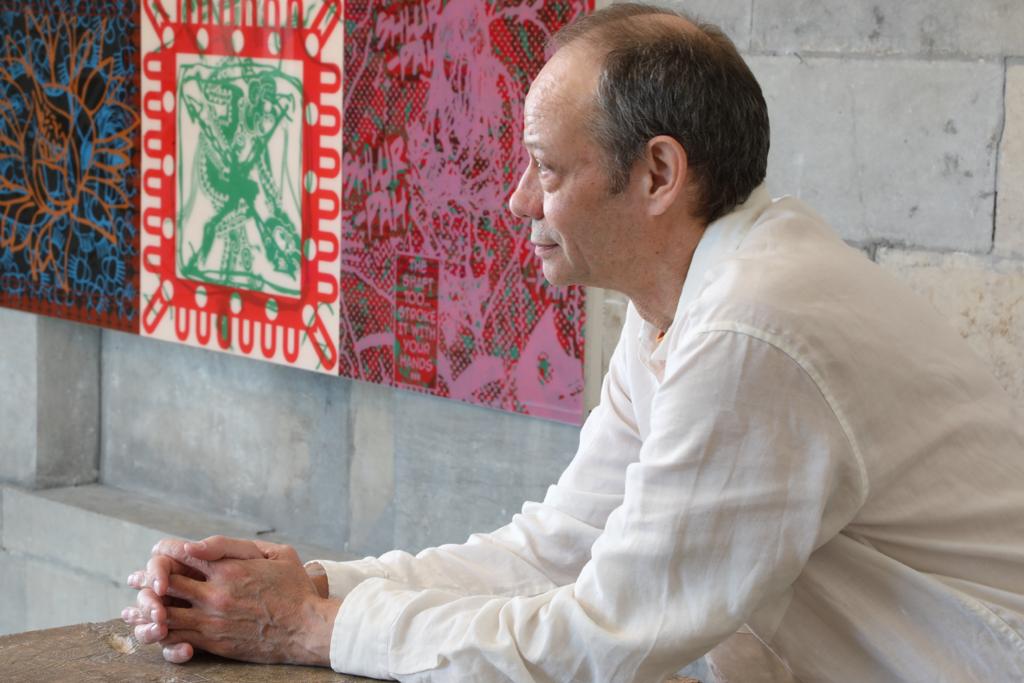
Reviews 2020-Present [2026]


INTERVIEW ARTIST JEAN-PIERRE SERGENT WITH BENGÜSU ALEYNA DEMIRCI, JUNE 09 2026 | ARTICLE TO BE PUBLISHED SOON IN Arete Project| bengusudemirci@icloud.com
1. For readers encountering your work for the first time, how would you describe the central ideas that have guided your artistic practice throughout the years?
My work: it is consciousness in action—revealing Life! It's is a commitment to showcase nature, all the living creatures, and cultural differences in all their glories and integrity!
I find and seek for meanings, from past and contemporary images, gleaned from drawings, potteries, mantles and sculptures, that are carrying beauty, wonder and significations during our common long past human history. Those meanings could be spirituals, religious like rituals, coming from Pagans, or animist group of people or cultures, from high antiquity to current examples and from "countries" from Mexico to Japan or Australia etc…
I need to get meaning out of every single art concept and any preconceived idea that I wish, and despite all the obstacles I've faced (very few sales of my artworks), throughout my art career, to get into galleries, i am cast back in true Life energies again! Perhaps, in a presumptuous reversal of logic, a call to action! A spell!
A few sentences, about the history of my art practices and its development:
I painted abstractions from 1984 to 1991, then after having moved in 1991 to Montreal, I started silkscreening images that I found, that were worth showing. I moved to New york in 1993, where I started to print my images on Plexiglas panels, first a small one (35 x 17,5 cm), then in a unique square format of 105 x 105 cm. Since then, I work alternately on Plexiglas or on paper. My work have been exhibited in numerous galleries and Museums of severals Countries around the World and in September 2019, my monumental work of reverse silkscreen paintings on Plexiglas: Four Pillars of the Sky, was exhibited until September 2023, in the two stairwells of the Besançon Fine-Arts & Archaeology Museum (the oldest Museum in France). This was a fresco-installation of seventy-two paintings covering a total surface area of eighty square meters, which was on display in the museum for four full years. To date, it is the my largest and most monumental mural installation.
2. Your work brings together spirituality, cosmology, organic forms, and contemporary visual culture. What first drew you to these themes, and how have they evolved over time?
Well, while living in France, my work was mainly abstract but little by little, over the years, and after having moved to my art studio in Montreal, its became very clear and obvious to me, that painting just abstraction coloured fields, as beautiful the paintings could have been at the time, wasn't enough to express all the feeling I do have, as an artist, in front of the whole diversity of Life and all the different cultures from around the World. As said Claude Lévi-Strauss in his outstanding book: We are all cannibals:
"Nearly two thousand five hundred years ago, Herodotus, while visiting Egypt, was astonished by customs that were the opposite of those he had observed elsewhere. The Egyptians, he writes, behave in every respect in the opposite way to other peoples. Not only do women engage in trade while men stay at home and weave, but the men begin the weaving from the bottom up and not from the top down as in other countries. Women urinate standing up, men squatting. I will not continue the list."
So, as for, at this moment and time, I started reintegrating, into my visual iconographies, little by little, being so much curious about all kind of differences of human behaviors depicted in those images, that I needed to show, to share them, being good or bad, beautiful or horrible, crude or sensual, spiritual or grotesque! Most of those images are belonging to "THE GLEANER'S SHARE". Montaigne, a French writer of the XVIe century, explain what it is: "If we have enough left over to make an impression (with money)—this surplus of fortune’s generosity—let us allow it to flow a little more freely at the mercy of its servant; the gleaner’s share." from On Vanity, Montaigne (1533–1592).
This left over part, thrown away by the unbridled capitalist system, like scraps left for the dogs, the poor, and the animals; this share of the gleaners—which Agnès Varda so masterfully depicted in her magnificent movie "The Gleaners", 2000, in which she shows poor people scavenging for food in supermarket dumpsters and in fields—is exactly the part I recuperate as a primary material for my work, because news paper clips and pornographic images that are recovered from the internet, are free of copy right.
Anyhow, at that time, in Montreal I was choosing and cutting out from the famous and enormous Sunday New York Time news paper and then silkscreened them afterwards.
As a proof of that, just last year, I found, hidden into my storage room, a huge black leather forgotten portfolio (90 x 65 cm and weighting around 15 kgs), with almost 300 art prints from Montreal (1991-1992) and New York (1983-1994), freely screen-printed, as if in a spontaneous gesture, a leap into the unknown on sheets of newspaper with some others on art papers.
Doing so, my reflection was, in photographing in my studio, all of those ancient prints, last year; that since my first years in America, all the images I had chosen to print, were displaying, as you so rightly asked me: some images describing sensuality, desire, strong art pieces revealing a spiritual content and presence. Sometime also, violence of some disruptive and disturbing capitalist destructions… As well as a lot af photos of animals in the wild, in their freedom, all those themes haven't change a bit over the years. Excepted that nowadays, I am not anymore going to Museum shooting photos of some nice art pieces, neither buying books, like sometime, in going visiting the MET every Sunday, neither from news papers… But I collect them directly on what I find on the internet. It's much more simpler and easier, but the subjects stay the same and my statement is to recreate and redesign every image or information into art. It could be also texts, that influences me as well, as I am also collecting and copying extracts of writing from the books I am reading on a daily basis into my "Notes from Besançon" website page.
Once again, as you said it, it's always done with a specific and positive intention to showcase, in my art, all the World's cultural diversities and mix them together, in a kind fusional state. What have to do the Aztec Xipe Totec "Flayed One", a statue of a priest, located at the Natural History of New York, with an image of a Japanese woman body in bondage? Or a contemporary pornographic image of a woman in an ecstatic orgasm surrounded by three phallus ejaculating sperm all over her body? And what has to do an Hindu metaphysical and highly spiritual yantra with a middle age drawing stating in latin: "SILENCIUM EST" (SILENCIUM IS), they all are part of things created, ex nihilo some how, by human being, as you are and as we are all! One can reflect on cultural opposition on this small quote of the book I am actually reading:
"I have no doubt of it. Wild life is so simple, and our societies are such complicated machines! The Haitian touches the origin of the world, and the European touches its old age. The gap that separates him from us is greater than the distance between a newborn child and a decrepit man. He understands nothing of our customs or our laws, or sees in them only obstacles disguised in a hundred different forms—obstacles that can only arouse the indignation and contempt of a being in whom the feeling of freedom is the deepest of all feelings." Denis Diderot, Supplement to Bougainville’s Voyage
Nowadays the World is still in a great turmoil and changes, upside-down, it's perfectly clear also in my art with its global accumulation, and the aggregation of different multicultural images that enables me to exit any sensation of belonging to only one-and-only culture, even the best of the best, which ever could be that one? But I am really happy to be living in France now, were we can be free to express ourself, as an artist and we are having also our "freedom of thought and speech", which is unfortunately not the case, in most of the countries around the World, freedom is so important to me… Ultimately artists are here, perhaps, to alchemically transform society's crap into Art.
3. In your recent lecture, The Shakti & The Metacosmic Void, you explore ideas that extend beyond conventional understandings of reality. How do these philosophical and spiritual investigations influence your artistic process?
When talking about reality, it needs to be said about what kind of reality we are talking about? Is that reality of the actual knowledge of Western science? If it is so, I must say that my art is totally misunderstood here, in my country, France, were there is a deep rational mainstream idea and a strong atheism and materialism which lead to a misunderstanding of every spiritual practices as a whole and all diversities of behaviours… French people are very reluctant to embrace any other way of thinking, like animist, Buddhist, shamanism and certainly not Tantrism…
Personally, I don't want to and cannot fight against that kind of miserable and poor understanding of Art, Life and Cosmos as energies and entities. As I think that mankind deserves more than what we think we are made of: skeleton, muscles, sex, and blood; and that even our body system and consciousness and souls are much larger parts with our inner energies and forces. What I am personally seeking, is not different from the knowledge of ancient cultures, those whhich had a strong and immanent spiritual presence. As an example, this concept of the "Metacosmic Void" was discovered in a really small gouache paintings from India of the XVIII century. This is what I said about it in my last lecture:
"Here, we can see the Metacosmic Void. It’s a concept that’s pretty hard to grasp, but here’s this little Hindu gouache painting that describes, defines, and depicts it and which has had a big influence on me. And when I saw that, I said to myself: "Well? What on earth is that?" Because, there’s just the "border", there’s no subject matter at the center, there’s nothing. it's empty, it’s truly the Void, and it challenges frontally our rational mind, in a way."
I found often into Eastern concepts and ideas of religious thinking many answers of my interrogations, like the paradoxal thinking, which intreated me during my working process reflexions, such as the Tantrism in India:
"Now, Tantrism, far from avoiding these paradoxical behaviors, values them, on the contrary. The basic idea is that since the harmonious union of the two principles is very difficult to achieve under normal conditions, one must, to achieve it, use violent means." in "The Secret Teaching of the Divine Shakti", by Jean Varenne
Such as in my work, I am also exploring all kind of paradoxical sexual energies such as the "Shakti, which means "power", "strength". In Tantrism, this word refers to feminine energy, the active principle of the force that animates both the Universe and all the living beings that inhabit it." All of my art is about that, the transmutation of some flat ordinary images, inert, ordinary, dirty, vulgar, and obscene into a Force-Energy, a Karma-Energy full of colours and vibrant of Life-Forces! By merging them together with other meaningful images like old spirituals genetic patterns, mixing them during the working process in order to achieve a kind of "Grande Œuvre", the alchemical Great Work which mean, changing matter, throughout a kind of magical and powerful means of creation to sublime the inerte matter: image into energy! With a deep will of transgression assumed, to enter, to achieve a state of ecstatic and transgressive trance, as such as in a shamanic trance… That's the true secret mechanism of art!
4. Many contemporary artists focus on political or social issues, while your work often turns toward consciousness, transformation, and metaphysical questions. Why do these subjects remain important for you today?
Yes, it's absolutely true that I don't really recognize myself in the mainstream global art market of today. And even rarely, when I am going to some main stream Art Fair Market, like the most famous Basel Art Fair, I am always leaving the place with a deep nauseous feeling! I feel absolutely sick and extinguished, even exhausted! So much money, so much talent and energy, so much time to create art works which are just mirroring contemporary society in its wholeness, or showing just the opposite, the darker side of it. Which end up being the same at the end, it's all about being the most famous artist in the world, having the most powerful demonstrative artist statement, making the most amount of money on an art piece and generally selling art the utmost price at the richest people collecting art throughout the World! All that seems to me totally useless, utterly hopeless, paradoxical and ultra-kitschy…
As for me, an artist should stay a creator and a messenger of pure beauty and energies. Not that I have no interest in social or political issues, neither to sale my art to hypothetical collectors. It just that I do have the deep feeling that art, is a special gift, a blessing and a curse, of course, that can and should open the utmost consciousness of firstly the artist, quite obviously, as we need to work on trying to dig deeper and seeks and collect the most information that we can, into the collective unconscious, in order to be a kind of witness, a seeker, who, like a solitary hermit monk of the good old time, has a full understanding of the world that surrounds him, but goes farther and deeper beyond all borders and barriers into some deep conscientious fields and levels of understanding. We artists, have somehow the possibility of sharing, into our art, our ideas, thoughts and emotions on the vanishing worlds around us today: traditions, nature, animals, plants, social connections, primary cultures or even kindness, love, compassion and desires… which can affect and change us, artists, throughout our artworks and secondly, as by a singular ripple effect, which can be sometime a period very long and taking infinite time, finally the viewer!
5. Your large-scale installations invite viewers into immersive visual environments. What becomes possible when painting expands beyond the traditional frame and enters architectural space?
Yes, absolutely, I want to get myself and my art "out of the frame", out of the narrow scale, out of the box: "Sortir de la peinture fenêtre" is one of my main wishes, statement or requirement, removing paint from its traditional window-frames, even as big as it could be! By throwing away, any injunctive, structure and aesthetic assumptions, historical or social dogma as perspectives, morality, rules of beauty, or any other normative aesthetic dictates! I really want to enter into beauty as a whole sensation, as an energy. And with some of my large scale paintings installations, the largest one was on display at the Museum of Fine-Arts in Besançon "The For Pillars of the Sky", a 80 square meters large and was composed by seventy two painting covering the full walls with a total size of 80 meters.
Being in front of such a monumental art piece bring and engages the viewer, not only intellectually, as within just a glance at art, but also physically with its own body and it own knowledge, fears, desires and believes.
I am not so crazy about the term of 'immersive" which is a word really over used these days, even if I find it totally accurate. But I would prefer the notion of the "Oceanic Feeling" well described by French writer Saint-John Perse, or the "collective unconscious" largely used by Jung.
"The Sea, woven within us, down to its bramble thickets of the abyss, the Sea, within us, weaving its great hours of light and its vast trails of darkness—All freedom, all birth, and all repentance, the Sea! The Sea! At its surging tide, In the rush of its bubbles and the wisdom infused in its milk, ah! in the sacred boiling of its vowels—the holy maidens! the holy maidens!—The Sea itself all foam, like a Sibyl in bloom upon her iron chair…" in Amers, Saint-John Perse
As today, people are so lost, so lonely, so isolated, so unhappy that they definitively want to immerse themselves into something larger, in order to get lost, to disappear, for no more know what they seem to be themselves. In order to forget about their absolute nullity and their egotistical despair. As an example, you can see on any art driven Instagram account, some art curators or art aficionados, that they all are taking photos of themselves in front of any art works they are passing by (even in changing their dresses in order to perfectly fit with the paintings main colors) in some galleries exhibitions or Museum shows.
For me this is immersive and immersion. But, it feeds itself with a totally narrow egoistic external feeling, with absolutely no fusion, neither interconnection, with the work, it is just camouflage and mimicry… Trying to be part and merging into an artist painting universe such as those of Van Gogh, Gauguin or Rothko, doesn't work that way, it's never so easy! If you haven't experienced yourself the suffering, the joy or even the deep despair of an artist life, it's seems to me complicated, even absolutely impossible to receive firstly, the message, secondly the energy of that particular work. Maybe art is reserved to privileged people, or maybe not at all, it just a thought!
But none of those contemporary funky people would ever have the true experience of the "oceanic feeling", the universal fusion into an art piece. Just for example—and for a laugh—here’s a little personally interesting fact that illustrates exactly what I mean: I had lunch, two weeks ago, with a good friend of mine, while chatting freely with her, she told me that she had been hurt very deeply, when about two years ago, during an other lunch, she had asked me why, she couldn't cry in front of any Rothko paintings during her visit at the Mark Rothko exhibition at the Louis Vuitton Fondation, in Paris in 2024, as most people had tears in their eyes in front of those paintings. At that moment, in that exhibition, she felt completely, lonely, helpless and lost. I did answer her at that time, that it is neither necessary not a norm to cry in front of a Rothko painting, and that it was under no circumstances to be considered an obligation. And since she kept questioning me, I then explained to her, that sometimes, at some point, one needs a cultural initiation or an introduction to enable you to enter the world of a particular painting… or even a personal souvenir, some body experience, a shock, like pain, loss, desperation or joy in order to enter into the inner world of an artist. What I had been telling her was an absolute truth which really upset her, however it was perfectly true. What to do then? "Do not be struck dumb by the true dragon." is a saying Fukanzazenji, Dogen Zenji, quoted in The Snow Leopard, a must read book by Peter Matthiessen
I guess initiation, culture, knowledge and, above all, ultimately, getting rid of your ego are absolutely necessary, in order to enter and appreciate fully, for example, some works of Veermer, Fra Angelico, Caravagio, Pollock or a Mayan Temple, Pygmies loincloths (Africa), Asmat totem poles (New Guinea), etc., etc.
Somehow, you need to have a sort of humility and love towards art and every artist's life, in order to be connected, to "understand" and comprehend the energies of any Art! Could it be at times prehistorical or contemporary, that doesn't really matter. And Rothko was rightly saying about his paintings: "Perhaps to dominate the viewer’s field of vision and thus create a feeling of contemplation and transcendence."
Getting back to my art, it is somehow, about the opposite of a monolithic regular single painting, because its large format composed of multiple paintings on Plexiglas, a panoptic view (a complete and continuous view of an entire interior space), which bring the viewer to a higher level of consciousness and to an other level of understanding of the "The Cosmic Mechanics of Life". The large scale of my works, as you mention it, could become like an architectural space, a safe englobing house, protecting like a tomb, like a womb, an Indian tipi, a yourte, where some kind of magical connection and healings could happen and proceed. Talking about this painting as expansion into a new dimension and presence of my large mural paintings installations, you are totally right! It's a fact, I have have been lucky enough to visit some Egyptian Tombs and Temples, in 1984, with my grandfather Maurice and my sister Marie-Paule, being there, physically, alone sometimes, into some man-constructed huge spaces, highly decorated with hieroglyphs images all over the walls, with beautiful colors… This had put me into a kind of mystical and cosmic state, a revelation, an initiation. Into those monumental collectively build architectures, but still done by little humans helpers, as we are: architects, craftsmen, sculptors and painters, like me, who had collectively build a "sacred machine" a mystical architectural structure, capable of defying time and even the dreaded death! As cave painting, European Cathedrals, the great wooden Buddhist temples, the Mexican Pyramids etc, all those great works that deeply inspired me, have been completed with, what we can name collective collaboration, intelligence and social connection and organization.
So this veridic fact, sparked in me a need to no longer be just myself, an artist, but to expand my own being tenfold and, through sheer will, to belong in a multiplied way, by permanently putting my ego to rest and reintegrating myself into the vast human community. To become Japanese when I paint an erotic Japanese bondage, to become a Siberian shaman when I draw a shamanic drawing, to become Hildegarde Von Bingen, when I copy one of her drawings, to become an Aztec sacrificial priest when I copy the statue of Xipe Totec, 'The Flayed One', and to become a whale when I paint a whale. All this might be considered madness, or transgression, or totally schizophrenic, but I think it is, in fact, the true and real mystical journey of an artist. As truly, at some point, you absolutely must merge with all of living beings! Even if, during this terrible process, you have to completely destroy yourself and be utterly annihilated…
6. Nature appears throughout your work not merely as a subject but almost as an active presence. How has your relationship with nature shaped your artistic vision?
Yes, absolutely, Nature is essential for me as it should be for everyone. Luckily, it's happened that I was living, all by myself, like a monk or a mystical hermit, for about ten years, from 1980 to 1991, and full time, into a farm, located in the beautiful Jura Mountains, just at the Swiss border, where I was care-taking and raising goats and horses and training them; at the end I had a herd of 17 horses all together… Needless to say that I was really desperate when I had to sell them all, in order to move to Canada!
To have experienced this very intense and profound physical, bodily and spiritual interaction with animals, whose power far surpasses your own, teaches me, firstly humility and being really respectful, to pay attention, to be kind, to be patient, then to be gentle, as when you are asking animals to do something they don't really want to do, you need to have a great attention to them and being a good listener as well as being present at all instants, as you need, at any time of day or night, to be there for them. If for example, a mare was about to give birth on a certain night, you need to sleep in the stable, in order to be there to help her giving birth and taking care of the foal. So this presence at any moment of time is developing in you, all your senses and antennas in order to be able to react quickly to any problems that may occur.
Nowadays, I am living not too faraway from that place and can go canoeing in the Mountains on the Doubs River, separating France and Switzerland, during summer time. As you mentioned it, being there, alone on the water, you can feel an active presence, strong and untouched and eternal, one can hope so!
Immersing yourself in nature is like stepping into a neutral space, in the sense that it doesn't give a damn about you being there, so it teaches you, by its total indifference, a total unwavering humility. You need then to destroy completely your ego and brain thoughts, erasing them thoroughly! And I particularly have noticed for example, even if I don't really have a stressful life, despite it; when going canoeing or walking in nature, it's always taking me about half an hour in order do be in full harmony, in full exchange, in full peace with myself, into this fusional state with the elements : Water, Wind, Rocks, Trees and Animals; in order to reintegrate our full self and at an higher state of consciousness. Nature takes time and you also need to take this time in order to be fully be present. I strongly believe that it's exactly the same about approaching true Art!
In my art, during the working process, I am also using mainly natural pigment as: mars red, burnt sienna, yellow ochre, zinc white, or bone black etc - everything is coming from Earth and Nature… And some images of animals, encountered spiritually during some of my shamanic trances, as 'animal spirits guides' could help also other people to find their way throughout spiritual paths. They are: Horses, Goats, Hawks, Snakes, Bears, Hummingbirds, Eagles, Whales, Jaguar (el Tigre, in Mexico) or Ants… There are always present and part of my human history, as my ancestors, into my memories, and often also, in my powerful spiritual dreams… gratitude and respect to all of them!
Also, nothing can be take appart from Nature as a whole, as everthing is interconnected, that is also a concept and a working process that I do use fully in completing my art. Nature and Art are closely related and for us, human, one cannot exist without the other. Nobody will ever clear the Sun, the Water, neither the Sex, neither the Female Body, neither the Vulvas, neither the Dicks, out of my paintings. They are fully integrated and are full part of the human Odyssey.
7. This interview will be published for Turkish readers. Is there a particular aspect of your work, artistic philosophy, or research that you would especially like to share with audiences in Turkey?
Well, unfortunately, I never been to Turkey, but it seems to be in-between some political change for freeing women's rights and in a balance between conservative traditions and access towards more freely democratic States as European Country. I like to salute all the Turkish readers, in hoping that all of them are feeling well and happy with the life they are living. If there are some artists reading this article, I would like to wish them good luck for getting their art to be well known, even if it's a really difficult and harsh choice to choose that way of living. But, as for me, It's the only viable option, the only path, there is absolutely no other way and I enjoy taking it. As my grandfather Maurice used to tell me: "Artists are very important to society because they leave behind them, when they died, a pile of wood larger than the one that was there when they came to birth." I believe that artists are here for a reason, even this mission, to be the witness of our common contemporary life, trying to change things a bit and mainly listen, observe, and report:
"If we have even briefly touched upon beauty, then we will not have come to this Earth in vain." Jean-Claude Carrière
8. Looking ahead, what questions, ideas, or territories are currently driving your artistic research, and what can we expect from your future projects?
Yes firstly, I like to thank you very much, dear Bengüsu Aleyna for your really kind, great, interesting and challenging questions for this new interview, it was a great pleasure doing it and I hope I answered them clearly and that the reader could have some idea about the complexity and the deep meaning of my art works. And if you are having any question, please don't hesitate to contact me.
As for the projects during this year 2026, I started, last fall, a new collaboration with Chrissy & Andrew Moore Art Advisory; located in Edinburgh, Scotland and I hope they will find a way to exhibit my art over there. In the next few days, I’ll start working again on a next series of works on paper that I started in 2022: "The Shakti Yoni, Ecstatic Cosmic Dances", a series of unique silkscreen prints on medium size paper (100 x 70 cm). I am also working a lot on writing some texts, editing films and subtitling them in French and in English, luckily, I finished, a few weeks ago, all the editing of the filmed artist lecture I had given on March 13th at the Mulhouse Museum of Fine-Arts, were I had also a huge monogamic exhibition in 2010 (in the full Museum floor). I hope that after this article, maybe some people could be interested in showing my art in Turkey, in Gallery, Contemporary Art Space or Museum, that could be great and challenging, let's hope for it and I am leaving bellow all the informations to contact me.
I like to thank you all, in wishing you a great day and a beautiful Spring time,
kind regards from France,
Jean-Pierre Sergent, Besançon studio, Sunday June 7th 2026 (text kindly proofread by Johnes Ruta - Azoth Gallery, New Haven, CT, US)
"JEAN-PIERRE SERGENT: PAINTING THE SPACE BETWEEN THE MYTHIC AND THE HUMAN" | Article to be published in Artflow Alliance, July issue by Dominique Sahms
For some artists, painting is a way to capture what they see. For Jean-Pierre Sergent, painting is a way to uncover what lies beneath the surface. Born in Morteau, France, he lived and worked in Montreal (1991-1993) and in New York (1993-2003) and he is now working from his studio in Besançon, eastern France. Sergent has spent decades developing a visual language that moves fluidly between the erotic, the mythological, and the cosmic. His work draws inspiration from an extraordinary range of sources, from ancient civilizations and spiritual traditions to contemporary culture, weaving them together into layered compositions that feel both timeless and deeply personal.
At the heart of Sergent's practice is accumulation. Through successive layers of silkscreen imagery, Indian ink, color, and symbolism, his paintings become records of time itself. Images build upon images, creating dense visual environments where meaning is not fixed but continually emerging. What results is not simply a picture, but what Sergent describes as a "presence," a moment where something unexpected reveals itself through the process.
His approach often evokes the collective markings left throughout human history, including prehistoric cave paintings, ancient ritual symbols, and even modern graffiti. These visual traces speak to a fundamental human desire to leave a mark, to communicate, and to connect with something larger than ourselves. Sergent sees these impulses as expressions of a shared creative energy that transcends cultures and generations.
This exploration reached a monumental scale in his exhibition, "The Four Pillars of the Sky," presented at the Museum of Fine Arts and Archaeology of Besançon from 2019 to 2023. The installation transformed the museum space into an immersive environment where mythology, spirituality, and contemporary experience converged. It stands as one of the most ambitious realizations of Sergent's ongoing investigation into the origins of human imagination and belief.
More recently, Sergent expanded these ideas through his 2026 artist talk at the Mulhouse Museum of Fine Arts, "The Shakti & The Metacosmic Void," and his 2024 print series "Karma-Kali, Sexual Dreams & Paradoxes." Across these projects, he continues to explore themes of transformation, renewal, and the search for meaning in an increasingly fragmented world.
What makes Sergent's work compelling is his refusal to separate the physical from the spiritual. The body, mythology, memory, and desire all coexist within the same visual space. Rather than offering clear answers, his paintings invite viewers into a dialogue with ancient questions: Where do we come from? What connects us? And how do we find meaning within the vastness of existence?
Through color, layering, and symbolism, Jean-Pierre Sergent creates work that is both deeply personal and universally resonant. His art reminds us that creativity is not simply about making images. It is about engaging with the forces that shape our humanity, our dreams, and our place within the cosmos.

“SEVEN ARTISTS TO DISCOVER AT THE KELLER GALLERY TO CLOSE THE SUMMER SEASON” ARTICLE WRITTEN BY BARBARA PERNOT FOR L'EST RÉPUBLICAIN, BESANÇON, TUESDAY, SEPTEMBER 2, 2025
Until September 13, this amazing gallery near Square Saint Amour offers unusual visions, with aspirations from all over the world.
This small gallery, nestled in the heart of the Saint Amour district in the historical Center of Besançon, is definitely very active, with one exhibition after another. The last of the summer season welcomes seven international artists until September 13. All you need to do is be a little curious and dare to ring the bell and walk down the long corridor to discover the treasures it holds.
Greeted warmly by the two souls of the place, visitors are immediately captivated by the uniqueness of the location and the choice of the ehibited works. “Although the gallery's project is to promote regional artists, we have chosen to invite seven international artist friends to this edition,” emphasizes Jean-Pierre Sergent, exhibiting artist and curator of this exhibition. “Heidi Suter and I believe that the exhibited artist and their works are in deep connection with the spirit of this internationl gallery and deserve to be presented.”
A message of hope coming from Iran
This is an opportunity to discover the work of artists from Ireland, Germany, Switzerland, and Iran, such as Samira Sahra Naward and her painting World Peace, a message of hope for all women around the world.
See illustration: the painting "Le Cerf anthropoïde qui sourit dans un vortex de papillons" (The Anthropoid Deer Smiling in a Vortex of Butterflies) by the painter Guimbarde, described as “the painting that scared me when I was little” by his daughter Fanny, all kinds of strange and inspired forms enrich the collection of “Bric-à-brac et impromptus.”
Jean-Pierre Sergent also invites visitors to admire Mayan Diary, a work on Plexiglas imbued with a strong spiritual energy et power.
On display until September 13 – Galerie Keller, 7 rue Proudhon – Besançon – Wednesday to Saturday from 2pm to 7pm and by appointment.

“BRIC À BRAC,” A VIBRANT EXHIBITION IN THE BESANÇON WEBZINE, JULY 7, 2025
From June 27 to September 13 2025, the Keller Gallery is hosting a group exhibition entitled “Bric à brac & impromptus II.”
Zurich gallery owner Heidi Suter has opened an art space in Besançon at 7 Rue Proudhon. This summer, she is presenting seven international artists, including Jean-Pierre Sergent, who is both an exhibiting artist and the curator of the exhibition.
Claude Boillon-Breton, from the Jura region, will bring the “lively and gentle presence of her small works of painting under glass” inhabited by “Birds of Paradise.”
Franco-German visual artist Barbara Dasnoy, an adopted daughter of Besançon and a graduate of ERBA, will show five of her vibrant works of color and geometric abstraction.
Born in Ireland, Eilbhe Donovan explores the relationship between humans and the sea, expressing her fascination with the oceanic world, “both seductive and treacherous, provider and destroyer,” capable of “bringing the greatest calm as well as the most total destruction.”
From the “calligrapher of the body and reinventor of myths,” the Swiss artist Jean-Michel Jaquet (now deceased), we will be able to discover five drawings in chalk, Indian ink, graphite, and other media, which deliver a credo: "Drawing cannot deceive; it always tells the truth about its author, whether skilled or unskilled, professional or occasional. All drawings are self-portraits."
Noël Girard-Clos, alias Guimbarde, who considered himself a “Christian pilgrim” artist and died in 2024, leaves us his “Horned God” and “Anthropoid Deer” as his legacy. Heir to cave art, passionate about nature and primitive culture, Guimbarde produced joyful, cosmic paintings, made up of journeys wherever they may take us.
“Peace, Woman & Art” will be the only work on display at the exhibition by Iranian artist Samira Sahra Nawad. This professor and art historian imagines a World Peace “where all women dance and laugh, continue to live in peace and freedom, and have the right to choose their own lives.”
Finally, “Croquis de New York” and “Mayan Diary #95” by French-New York artist Jean-Pierre Sergent, a native of Morteau working in Besançon, offer a selection of works charged with spiritual energy, diverse experiences, and mystical or physical ecstasy, providing access to other levels of life.
Opening Friday, June 27 (4pm-8pm) and Saturday, June 28 (2pm-7pm)

RADIO BROADCAST > LES PÉPITES DE PÉPÉCOYOTE #102 (lespepitesdepepecoyote@gmail.com) | JEAN-PIERRE SERGENT – PAINTER | April 9, 2025 | Duration: 1:52:00 | Radio Campus, Besançon (listen to the entire broadcast in French) | download the PDF (205 KB)
Born in Morteau, France, Jean-Pierre SERGENT has been drawing and painting since his early childhood. After breeding Appaloosa horses in the Haut-Doubs area for several years, the artist set out to try his luck in the art world in Montreal, then New York, where he enjoyed some success.
In 2005, he returned to France and set up his studio in Besançon. Exhibited at the MBAA and recognized by his peers, the artist has just opened the KELLER Gallery on Rue Proudhon with a Zurich Swiss friend, Heidi Suter.
You are listening to special program lasting over 90 minutes, in the form of an initiatory journey in which this passionate painter candidly discusses his career, his artistic and spiritual approach, his inspiration drawn from travel, women's art, and so much more...
PART 1/3
LAURENT DE PÉPÉCOYOTE: Hello, everyone. Today on Pépé-Coyote's Nuggets on Radio Campus Besançon 102.4 FM, I welcome Jean-Pierre Sergent, a painter from Besançon and New York, to our broadcast. We will be talking about his journey from Haut-Doubs to the Americas and shamanic trance in this very special program, and above all about his artistic work, which can be understood as an artistic epic... Hello Jean-Pierre.
JEAN-PIERRE SERGENT: Hello! Hello dear PépéCoyote, it's thrully a great pleasure to be here with you and I hope we can have an in-depth discussion on many important topics matters that are close to all our hearts.
PPC: Radio Campus is not unfamiliar to you, since you already had a broadcast in 2020 with Aurélien Bertini, and I believe it was at the Museum?
JPS: Yes, it was a very nice show that we recorded at Besançon Fine-Arts Museum, and it lasted over an hour. I filmed the whole interview with my camera, so you can find it on my website.
PPC: Jean-Pierre, were you born in Morteau?
JPS: Yes, in the Haut-Doubs region.
PPC: In the cold and snow...
JPS: Yes.
PPC: And then you went to study architecture in Strasbourg?
JPS: Yes, that's right, it was the closest thing to what I was expected to do. But after six months of studying there, I quickly realized that there were too many constraints in architecture. That's why I turned to fine arts and stayed in Besançon for a year and a half at the Fine-Arts School.
PPC: So at what is now the ISBA (Institut Supérieur des Beaux-Arts).
JPS: Exactly, yes.
PPC: So you know already our Bouloie neighbourhood a little bit?
JPS: Yes, I know it, but I haven't been back there in over 40 years, and it's a pleasure to be back here again.
PPC: On a family level, were you born into a family of artists, in the Haut-Doubs?
JPS: Oh no, not at all! No, no, I would say more in a family of humanists. My dad was like a country lawyer. He really loved his clients and had a big heart. And all my grandparents were also very kind people, humanists with great generosity and kindness, once again I should say.
PPC: You started your career early as a visual artist, let's say in Haut-Doubs, because when you were a small child, you were already drawing and making reproductions of drawings from existing images.
JPS: Yes, in fact, at the time, I suffered from very severe asthma attacks, and when you have asthma, you can't really move around much. So you stay in your room and discover the world through books. Of course, I had a book on Native Americans, I had books on animals, so I often copied them, with a pencil and carbon paper underneath, and I copied these images, these other marvellous Worlds, and then I painted them on small panels of hardboard or plywood. And that's kind of what gave me the impression that Art could save us, in a way, from suffocation and suffering. That's exactly what's happening today, in a society where we are all suffocating and suffering deeply. And I deeply think that Art has never been more important as a symbol of freedom.
PPC: Freedom for you too, with your love of nature, horses, and animals led you to breed American horses in the Haut-Doubs region.
JPS: Yes, yes, but what I mean is that my grandfather bought an old small farm in the 1950s, at a time when rural areas were becoming depopulated. Many farmers were selling their farms, and he bought this farm in Charquemont, which had a little bit of land. I squatted on this farm and at first I bought goats and made goat cheese. Then I bought an Appaloosa stallion in the Vosges. I really liked this breed because it belonged to the Nez Percé Indians of the northwestern United States. They had chosen and selected these horses for their hardiness and endurance in cold weather and long walks. And you could leave them outside in winter, so it was less work. And above all, they are magnificent. They are all spotted and dappled. They are the ones you often see in the Western movies. Appaloosa horses are aesthetically one of the most beautiful things in the world.
PPC: How many horses did you have?
JPS: Actually, after that, as I often imported horses directly from the United States via Germany, because the Germans are very fond of Quarter Horses and Appaloosas and they import them in quantity to Hamburg, near Bremen. So I would go there to pick them up. I bought four mares, but they were Quarter Horses, another breed of American horses that are more docile and adapted for western riding. And so, in the end, I had a total of seventeen horses.
PPC: Oh, seventeen?
JPS: Yes.
PPC: And did you ride horses too?
JPS: Yes, of course, I was training and broke in horses and did American riding. I competed internationally in Bern, Switzerland, Augsburg and Munich, Germany too!
PPC: Oh yes, and what is American riding?
JPS: Well, there are several disciplines. There's trail riding, which means you ride a horse and do short courses with obstacles, not show jumping, but crossing small bars on the ground. It's like dressage, if you like, but the best is the discipline of reining, which is a course to be completed at a gallop! And that's really great fun. The courses are shown an hour before the event, and I went to Bern to compete in these competitions with a mare I bought in Canada (Nowata Connexion). It was a wonderful time because you have to be in harmony with the horse and you have to train every day too.
PPC: So you rode horses and you also painted, you did both?
JPS: Absolutely, yes, I did both in Charquemont. And it's a bit like now. However, it was the opposite because, at that time, I could only paint in winter time because I had less work with the horses. Now I paint in the summer because the studio is much too cold to paint in during winter. In fact, my work is still seasonal, but it also that requires me to stay connected to nature.
PPC: And then there's nature... So you don't ride horses anymore, but you do canoeing.
JPS: Yes, that's right. Every summer, I'm lucky that my family still lives in Morteau, and in Villers-le-Lac, I have my canoe, so I go for trips on the Doubs lakes, which is interesting when you're in nature, because in our daily lives, we're always anxious, we're stressed, and I always realize that I need maybe fifteen minutes or half an hour, to be completely free and let nature completely envelop me. For me, freedom often comes back, like a leitmotif. You have to be free in your body, even in your body, I am always daily deeply impressed and shocked by human stupidity, and maybe after fifteen or twenty minutes, you can finally free ourselves completely and enter into the wind, the water, and the rocks. That's an important and essential fusion.
PPC: Is freedom also, as for your first musical choice? Is it a cumbia?
JPS: Yes, it's a cumbia. I chose it because I was married to my dear wife Olga for a long time in New York, and we are still very good close friends. And in a cumbia and all Latin American music from Colombia, Brazil, and elsewhere, there is a freedom of the body and a joy somehow. I think we've lost that feeling a little in France, where we're all a bit sad and too serious!
PPC: So, let's start with some cumbia. Aimer per dio, by Kader Rita, chosen by Jean-Pierre Sergent, here with us on Radio Campus Besançon.
Now, I suggest we take a little trip to Egypt, because you discovered Egypt when you traveled there with your grandfather, right?
JPS: Yes, absolutely. I think it was in 1981, and we went on vacation for Easter with my grandfather Maurice and my sister Marie-Paule. And it so happened that I was always trying to be a little alone, aside, isolated, because when you're in a group, you can't discover, you can't be initiated into cosmic mysteries, one could say. And at one point, I entered a priest room's that was square, exactly cubic, and on the ceiling there was also a square window. So I stood in the beam of light and at one point, I had what felt like a cosmic experience, an elevation, that is to say, you leave your body a little and then you enter another dimension. Having experienced that made me realize that, on the one hand, art was not to be taught in schools and that true art was worth much more than anything you saw in museums; it is in fact an immersion in the universe. So I had to find another way to express this intimacy with the sacred. And I wanted to come back to something, since we're talking about my grandfather Maurice, who is someone who has always helped and supported me. Throughout my entire life as an artist, he helped me financially and intellectually, and I always remember sitting with him outside his cottage, and he would say to me: "Jean-Pierre, you know, it's really good to be an artist because artists are very important people, because when we come into the world... (this is not a material but a spiritual thought)… everyone comes into the world with a kind of small baggage, as a small stack of wood. And when artists leave this world, their pile of wood is bigger than when they arrived." And I can't say that I think about that every day, but it's my real task as an artist to increase my knowledge and share it with the world too. I believe that being an artist means sharing the feelings and joys that the world brings us, through art but also through... whatever: literature, music, and all that. Sharing and passing on knowledge is so important.
PPC: Was Maurice a collector? Did he have any of Jean-Pierre's works?
JPS: Yes, of course, and especially at his home, there were many paintings, but it was also a different period because, at that time (from the 1950s to the 1980s), people who were a little wealthy would invite artists to their homes for dinner and they would go to see their works in their studios and then they would also buy art! That is no longer the case nowadays. As in those recent last years, I hardly see anyone in my studio anymore. Yes, that's right, and all contact with the public has completely disappeared. It's this enthusiasm and respect for artists, at least in France, that no longer exists today.
PPC: We leave Egypt with this cosmic revelation. You explained to us that you had this revelation without any specific product.
JPS: No, it was just while I was wandering around a priest's cell. Yes, it's true that architecture can sometimes take us, as in the pyramids at Uxmal in Mexico, to encounter the spiritual and other encompassing worlds, that's it!
PPC: And then, a little later, you finally decided to sell your horses and move to Canada?
JPS: Yes, that was about ten years later.
PPC: Ten years later, you joined your brother Alain in Canada.
JPS: I went to see him when he was still living in Toronto, and I was in contact with a very important gallery in Toronto named Galerie Moose. So I took a painting with me, a column as I called them at the time, composed of five parts (5 x 0.50 by 0.50 cm, 1991). So I packed it all up in a big box and arrived at Gary's place at Galerie Moose, and he said to me, "Well, Jean-Pierre, please hang your column on the wall in this exhibition!” And then he told me: "Jean-Pierre, I want to work with you and show your work, but you have to come and live in Canada to make it more practical." And then I said OK, so I went home and sold my seventeen horses in less than two months and moved to Montreal in the fall of 1991.
PPC: So, with your backpack, the box of brushes etc.
JPS: Yes, exactly, I put all my brushes in it, not the paints, but all the brushes. And all what I wanted to take with me over there. And I had two or three backpacks and a military huge bag, and then I arrived in Montreal like that, out of the blue!
PPC: So watch out! Jean-Pierre is coming in Town!
JPS: Yes, that's right.
PPC: And it was there, in Montreal, that you started making silkscreen prints on Plexiglas.
JPS: That is to say, at the very beginning, I continued the same work as I had been doing in France. I was doing abstract art because, rather foolishly, artists often think that abstraction is more important than figurative art. In France, we always think in terms of a value scale. So we think that abstraction is better than figurative art, for example. But that's not true at all. So, at one point, I made a large abstract painting, which was about 2.8 meters by 2.8 meters, and I stood in front of it for more than two weeks. I knew that standing in front of that painting for so long was an essential and important event and moment in my life. And then, after this long time, I said to myself, well, I can do variations, as many painters have done, but that repetitive way of working didn't really interest me at all any more, I like courage risk! So, at that time, I often picked up the Sunday New York Times, which was a thick newspaper four or five centimeters thick, and cut out, into it, images that were interesting me. And after, with these images, I decided to start screen printing them, first on canvas and then on Plexiglas. So I bought some Plexiglas sheets to paint on it.
PPC: So, from Canada, we're going to New York. But before we leave and arrive in New York, I suggest we listen to a short text and then you can tell us about it afterwards, since it's one of your musical selections. So, here's a short text by a Bishop.
JPS: Yes, I'll translate it into French for you. So, it's Marianne Budde and it's her speech because Donald Trump went to a mass where this pastor had the courage and the "nerve", in quotation marks, to put him in his place. So here is her speech: Bishop Mariann Budde, speech against Donald Trump, January 21, 2015, in the Cathedral of the Episcopal Church in Washington.
"I ask you to have mercy, Mr. President, on those in our communities whose children fear that their parents will be taken away. But the vast majority of immigrants are not criminals. In the name of our God. I ask you to have mercy upon the people in our country. You are scared now. There are gay, lesbian and transgender children in Democratic, Republican and independent families, some who fear for their lives."
And I could NEVER have imagined that our world would be turned upside down to such an extent with the rise of the far right in Europe and especially in the United States. Because this far-right policy will destroy and cause suffering to so many people, so many families, sending people back by plane, imprisoning them and persecuting them by I don't know what police means, it's absolutely inconceivable what is happening today in Europe and the US. And the United States will pay a heavy price for those atrocities, because all the people who produce vegetables in California and New Mexico are immigrants. So at some point, I think the US economy will just collapse completely. It's really terrible, and I salute the courage of this Bishop.
PPC: Is this a subject close to your heart because you are American, you are from New York and you have the American citizenship?
JPS: Yes, absolutely, and so, I arrived in a country where I knew no one and, in Montreal, the same thing. And then I had to become an American because the immigration laws were drastically changing. So my girlfriend Olga and I got married on the sly so that I could stay in this country longer. So I know this fragile immigrant life very well. I often went through customs at airports where I was held for half an hour or for an hour with Pakistani immigrants who were chained up. I even saw, once, a brave lady, I laugh about it now, but it's so sad: a Pakistani lady who, at one point in the customs waiting room, took out a big wad of 5 inches bills to pay the customs officer to let her in the country. And that's life, that's the absolute true and reality! So we really have to be careful about what we do and who we vote for!
PPC: So, New York in the 1990s, you lived there and moved several times within New York, to Brooklyn, to Manhattan, and there you met some wonderful people. I believe you met the biggest art collector or buyer in New York, in the United States, a big gallery owner perhaps?
JPS: Yes, I had the immense good fortune and pleasure of meeting Leo Castelli, thanks to a friend, Anne-Marie Danenberg, who had a small gallery in Soho. She had said to me, "Jean-Pierre, you know, you should go and meet with Leo Castelli because I know he welcomes young artists and have a look at their works." Then I said, "Wait, he's the biggest gallery owner in the world." Because, in fact, he was the one who brought artists in the art market such as Jasper Johns, Rauschenberg, Andy Warhol, Lichtenstein, etc. to international prominence. He was the one who brought all the Pop Art artists to the fore. And I told her: "Do you really think it's possible?" So I called the gallery and said to the secretary, "Hello, my name is Jean-Pierre Sergent and I'd like to speak to Mr. Leo Castelli." I'll always remember his soft voice when answered me "My name is Jean-Pierre Sergent, I'm an artist (I knew he spoke French) and I'd like to show you my art work." He replied, "Yes, very well, so come to the gallery on Wednesday at 4:30 p.m." And that's how I had the chance to met him several times. He was the pope of art world, and I met someone who was exactly the same age as my grandfather, since he was also born in 1907. He was someone from another generation (because they had lived through two World Wars) and he really loved artists. And when I showed him my work, he smiled and said to me at one point, "Look, here are some animals!" as if he had seen the Virgin Mary. These were people who had retained an emotional connection and curiosity about artists. He tried to help me. He even tried to call Annina Noesi, who was the gallery owner who showed Jean-Michel Basquiat's first exhibition, and I went to see her. But it didn't go very well... but anyway, it didn't matter, as I knew then Leo Castelli, had gave me a bit of an aura among my other artist friends, because he was really the person to know at the time. And so, my work was a little stronger and more important than the one of the other artists.
PPC: So, there in New York, you experienced the nightlife, the parties. What was it like there and in your studio? Did you have a huge studio? I think you had everything rebuild to have a beautiful loft, and then they kicked you out?
JPS: Yes exactly, the first studio was in DUMBO (Down Under the Manhattan Bridge Overpass), in Brooklyn, just below the Manhattan Bridge, and I stayed there for a year and a half. Then I was with my girlfriend Olga, so we thought maybe we should move closer to midtown of Manhattan. It was in Chelsea, in the gallery district, because that's where all the big galleries are now, and we rented and renovated a commercial space, so we redid everything anew in there. But unfortunately, we got kicked out after six months as it was not a living and working place. So we had to find a lawyer to negotiate our exit. In fact, we paid for three months and we got three months free, but if we haven't leave before June 30, we would have had to pay a penalty of $1,000 per day. So I had to urgently find a studio in Long Island City, and it was a very nice space too, which we rented and renovated with my friend Olga, and where I stayed for almost seven or eight years.
PPC: And that's where you created your series on the Mayans?
JPS: The "Mayan Diary" series, yes, exactly.
PPC: With a format of one meter by one meter.
JPS: That's right, I started working on Plexiglas in that size (1,05 x 1,05 m) because my body feels very comfortable working in that format, in that module. And so that's my main work, we haven't talked about it, they're large monumental works on Plexiglas that are assembled together on the walls, the latest of which were presented at the Musée des Beaux-Arts exhibition in Besançon from 2019 to 2023. For four years, could we perhaps play some Mexican music now?
PPC: Either Mexican music, or I can play you a little surprise tune.
JPS: OK, go ahead.
PPC: Back from New York with the Talking Heads. The surprise is to remind us a little of your stay in New York with this kind of New York music. What was the atmosphere like in New York, is it alive 24/7?
JPS: Yes, New York is alive 24/7. But above all, there is in that City, an incredible energy. It's very difficult for us Europeans to understand. I'll start with an anecdote because every time I came back from New York and landed in Geneva, Paris, or either Vienna… I had, for example, a group exhibition in Vienna in Austria, in a museum in Vienna, and when you land in Europe, anywhere, it's as if the vital energy has disappeared. Everything is small, everything is depressed, everything is cramped, everything is depressing. And you say to yourself, but what is this, what is really going on here? It's the Middle Ages! As the energy has completely disappeared. And that's it, that's what it is, and so New York is pure energy, almost infinite, to your heart's content! At least, it was when I was there. But that must still be the case today, I guess so? There's also a multicultural collective intelligence at work, meaning that I was able to make friends from all over the world there, friends I still have today. There is no racism, in the sense that we understand it here in France, and I may come back to the law on secularism, which, as an American, I don't understand at all and find totally absurd, because the idea of God is something universal, it exists everywhere, worldwide, and is indivisible. So to say that certain places are beyond God's reach is unbearable for true believers! Anyway, it's a bit complicated to talk about it here, but for me, New York is the place of absolute freedom. New York is about encounters, yes, encounters, that's it!
PPC: Freedom, and that's where you also go into trances, what you call shamanic trances, but it has nothing to do with shamans? How does a shamanic trance work?
JPS: Absolutely, no, it really has to do with the shamans, completely, because shamanic trances are done with techniques. For example, among the Kogis in Colombia, it takes twenty years of learning to finally become a shaman. That means you have to study nature, plants and animals. So they study plants and also the places they travel into theirs trances too. You mustn't get lost, otherwise you die. I had a good friend, Miguel Angel Baltierra, who was originally from Mexico and lived in Los Angeles, who told me that one of his artist friends had died during a shamanic trance because he got lost in his trip. So you may well never come back from it. I experienced these trances through a therapeutic technique called Ericksonian hypnosis, which is hypnosis. A doctor named Glenda Feinsmith put me into a trance. She treated me under trance for several months. And then, one day, we did a shamanic trance, we did four or five of them, and each time, it was like discovering universes that could be called primary, original, wonderful! Somewhere and somehow, we go to the origin of Mankind, to the beginning of humanity, we enter into nature, we become a whale, we become a bear, we become a jaguar, we become a hawk. This is what Native Americans call meeting your 'animal spirit', your spiritual guide, which means that you always meet animals and so, often, you can also die. In fact, most of the time, you die. So I was lucky enough to experience these trances and I talk about them in my work, they are big inspirations to me. Sometimes I describe them and draw them directly in some paintings in which the lighting is different. And above all, the body has lost all its weight. We could perhaps come back to this later with Simone Veil, who is a philosopher and who talks about the weight of the body, in spiritual and religious trances. In fact, it's like being outside the body but inside the body at the same time, concurrently, since you become a skeleton, your body is eaten by some snakes, or ants, you are eaten by lions, you find yourself in Africa and, the next moment, you are in Siberia and then you are in the ocean or merging from a volcano. It's really what we call a cosmic travel. And that had given a full strength to my work. A cosmic strength which I had first encountered in Egypt but for which I had no images at the time. Now, I had images, scenarios, so to speak, the scenario of what a trance is, an ecstasy, an orgasm. And sometimes you die outright. You have this mystical experience of encountering and merging into the light. And so I can talk about it. But then, does it really exist or not? What's important is that it's in the human brain, in the structure of the psyche, it's not at all invented or delusional, since shamans can perfectly guide themselves into the other world, thanks to their knowledge, they can guide themselves into other worlds, other realities, just like that!
PPC: And you, did it help you in your work? When you come back from these shamanic trances, you pick up your brushes again, you see all these images, you try to put them on a medium, on photos, on your Plexiglas panels?
JPS: No, it's not that I try, I do it really, I know, I just do it. It's as if you've touched God or you've touched orgasm. You absolutely cannot go back. You've been happy beyond human knowledge, beyond literature, even beyond Art. You've touched something, you've touched fulfilment and grace. It's like the state of satori among the Japanese Buddhists. For example, there are some monks who stay in their monasteries for 20 to 40 years and never had a chance to experience the satori. So the master, fed up with them constantly pestering him with their desire for revelation... "Master, please teach us satori!” So he says to them, "You're pissing me off with your bullshit and constant requests!” And then, for example, he violently grabs the monk's arm, pins him in the door and boom, he breaks his arm and then, the guy finally, experiences the satori state. That is to say, the state of satori is to be awakened and illuminated to the entire World, it is to understand everything at once, it is the ultimate consciousness, if you like! Knowing where you are and that you are nowhere and everywhere at the same time, you enter the Void. And once you've experienced that, you can talk about it. At some point, I can see people coming and glancing at my artworks, they can't understand it because, if you haven't been initiated into it, you completely miss it, you pass it by.
PPC: So, to appreciate your work, do you have to have had an experience of shamanic trances?
JPS: Not necessarily, because you can find bits and pieces of it, yes, you can feel bits, and pieces of it, little fragments. And then the colors I encountered and describes are surprising and vibrant colors. You can see in my work that there are a lot of quite unexpected, bright and marvellous colors.
PPC: On the subject of art and your work, you say that it's important to break the rules.
JPS: Yes, it's absolutely essential!
PPC: That's kind of what your work is about, all those trips, all those experiences that lead you to make these Plexiglas pieces and break the rules. What do you want to show us?
JPS: Yes, I want to demonstrate that, what we are and what we think art is, isn't art at all, it's crap. And what I would also like to show is that art can, in fact, be totally at a different place from where we think it is and exists. And then, people always have a cliché about what art should be. I'm going to read here a few short sentences that I thought of about my work, which are:
"My job is to break things, aesthetic codes, moral and academic preconceptions, so that they burst, shatter, scatter, fit together and rebuild themselves differently, in another ecstatic, joyful & spiritual state!"
And then I say: "to understand or to try to understand, I could say: Art in general is already about dissociating things, taking them apart. Because Art is in the realm of revelation and the inexplicable. And also, my paintings are liberating, just as reggae music was liberating for Bob Marley. Maybe, we could have played a Bob Marley song? That is to say, for me, the very meaning and primary function of art is to liberate the viewer's mind. Because we all live into a poor and petty bourgeois lives, as in Jacques Brel's song Chez ces gens-là, with our little cars, our little wives, our little children, etc. Human life is very sad. In Europe in particular, it lacks completely some spiritual dimension, not as the sages and sadhus in India and the anciens hermits of the desert…
PPC: Have you already been there? Have you ever been to India?
JPS: Unfortunately, no, I haven't been there. But I've read a lot of books about India.
PPC: But, you have you been to Mexico too? Guatemala often from New York?
JPS: Yes. It turns out that my friend Olga is of Colombian origin, so she has an Indian look. And Mexico and Guatemala are quite close to New York. It takes four hours to fly there, and we often went during what is called Spring Break in April because Olga had some vacation time. And in September too, we went to Mexico four or five times and to Guatemala twice. And that's where I had some another cosmic and aesthetic revelations, perhaps, also with meeting with the kindness of these Mayan peoples, with their vibrants colors, of course, because their costumes are very colourful, as is their art. Because, also, when you visit the Museum of Anthropology in Mexico City, you get a huge shock. For the reason that what their art tells us is not what Western art is describing and telling us. These are not small, neatly framed paintings, what I justly name: "the Window Painting." Their art have a powerful volcanic, solar presence... It's Life, it's Sexuality, it's human sacrifice and it's Death, all intertwined and intermingled... And it's full energies, no bullshit, it's telluric forces. Unfortunately, you can't find that anywhere in our poor Western art.
PPC: But that's what you do in your Plexiglas and many square mandala-shaped formats?
JPS: Yes, I often use mandala patterns.
PPC: You create an accumulation of superimposed images?
JPS: Yes, that's right, exactly.
PPC: I'd like to know how many layers you superimpose?
JPS: Yes, we discussed this together when you came to the studio, and perhaps we could play that excerpt? In general, there are no specific rules, and I also work on the back of the Plexiglas panels, so I can add two, three, or four layers, and at the end, I finish the painting with a last layer of monochrome acrylic paint applied with a brush to complete the work. Yes, to finish it and then... but as I explained in the workshop, I have no idea in advance what the result will be or should be, so I work with the unexpected, the subversive, the randomness and luck… It's very important for me to work blind, because we all have aprioris and preconceived ideas, aesthetic or moral, about what we want to do, what we would like to achieve. And I don't want preconceptions to get in the way of my creativity.
PPC: You mentioned visiting your studio, so let's listen to our visit to your studio:
INTERVIEW WITH LAURENT IN JPS BESANÇON STUDIO'S, FEBRUARY 6, 2025
- Jean-Pierre, is your studio open to the public?
JPS: No, not at all. My studio is open, but only by appointment, because I am always working a lot and every days and I don't have much time to receive people, just like that, unannounced.
PPC: But by appointment only, yes, one can come. There are no open days, nothing like that?
JPS: For a long time, I held studio openings to the public, one open day a year, but it didn't work very well, so I stopped.
PPC: So, we are in this large space with quite a few of Jean-Pierre's works hanging on the walls. They are screen-printed works on Plexiglas, measuring 1.05 meters by 1.05 meters. Then we have a whole wall like this (3.15 by 6.30 meters), in all colors, with lots of images, which is really magnificent! I see we have lots of paint pots on a small trolley, we have tables, we have chairs, we have the floor, with quite a lot of tiny pieces of coloured scotch tapes. What are all these pieces of scotch tape for, Jean-Pierre?
JPS: I often film when I'm working, or I film interviews, so I need to know where to place the cameras. So that I don't have to calculate each time where the camera feet are every time, I have my little markers like this, there you go!
PPC: Ah, camera markers. Because Jean-Pierre films himself, you can find all his films on his website (j-psergent.com) when he's working. So we have a huge work table, and he has explained or will explain this work table and its history to us, because it's a work table that comes from the United States, from New York... with wooden tables, a pile of papers, and also with a huge bookcase at the back of the studio. And so you use this bookcase and your books for your work?
JPS: Yes, absolutely. I “use,” in quotation marks, writers and ethnologists. I love reading, for example, the stories of Alexandra David-Neel because she traveled to Tibet and India. I read a lot about Buddhism, Hinduism, anything that's a bit outside the Western world and narrow thought, to give me back energy that we've more or less lost here, in Europe. And I wanted to come back to my Plexiglas modules. They are works, in fact, it's some inverted paintings, meaning that I apply three layers of screen printing and then add the final touch as a monochrome, with a brush. So it's really a painting reverse, sa it's on the back of the panels, what is called reverse glass painting in English. The format of my module is 1.05 by 1.05 m. But when the Plexiglas is framed, it measures 1.40 by 1.40 m at total.
PPC: In your workshop, one can also see that there are a lot of statues, masks, and sculptures, probably a little bit Aztec or Mayan, they come from Mexico? So here, we really have a wonderful atmosphere, and I invite the listener to make an appointment to come and visit Jean-Pierre's workshop. We return to the studio with Jean-Pierre and continue talking about his work and his art. I suggest we take a little trip to India with a piece from your music selection: Raga Baïrag, by Gopal Krishan...
PART 2/3
PPC: So, we come out of our shamanic trance with this music track. We were in India with Jean-Pierre. So we have been to Mexico, Guatemala. We stopped briefly in India, and now we're back in Besançon, France and in Besançon, it's 2016-2021, and now you're doing a new series. So, it's some small works on paper which are perhaps more interesting selling in France and Europe? Smaller formats compared to larger formats? They are 25 by 25 centimeters, and at that time, you have completed more than 3,000 of them! 3,000 silkscreen prints like that, from a series called “Shakti-Yoni”, with quite a few images, little bit erotic or pornographic, taken from Japanese videos or Japanese books. Can you please tell us a little bit about it?
JPS: Yes, of course. Actually, the full title is "Shakti-Yoni: Ecstatic Cosmic Dances," and Shakti is the goddess of sex and death, and Yoni is the female sex in India mythology, the vulva, ecstatic and cosmic! What I mean is that I think what's important is the 'body in ecstasy', in dancing and in joy, somehow, therefore, throughout sexuality. And actually, I wrote a short text to read you specially for this program. It was because I'm asking myself a deep and serious question, because today we are all inundated with pornographic images. Pornography has roughly the same turnover as the arms industry, so it's big business. We shouldn't think that pornographic images just appear 'out of the blue'… like that. And we really have to ask ourselves, intellectually and politically, why so many pornographic images are appearing on and in the market or in our homes, on our computers, and who and what they really serving? I could make a serious connection and comparaison with the decline of the ancient Aztec and pre-Columbian societies and civilisations, where they constantly sacrificed human beings. I wrote this short text, which I will read to you and the listeners:
OBVIOUS CONNECTION BETWEEN MEXICAN HUMAN SACRIFICES & CONTEMPORARY PORNOGRAPHIC MADNESS, JPS, SPRING 2025
Hubris and the current pornographic madness could undoubtedly be compared in some ways, to the frenzied human sacrifices killings during the decline of the last Aztec societies, even those perpetrated just before the arrival of Cortez. Because in fact, the Aztecs believed, rightly so and collectively, that other gods would replace theirs, and out of fear, bravery, spite, and honor, they collectively sacrificed not only salves but even themselves, sometimes even their own elite, in order to prevent this crazy predicted apocalypse. It seems to me that, in comparaison to those sacrifices, as the global pornography business (which also sacrifices a lot of human lives) now generates a turnover equal to that of the arms industry, we can only wonder, beyond our own individual history and taking a historical perspective and analytical distance, to try to understand where this enormous, so pervasive, almost vital and practically insatiable need of man to feed, drives, and stupefy himself so completely, so abundantly, so orgiastically and ‘ogresquely’ with all those erotic images, all so similar, so simplistic, so stupid and so meaningless, other than masturbatory, comes from! Because, ultimately, pornography is ultimately only used for masturbation. So, haven't we, all collectively returned to the days of a society that was simply sacrificial and slaveholder as in Roman times, completely subjugated and subservient to the trade in bodies and business at any cost, to the society of spectacle and the total disappearance of religious and spiritual aspirations? Because we can only destroy what is subjugated and subservient to the system. This is in reference to a text by Simone Weil, a philosopher, I may talk about later. And of course, by widely combining pornographic images, let's say, for example, that every other image in my work comes from a porn website, then why do I use these images so widely? Firstly, to place and put a mirror image of the people who look at my work. They may say: "Hey, your work is highly pornographic!" But I can reply them: "But don't you also look at pornography, it's very usual practice? It's obvious!" And secondly, to say that sometimes, in some of these images, just a very few, there is a kind of state of "grace" and of holiness, of ecstasy. And it is this state of grace and ecstasy that I try to represent in my work.
PPC: We can also quote Gustav Klimt, that you quoted who said, "All art is erotic!”
JPS: Absolutely, yes, exactly.
PPC: Yes, that's true. But in your case, is it more erotic, or pornographic, or a mixture?
JPS: No, I don't have a definition or justification to give to anybody.
PPC: It's a mixture of everything?
JPS: Yes, absolutely, I hate definitions. I hate to confine my art to a definition or a concept. It means nothing for me.
PPC: Will this pornographic or erotic image be inserted into your work on Plexiglas or later on a print on paper mixed with other images, sometimes with very symmetrical and geometric designs?
JPS: Yes, I work a lot with what is called a 'pattern'. A pattern is a repetitive motif. I often find them in so-called "primitive" or "first" societies, and for these peoples and societies, these patterns often represent some genetic and linear connections, that is to say: the father, the mother, the son or the grandfather too, they are genetic links and so it's like a kind of net, a social, genetic, cultural and ancestral network that should never end. But this human network, all these human networks, these links and their connectif weaves, are totally disappearing nowadays. They survive a little now with the Internet, but we can no longer communicate with the dead, our ancestors. Sa for, we can't no longer communicate, not even with the living persons. I always remember this personal anecdote that once, I saw in dream, my grandfather falling in his kitchen, and unexpectedly, a week later, I learned that he had really actually had fallen in his kitchen. In other words, these connections, which all Africans tribes know about, or which indigenous peoples, Native Americans, etc. knew about, all those connections channels, as we can name them, these channels of information and love, and also knowledge, these channels used by shamans, have totally disappeared. And we, Westerners have lost them all (the emperor has no clothes and is fully naked!). So for me, it's a deep, unbearable and irreparable loss. And how many indigenous languages are disappearing? How many cultures are disappearing today, just in front of us? It's countless and immeasurable! And that's why I use a lot of images from these societies that have unfortunately disappeared today.
PPC: Is art made by women artists, in your opinion, well represented, not well represented, or even underrepresented?
JPS: Of course not. Because I believe that only about 1% of the works in Museums in France are done by female artists!
PPC: And you had a quote you wanted to share. On your website, I saw a short sentence you had written that said that half of humanity is not represented in the art museums?
JPS: Exactly. Well, they are in museums, but only because of the men's gaze and desire for their bodies.
PPC: So now, an excerpt from this Iranian painter and teacher from Tehran. A friend of yours?
JPS: Yes, she's a friend on Instagram and she likes all the posts I add on Instagram. So I think my work is important to her. Her name is Samira Sahrabavard and she is an artist and an art teacher. She teaches art to children and teenagers in Tehran, Iran. And so she says this, and I'll translate some part of her excerpt for you.
SAMIRA SAHRANAVARD, IRANIAN PAINTER AND TEACHER IN TEHRAN
"I am an art teacher and I teach art to children and teenagers in Iran professionally.
Greetings and respect to all the dear listeners of Radio Campus Besançon, as well as a special greeting to our dear friend, the artist Jean-Pierre Sergent.
As an artist and teacher involved in the field of art and art history, I try to make the role of women in Iran more exciting by organizing art classes in the right direction and focusing on modern and creative arts. I devote all my time to providing a good education to children and teenagers so that they can continue and develop in art with the right understanding and concept as adults. As we know, the role of women is a subject that is found abundantly in various arts, and this issue highlights the importance of women's issues and freedom in every societies.
The lives of women in my country today are linked to communication technologies, virtual spaces, and their tools, and it makes sense for them to express themselves so that they can properly convey this important issue to future generations and become more prosperous day by day.
With my gratitude to all of you, dear friends, who pay special attention to art and the role of women in it.
And I wish for a world full of color and joy for everyone."
PPC: So you have quite a few female friends and painters? More than men?
JPS: Oh no, no, it doesn't matter at all, I don't count. But I have a particular affinity for the work of female artists such as Frida Kahlo and, of course, Louise Bourgeois. But Louise Bourgeois' work disturbs me a little bit, because it's very difficult to look at it as it's very harsh, depressing, anguished, and full of suffering, but I love it anyway. And I like for exemple the work of Nancy Spero more, for example, she uses more ancient and obvious references to culture and sexuality. Because in a way, these female artists obviously feel trapped, as if in a prison, a prison that we, men, morals, and religion have collectively built for women throughout thousands of year of history. They are absolutely right, to try to want to free themselves. But, my art is also liberating. It's this kind of freedom that I want to achieve in initiate. Of course! And it's true that in my work, we haven't talked about it yet, but you can see big dicks, pussies, tits, and ass-fucking. It's true that all this shocks the bourgeoisie mindset, but art is mainly made to shock, otherwise we might just stop doing art.
PPC: It's not just that, I should point out, but there's also that, of course. But there aren't only simply pornographic images in your works.
JPS: Yes, but I think it's the true role of an artist to shake up society and moral codes a little bit, or even a lot, otherwise we all fall asleep. Otherwise, we will paint flowers all our lives and that's it. And then we will become rich and stupid!
JPS: We paint flowers all our lives. Yes, I like that definition.
PPC: Jean-Pierre, you do a lot of Plexiglas silkscreen printing, but are do you doing anything else? Do you also do sculpture?
JPS: No, no, not at all.
PPC: No sculpture? But there are a few sculptures in your studio?
JPS: Yes, I made a few in New York with objects I found on the streets of Brooklyn, by the East River. Of course, there are a lot of statues, but they're not mine. They're mainly works I bought in Mexico or Guatemala, mainly ceremonial masks, yes.
PPC: They're rather unusual statues. What do you like about them? They're statues that remind you of your shamanic trances. There's a jaguar, and there are also animal heads and masks.
JPS: Yes, like El tigre (the spirit of the Mayan jaguar!), which means that, as I said earlier, in trances, you always encounter your 'animal spirit'. So I have the Tiger, and it is the spirit of the shaman that guides him into the other worlds. And these artworks have some power that I don't have. Well, maybe I do have it? But anyway, that's the goal and the direction I'm trying to move in. It's definitely the place, it's "the shaman's place," yes, I think so. Talking to spirits, talking to the dead, and regenerating the world—that's my humble and ultimate goal after all!
PPC: Going back to your studio, what is the first thing you do when you get there in the morning?
JPS: Usually, I get up in the morning and then I take care of the social media networks,: Linkedin, Facebook, Twitter etc. And that's a lot of work because, in a way, success doesn't really come because my work has absolutely no audience, no public, here, in Besançon. Because of this, I am somehow compelled, forced, and obliged to make connections with some international social media. For example, on my LinkedIn account, I have almost thirty thousand contacts. So the first thing I do in the morning, because, on this network you're limited to 30,000 contacts, so I do remove contacts, which takes me between an hour or two hours, and then I contact some new other people to try to reach some suitable personnes which could be interested in my art as: museum curators, journalists, gallery owners, and so on. All this administrative and communication work sometimes takes me two to three hours a day. And I also do a lot of editing work these days. For example, I'm working on editing the videos I filmed last summer in my studio at work. It takes me about twelve hours a day to edit a video. So sometimes I don't have time to work on social media. I way behind… Right now, for example, I'm a month behind on LinkedIn. That's what I do, and I'm also on Facebook, Instagram, and Twitter.
PPC: Can your art and your artworks be considered as Outsider Art?
JPS: I would like to, but it doesn't fit, because I have been to an art school. Only people who have not had any artistic education and who are, for the most part, institutionalized in asylums and who make the art they want to make, without possibly being influenced, are considered part of Art Brut community. So, they haven't had an education. They may have had painting classes in these institutions, but I can't be considered as an Art Brut artist. However, that's what I'm deeply striving for, because, of course, in Art Brut, there's a force that is completely unbridled, an unruly energy.
PPC: We can see all that on your website, which is extremely comprehensive and where you post examples of Art Brut artists with your explanations on them. So how can we find your website?
JPS: Yes, the address is: j-psergent.com
PPC: And this website is a real goldmine of information. I don't know how many years you've been running your it, but, in fact, when did you start?
JPS: I started it in New York, at least 25 years ago. I knew a Brazilian friend, Elaine Scola, who did it for me. I met her at a party in Brooklyn, and my friend who invited us had brought a Brazilian samba school to this party. It was a really great party. And then I met this Elaine and suggested that we collaborate on setting up a website together because she was a web designer. And she was the one who started this website. And now my friend Cyril Clément, who lives in Brussels, is in charge of managing it. But I'm the one who adds all the news and content, somehow. Yes, that also takes quite a bit of time, because you have to add photos, text, videos, and all that...
PPC: There's something surprising about your musical choices, too. Maybe it's a memory of New York, is it Eminem? So why Eminem?
JPS: Precisely, there's an energy in his songs that many artists don't have.
PPC: So we listen to Eminem on Pépé Coyote's Pépites on Radio Campus Besançon. And then we'll come back to talk about art with Jean-Pierre, because his story is a well, as they say, a bottomless, it is an inexhaustible source
JPS: Well, let's try to remain humble and simple…
PPC: "Please stand up, please stand up!" Pépé Coyote and Jean-Pierre are here. Jean-Pierre, I haven't heard you sing?
JPS: Oh yes, that's true.
PPC: Are you ever singing?
JPS: Not much? No, unfortunately not much.
PPC: Why did you choose Eminem? Because you know him and like him? Do you find it festive? Is it funny?
JPS: Exactly, there's so much humor in what he sings, especially when you understand some of his lyrics, even if it's really difficult to understand him, even for me, as an American, I don't understand everything he says. But I know there's a lot of humor and a lot of energy in his lyrics. And a lot of rhythm, of course. And I'd like to come back to my work, because it's a bit about the same thing, there are a lot of obscene phrases and words, and when you understand English, there are a lot of phrases that challenge the audience in my works, and, for exemple, the difference between the French audience and the American audience, as we can see, is that people crack up in front of them; in fact, Americans are doubled over with laughter in front of my paintings, they are rolling on the floor laughing because I use phrases that destabilize them. Obscenity and bawdy humor make people laugh and destabilize the rigor mortis and even the stupidity of the viewer. Whereas here, in France, people go to see art like they go to some museums. They never laugh and they sulk. It's so sad, the way people look at art, here in France, it's so boring! Somewhere, I was thinking about that. And today, once my art is done, I don't give a damn about it anymore. That is to say, it lives its own life, and that's it. They are words, colors, and images that we throw out there, in the void, and then they go on with their lives. I like people to be in harmony with this energy, but it's not really that easy! It's not that easy to find harmony between the work of art and the public, especially if the public is so poor and uneducated! And I wanted to talk about the own weight of the body. I'm going to quote Simone Weil, if you don't mind.
PPC: It's a book by Simone Veil, "Gravity and Grace". Would you like to read us a short excerpt?
JPS: Yes. So here we have Simone Veil, a philosopher who is not the Simone Veil we know, the politician who survived the extermination camps, but she was also Jewish. She was persecuted but she was not imprisoned in the camps. And so all her reflections are reflections on the body, on religion, and on art as well. It's a very short book that I really recommend everyone read. So at one point she says:
BOOK: "GRAVITY AND GRACE" BY SIMONE WEIL
"The only way to preserve one's dignity in forced submission (as in pornography) is to consider the leader as a thing. Every man is a slave to necessity, but the conscious slave is far more superior."
This applies completely to our current situation! That is to say, even in the worst, most appallingly difficult moments, the body has its own intelligence, its greatness, its resilience, and its grace. And we must all of us, remember that. And as an artist, I always work with that grace. And she goes on in saying:
"Modern life is given over to excess. Excess invades everything: action and thought, public and private life. Hence the decadence of art. There is no longer any balance anywhere. The Catholic movement is partly a reaction against this: Catholic ceremonies, at least, have remained intact. But they are also unrelated to the rest of existence."
Because in fact, Simone Weil was of Jewish origin and she became a Christian because she found, at some time, grace in this religion, and that is entirely respectable. And further on, she talks about art. She says:
"Beauty is the experimental proof that incarnation is possible. Therefore, all art of the first mean is essentially religious. (This is something we are no more longer achieving today). A Gregorian melody bears witness to this as much as the death of a martyr."
And she is absolutely right about art. What interests me, in my work, is finding some transcendence somewhere, going beyond norms and, precisely, going beyond the body and beyond somewhat rational impressions, going beyond the rational, yes, that's very important!
PPC: You read a lot, a lot, a lot, a lot… You have a collection and a bookshelf with all different kind of books. It's crazy! It can range from nature and animals to poetry or pornography?
JPS: No, I hardly read any pornographic books, it doesn't really interest me at all.
PPC: No, but in relation to your drawings. It's more films, videos.
JPS: Yes, I get images from the internet and it's free.
PPC: Only free stuff. But do you buy those books?
JPS: Yes, I buy them because it's one of the only luxuries I can still afford, and that is to be able to buy a few books when I have some little money to spend. And it's true that I buy a little too many. But it was Umberto Eco who said that we shouldn't worry about having more books than we read. Because, in a way, if we read all the books we buy, we would be right in the middle of the consumering society system, in which we have to consume everything we buy, but books are superfluous, like art, for that matter!
PPC: And then you annotate your books, you read them, you take elements, phrases, you scan them, you put them on your website, you comment on them. Does that help you in your work too?
JPS: Yes, of course! But paradoxically, it helps me, yes, but often more in hindsight... For example, Marguerite Yourcenar talks about something... And well, in that work, at a certain point, I was going in the same direction. It's rare that it opens up a new avenue of thought for me apriori, but sometimes it does, as in the Upanishads or books on shamanism or tantrism. But in fact, it complements and supports my work in some way, yes, it's a parallel, the two feed off each other... Absolutely and it's always impressive to know that humans are always the same throughout history, whether they live in India or the North Pole or during the Middle Ages; what interests humans is, in a way, how to survive the extreme stupidity of societies, religious dogmas, and financial systems, in a way, it must be said and stated really clearly. And today, it's still difficult to survive the stupidity and incredible foolishness that are surrounding us.
PPC: Imagine you arrive on a desert island, like Robinson Crusoe. You find a hut, and in that hut there's a box, and in the box there are three books. What would you like to find in there? Or what books would you discover?
JPS: The "Upanishads", to start with, of course, I think it's a wonderful book, full of lessons.
PPC: The "Upanishads" are the sacred texts of the Hindus, right?
Here are two quotes from this book:
"I-47, In the World, whatever object one considers, it is only a vibratory process of consciousness and not a permanent entity."
"V- 94, ”I am united with the one who dwells at the tip of the blade of grass, in the sky, in the sun, in every human being, in the mountains, and even in the deities." ... thinking thus, he no longer knows suffering." In Annapurnna
PPC: And what else, perhaps, would you like to find in this box?
JPS: Perhaps the Life of Casanova. I had a dear friend, Bruno Dellinger, whom some listeners may know. He's a friend from New York who narrowly survived the September 11, 2001 terrorist attacks. And he said to me at one point: "Jean-Pierre, Casanova's "The Story of My Life" should be read three times: once when you're young, once when you're an adult, and once when you're old." But these are three large volumes and they are very, very beautiful to read and full of poetry, full of vital energy and with incredible adventurous twists and turns! Yes, I like Casanova, and perhaps what else? I like Marguerite Yourcenar, although I like her novels a little less because I read them such a long time ago… But recently, for example, I read her book "Source II" a book she didn't publish alive and asked not to be published until thirty years after her death. In it, she talks about India, Japan, and Mishima. Perhaps I could quote some short excerpts from some Japanese authors. I'm currently reading a correspondence between Mishima and Kawabata, for example.
PPC: An excerpt from Mishima. With pleasure, but we'll listen to a short piece from your selection, "Le jardin d'hiver" and then we'll come back on air with Jean-Pierre.
JPS: Thank you.
PART 3/3
PPC: A really nice song by Henri Salvador's "Jardin d'hiver" with the ukulele.
JPS: Yes, that incredible voice is the epitome of sensuality. And sometimes in my life, I've been lucky enough to meet women of incredible beauty with a sweet, sensual voices. That was "Jardin d'hiver" by Vaimalama Chavez, a former Miss France. And every time I hear that voice, it touches me like the voice of a mother somewhere, rocking us and soothing us. So, now, I wanted to talk a little about Japan and its relationship with beauty. I'm currently reading the book of correspondence between Kawabata and Mishima. Mishima is better known than Kawabata, but that doesn't matter. I read a lot of Japanese literature and I've been lucky enough to have had several Japanese girlfriends, and their relationship to life is totally different from ours, Europeans. They don't have that excitement, that anger towards things and life in general. And the Japanese are, for the most part, also animists. They believe that there are spirits in nature, such as the kami, and therefor, in certain places, they will put some ropes around a tree, or a stone, a rock to show, mark and signify that this tree is sacred. We have lost this relationship with all the sacred in general as Everything is commodified and marketable. In France, we rediscovered that feeling, a little with the inauguration of the renovation of Notre Dame after it burned, but it was still very grandiloquent! And we have lost the sacred in our daily lives. We have lost our relationship with death, with the dead, with our ancestors. We no longer know how to communicate. So, in the introduction to the book, the person presenting it said:
“In Kawabata, there is a sense of the sacred that is essentially religious, whereas in Mishima it is immediately linked to eroticism and narcissism, paganism and even destruction, to a 'disturbing intoxication' or a bloody sacrifice."
It is true that Mishima committed suicide by performing the samurai ritual of seppuku, because he could no longer find his right place in the world in which he lived. And that raises questions. But artists often have ideas about aesthetics or morality that are a little too narrow-minded and unattainable. And often, society or societies do not correspond at all to their high expectations and aspirations; in fact, there is a huge gap! And so, the author, in the book introduction also says further on about Kawabata:
"This faculty of abstraction, this love of spirituality, bursts forth in the speech he gave at the Nobel Prize ceremony (Kawabata): "The Zen disciple sits for long hours, silent, motionless, eyes closed. Soon he enters a state of impassivity, freed from all conception, all thought. He leaves the self to enter the realm of nothingness. This is not the Western Nothingness or Emptiness. Rather the opposite, a universe of the Spirit where everything communicates freely with everything else, transcending boundaries, without limits."
And I would like my work to be exactly like that: transcending boundaries, without limits.
PPC: Do we feel this spirit, this slightly Japanese essence in your work, or is it more Hindu? Like the series with the exhibition "The Four Pillars of Heaven"?
JPS: I hope we feel a little bit of all that: Japanese, Hindu, Maya, Australian, Prehistorical etc. I try to draw inspiration from different cultures, different civilizations, which had this deep connection with the Earth, with the Sky, with the Stars...
PPC: Because that series, "The Four Pillars of Heaven", was exhibited at the Besançon Museum of Fine Arts, and it was quite a monumental display.
JPS: Yes, absolutely. It could plunge the viewer into a state of ecstasy. Unfortunately, given the lack of feedback I received, I think people completely missed the point of my artwork. But that's the same problem with every real work of art, because there is often a huge gap between what the artist does and means, and the public's perception of the work. Maybe that's normal? Maybe it takes ten, fifteen, or 50 years to be reconnect to the public? I really don't know. In any case, my exhibition still made an impression on some people, because now, today, at the gallery, at the exhibition, some people still talk to me about this huge wall installation, but at the time, and since the exhibition lasted four years, I didn't get absolutely not any feedback!
PPC: Because it's true that it's a work that uses these large formats of 1.40 by 1.40 meters. When you look at this format up close, you say to yourself, "Oh, how big it is! It adds something to the work!" You're absolutely fascinated by it, you get drawn and merged into it. And when you're there, you have the perspective to see everything that was on the stairs in the Museum of Fine Arts, it was extraordinary... but how many paintings were there in total?
JPS: Yes, there were 72 paintings and it was 80 square meters in total size.
PPC: When you look at 80 square meters from a distance, you can already see the power of a 1.40 by 1.40 m painting.
JPS: Yes, actually, the dimensions of my units are 1.05 by 1.05 meters, but anyway, that doesn't matter. Yes, that's true, and it's also true that even the Plexiglas currently on display in the gallery has its own unique and individual power. Exactly, these are powers and energies that are brought and intermingled together, cultures that are merging together.
PPC: Because, we also find that in your studio at the moment, there's a whole section in your big wall. Do you change them regularly or not?
JPS: No, I change them only when I have a monumental exhibition, so I take down the works I want to exhibit in a new place, in a new exhibition. However, I will take down a work that I currently have in my studio to put it in the next group exhibition that we will have at the gallery soon.
PPC: Because there is indeed a new gallery, the gallery Keller on Proudhon Street, in Besançon.
JPS: Yes, the Keller Gallery.
PPC: So, it's a gallery that you created from scratch with a friend of yours from Zurich?
JPS: Yes, I've known Heidi Suter for almost fifteen years now, and because of the Covid, she had lost her gallery in Zurich as she came to see me often in Besançon, she asked me last August (2024): "Jean-Pierre, could you please help me to find a gallery place in Besançon?" So, I have a friend who works in real estate business and he found us this beautiful place and she came to set up her business there. It was a bit complicated because she doesn't speak a word of French. But we got organized and here we are. We opened this gallery in December 2024, and it's going pretty well. So, the next exhibition will be called "Odds & Ends & Impromptus [Timeless, Timeless, Erotic, Christ-Like, Anarchic, Ecstatic, Jubilant, and Orgasmic]" And so we will be exhibiting the following artists: Elisabeth Bar, Claudie Floutier, Guimbarde, who was my friend and who did a kind of Outside Art but who, sadly, passed away at the end of last October, and also Bertrand Saulnier, along with my own work.
PPC: This new gallery Keller is a must-see! Go check it out, it's located at 7 Rue Proudhon in Besançon. Jean-Pierre, I'd like to hear more of your musical selections, because you've made a playlist of I don't know how many songs… and we are selecting them as we go along during your interview. And now you've selected an Indian song for us, from an Indian tribe.
JPS: Yes, the Sioux tribes, and they are women singing.
PPC: So what does that remind you of from all your good past time? With your horses in the Haut-Doubs Mountains?
JPS: Yes, exactly! The Appaloosas, the horses of the Nez Percé Indians.
PPC: Yes, that's right. And does that inspire you too? Do you listen to music in your studio?
JPS: No, not really so much anymore, unfortunately. Because the older I get, the more I am working. So yes, I don't have much time to listen to music anymore.
PPC: But otherwise, do you work with music or in silence?
JPS: No, it doesn't matter much, I really don't care about that.
PPC: It doesn't matter. Sound for you? Is it more reading that works with you in your head than music?
JPS: Yes, or what I hear on the radio, the news, of course.
PPC: So you hear someone talking on the radio and it inspires you?
JPS: Yes, that's exactly right, I'm someone who is easily influenced and deeply curious about humanity in general.
PPC: There's something we haven't talked about, Jean-Pierre, and that's the screenprinting table in your studio. A work table that you brought back from the United States, from New York, along with quite a few books, brushes, paints, statues, and so on. But this table has an incredible history?
JPS: Absolutely, because I worked as a professional screen printer in Long Island City, at what's called the Drexel Press, run by Georges Drexel, and I was looking for a screen printing table and he sold it to me et the time. And this table is over 60 years old now, since they used to print Andy Warhol's work at the Factory, on it. I bought it from him for $800, and my workmates dismantled it and then reassembled it in my studio in Long Island City. So it's a table with an incredible history, and I'm proud and honored to work on it.
PPC: So Andy Warhol worked on it. His works were printed on it!
JPS: You know, he didn't do the printing himself because he had lots of assistants at The Factory. Yes.
PPC: Well, he did lay his hands on it.
JPS: On this table, yes, of course, but I'm not a fetishist at all, it really doesn't matter!
PPC: So in your studio, we can see the table on which Andy Warhol worked and which is now used by Jean-Pierre to make his silkscreen prints. Let's listen to: Women's Traditional Song Round Dance, Takini, Music of the Lakota Sioux of North America.
JPS: Yes, it's fascinating. There's an energy in these collective songs, a sacred energy and also a vital force that I mentioned earlier. And I really like this songs. Unfortunately, all these peoples have more or less all disappeared. Fortunately, there was a painter and writer named George Catlin, who traveled among the Plains Indians in the 1830s and documented all the rituals they performed, such as the Sun Dance, where Native American warriors pierced their chests. They danced facing the sun until they entered into a trance and the wooden pegs tied to leather straps came loose. I still remember reading these books about Native American ceremonies as a child, and it's quite fascinating to access spirituality through suffering. This is exactly what happens in Catholicism, since Christ died to resurrect us, "in quotation marks." So it's common to many past civilizations where, through suffering, one can enter a trance and other worlds. And there is also, in his songs, a joy and a collective thought, harmony and humility that, personally, I think is disappearing a little because we get to the point of no return, in our completely capitalist society. I think we have completely lost our collective intelligence. We are absolutely completely screwing up.
PPC: Did you also want to talk to us about Jean Dubuffet?
JPS: Yes, absolutely. I wanted to quote just four or five quotes about art, since art, is the human discipline that interests me the most. Jean Dubuffet said at one point... He was a great defender and one of the first initiator of Outsider Art, so he would go to asylums and collect the works of the insane and the mad. And he created a beautiful Museum of the Art Brut in Lausanne, Switzerland, which anyone should visit and which is truly superb. So he said:
"I am convinced that art has a lot to do with madness."
It's absolutely true that you have to be a little crazy and strongly brave and reckless to be an artist, maybe nowadays more than ever anytime time in history. You have to break down all barriers to enter another universe. And he goes on stating:
"Madness is a state of super mental health. Regular normality is psychotic. Normality means a lack of imagination, a lack of creativity.!"
And the huge problem today is that big collectors only buy completely standardized art, what we call politically correct. Jeff Koons' artwork are of absolutely no interest at all. That is to say, it is very well done and executed, but it is a manufactured product. People today are buying art as products from big famous brands like they buy a Vuitton scarf or an Hermès bag or scarf, and they think it will make them more famous and respectable… or even some Nike shoes or whatever. But that's not really purchasing those that items will make them more famous and respectable. That's not really what makes people important!
PPC: It's appearances.
JPS: It's appearances, obviously. And I also wanted to quote Pier Paolo Pasolini, a filmmaker I really adore. I really liked all it's films. He said this:
"I am an old man who has read the classics, who has harvested grapes in the vineyard, who has contemplated the rising or setting of the sun over the fields. So I don't know what to do with a world created by violence and the need for mass consumption."
In an other excerpt, he says:
"When nothing more remains of our the classical world, when all the peasants and artisans will be dead, when industry has relentlessly turned the cycle of production and consumption, then our human history will be over."
PPC: He was a true visionary man!
JPS: Yes, his films are truly visionary. And he used sex, in excess, to show people how wrong they were. It's not sexuality that's important, it's spirituality through sexuality. He shows this very well in his film, Arabian Nights. And then I wanted to finish about art quotations with Joan Mitchell, who was a famous American artist. I love her work too. She's another female artist, and she says very aptly:
"Painting is the opposite of death; it allows you to survive, it also allows you to live."
Art allows you to live intensely and in a deeper and more intelligent way than other forms of thought or activity.
PPC: But you have to be able to make a living from it, you have to sell a little bit. For artists, that's really difficult.
JPS: That's another problem. I don't really want to talk about it today it's beyond us, it's beyond our comprehension today, with the inflation of the art market and all the galleries closing down. We no longer have any control over the market, because the sale of works and the art market are completely escaping us, and we, artists, are completely overwhelmed and buried by the torments of this totally crazy and insane market.
PPC: You told us about your grandfather, Maurice. You didn't tell us about your dad?
JPS: Yes, I also wanted to talk about my dad, René, who passed away a few years ago.
PPC: Who also followed your work through your artist life.
JPS: He always greeted me with a friendly, “Salut l' artiste!” So my family respected my choice to be an artist, and I wanted to pay tribute to them and say how much I miss them today, now, that they are almost all dead. We'll finish that interview with this song by Joe Dassin. And there you go! My dad was a notary in Morteau, and I think he was loved by everyone of his clients because he was so humble and so generous.
PPC: And he used to be listen to Joe Dassin?
JPS: No, more Charles Trenet. It's my mom who loves Joe Dassin and she's still alive. So it's a bit of a tribute to both of them that I wanted to play this last song.
PPC: So we dedicate Joe Dassin to your mom. What's her name?
JPS: My mom's name is Poupette.
PPC: So we salute Poupette in Morteau.
JPS: That's right, exactly.
PPC: Joe Dassin. And the title is "Le chemin de Papa". So, it's a long road. Dad, you didn't sing either? Do you sing?
JPS: Yes, sometimes I do. But it's true that it's not really usual for me to sing, unfortunately. But actually, in New York, I discovered dancing, because there, we were often went out, very went often to parties, so we all danced and it was good and fun. Yes, but in France...?
PPC: Do you dance in your studio?
JPS: I do sometimes, yes, but unfortunately I don't have that joy or that culture there. But, I find that joy again in my artwork somehow, but I'm European, I regret to say. Although... I have a Guadeloupean artist friend who often said to me, "Jean-Pierre, you're almost Black and African,” because given the work you are doing, which is full of life and energies, I have a bit of that kind of energy, vital and overflowing, in my work.
PPC: Did you go to discos? Or nightclubs?
JPS: No, we went to parties. You know, in New York, people are having parties at their homes and everyone can come, everyone is invited! It's not like in France where you have to be personally invited. In New York, everyone can come to the parties, rich and poor, famous and unknown and that is a great mix!
PPC: So, thank you, Jean-Pierre, for coming and talking to us about art, spirituality, your work, and everything you are doing… And please don't forget to check out his website:
PART 3
PPC: A really nice song by Henri Salvador's "Jardin d'hiver" on the ukulele.
JPS: Yes, that incredible voice is the epitome of sensuality. And sometimes in my life, I've been lucky enough to meet women of incredible beauty with a sweet, sensual voices. That was "Jardin d'hiver" by Vaimalama Chavez, a former Miss France. And every time I hear that voice, it touches me like the voice of a mother somewhere, rocking us and soothing us. So, now, I wanted to talk a little about Japan and its relationship with beauty. I'm currently reading the book of correspondence between Kawabata and Mishima. Mishima is better known than Kawabata, but that doesn't matter. I read a lot of Japanese literature and I've been lucky enough to have had several Japanese girlfriends, and their relationship to life is totally different from ours, Europeans. They don't have that excitement, that anger towards things and life in general. And the Japanese are, for the most part, also animists. They believe that there are spirits in nature, such as the kami, and therefor, in certain places, they will put some ropes around a tree, or a stone, a rock to show, mark and signify that this tree is sacred. We have lost this relationship with all the sacred in general as Everything is commodified and marketable. In France, we rediscovered that feeling, a little with the inauguration of the renovation of Notre Dame after it burned, but it was still very grandiloquent! And we have lost the sacred in our daily lives. We have lost our relationship with death, with the dead, with our ancestors. We no longer know how to communicate. So, in the introduction to the book, the person presenting it said:
“In Kawabata, there is a sense of the sacred that is essentially religious, whereas in Mishima it is immediately linked to eroticism and narcissism, paganism and even destruction, to a 'disturbing intoxication' or a bloody sacrifice."
It is true that Mishima committed suicide by performing the samurai ritual of seppuku, because he could no longer find his right place in the world in which he lived. And that raises questions. But artists often have ideas about aesthetics or morality that are a little too narrow-minded and unattainable. And often, society or societies do not correspond at all to their high expectations and aspirations; in fact, there is a huge gap! And so, the author, in the book introduction also says further on about Kawabata:
- This faculty of abstraction, this love of spirituality, bursts forth in the speech he gave at the Nobel Prize ceremony (Kawabata): "The Zen disciple sits for long hours, silent, motionless, eyes closed. Soon he enters a state of impassivity, freed from all conception, all thought. He leaves the self to enter the realm of nothingness. This is not the Western Nothingness or Emptiness. Rather the opposite, a universe of the Spirit where everything communicates freely with everything else, transcending boundaries, without limits."
And I would like my work to be exactly like that: transcending boundaries, without limits.
PPC: Do we feel this spirit, this slightly Japanese essence in your work, or is it more Hindu? Like the series with the exhibition "The Four Pillars of Heaven"?
JPS: I hope we feel a little bit of all that: Japanese, Hindu, Maya, Australian, Prehistorical etc. I try to draw inspiration from different cultures, different civilizations, which had this deep connection with the Earth, with the Sky, with the Stars...
PPC: Because that series, "The Four Pillars of Heaven", was exhibited at the Besançon Museum of Fine Arts, and it was quite a monumental display.
JPS: Yes, absolutely. It could plunge the viewer into a state of ecstasy. Unfortunately, given the lack of feedback I received, I think people completely missed the point of my artwork. But that's the same problem with every real work of art, because there is often a huge gap between what the artist does and means, and the public's perception of the work. Maybe that's normal? Maybe it takes ten, fifteen, or 50 years to be reconnect to the public? I really don't know. In any case, my exhibition still made an impression on some people, because now, today, at the gallery, at the exhibition, some people still talk to me about this huge wall installation, but at the time, and since the exhibition lasted four years, I didn't get absolutely not any feedback!
PPC: Because it's true that it's a work that uses these large formats of 1.40 by 1.40 meters. When you look at this format up close, you say to yourself, "Oh, how big it is! It adds something to the work!" You're absolutely fascinated by it, you get drawn and merged into it. And when you're there, you have the perspective to see everything that was on the stairs in the Museum of Fine Arts, it was extraordinary... but how many paintings were there in total?
JPS: Yes, there were 72 paintings and it was 80 square meters in total size.
PPC: When you look at 80 square meters from a distance, you can already see the power of a 1.40 by 1.40 m painting.
JPS: Yes, actually, the dimensions of my units are 1.05 by 1.05 meters, but anyway, that doesn't matter. Yes, that's true, and it's also true that even the Plexiglas currently on display in the gallery has its own unique and individual power. Exactly, these are powers and energies that are brought and intermingled together, cultures that are merging together.
PPC: Because, we also find that in your studio at the moment, there's a whole section in your big wall. Do you change them regularly or not?
JPS: No, I change them only when I have a monumental exhibition, so I take down the works I want to exhibit in a new place, in a new exhibition. However, I will take down a work that I currently have in my studio to put it in the next group exhibition that we will have at the gallery soon.
PPC: Because there is indeed a new gallery, the gallery Keller on Proudhon Street, in Besançon.
JPS: Yes, the Keller Gallery.
PPC: So, it's a gallery that you created from scratch with a friend of yours from Zurich?
JPS: Yes, I've known Heidi Suter for almost fifteen years now, and because of the Covid, she had lost her gallery in Zurich as she came to see me often in Besançon, she asked me last August (2024): "Jean-Pierre, could you please help me to find a gallery place in Besançon?" So, I have a friend who works in real estate business and he found us this beautiful place and she came to set up her business there. It was a bit complicated because she doesn't speak a word of French. But we got organized and here we are. We opened this gallery in December 2024, and it's going pretty well. So, the next exhibition will be called "Odds & Ends & Impromptus #2 [Timeless, Timeless, Erotic, Christ-Like, Anarchic, Ecstatic, Jubilant, and Orgasmic]" And so we will be exhibiting the following artists: Elisabeth Bar, Claudie Floutier, Guimbarde, who was my friend and who did a kind of Outside Art but who, sadly, passed away at the end of last October, and also Bertrand Saulnier, along with my own work.
PPC: This new gallery Keller is a must-see! Go check it out, it's located at 7 Rue Proudhon in Besançon. Jean-Pierre, I'd like to hear more of your musical selections, because you've made a playlist of I don't know how many songs… and we are selecting them as we go along during your interview. And now you've selected an Indian song for us, from an Indian tribe.
JPS: Yes, the Sioux tribes, and they are women singing.
PPC: So what does that remind you of from your all past time? With your horses in the Haut-Doubs Mountains?
JPS: Yes, exactly! The Appaloosas, the horses of the Nez Percé Indians.
PPC: Yes, that's right. And does that inspire you too? Do you listen to music in your studio?
JPS: No, not really so much anymore, unfortunately. Because the older I get, the more I am working. So yes, I don't have much time to listen to music anymore.
PPC: But otherwise, do you work with music or in silence?
JPS: No, it doesn't matter much, I really don't care about that.
PPC: It doesn't matter. Sound for you? Is it more reading that works with you in your head than music?
JPS: Yes, or what I hear on the radio, the news, of course.
PPC: So you hear someone talking on the radio and it inspires you?
JPS: Yes, that's exactly right, I'm someone who is easily influenced and deeply curious about humanity in general.
PPC: There's something we haven't talked about, Jean-Pierre, and that's the screenprinting table in your studio. A work table that you brought back from the United States, from New York, along with quite a few books, brushes, paints, statues, and so on. But this table has an incredible history?
JPS: Absolutely, because I worked as a professional screen printer in Long Island City, at what's called the Drexel Press, run by Georges Drexel, and I was looking for a screen printing table and he sold it to me et the time. And this table is over 60 years old now, since they used to print Andy Warhol's work at the Factory, on it. I bought it from him for $800, and my workmates dismantled it and then reassembled it in my studio in Long Island City. So it's a table with an incredible history, and I'm proud and honored to work on it.
PPC: So Andy Warhol worked on it. His works were printed on it!
JPS: You know, he didn't do the printing himself because he had lots of assistants at The Factory. Yes.
PPC: Well, he did lay his hands on it.
JPS: On this table, yes, of course, but I'm not a fetishist at all, it really doesn't matter!
PPC: So in your studio, we can see the table on which Andy Warhol worked and which is now used by Jean-Pierre to make his silkscreen prints. Let's listen to: Women's Traditional Song Round Dance, Takini, Music of the Lakota Sioux of North America.
JPS: Yes, it's fascinating. There's an energy in these collective songs, a sacred energy and also a vital force that I mentioned earlier. And I really like this songs. Unfortunately, all these peoples have more or less all disappeared. Fortunately, there was a painter and writer named George Catlin, who traveled among the Plains Indians in the 1830s and documented all the rituals they performed, such as the Sun Dance, where Native American warriors pierced their chests. They danced facing the sun until they entered into a trance and the wooden pegs tied to leather straps came loose. I still remember reading these books about Native American ceremonies as a child, and it's quite fascinating to access spirituality through suffering. This is exactly what happens in Catholicism, since Christ died to resurrect us, "in quotation marks." So it's common to many past civilizations where, through suffering, one can enter a trance and other worlds. And there is also, in his songs, a joy and a collective thought, harmony and humility that, personally, I think is disappearing a little because we get to the point of no return, in our completely capitalist society. I think we have completely lost our collective intelligence. We are absolutely completely screwing up.
PPC: Did you also want to talk to us about Jean Dubuffet?
JPS: Yes, absolutely. I wanted to quote just four or five quotes about art, since art, is the human discipline that interests me the most. Jean Dubuffet said at one point... He was a great defender and one of the first initiator of Outsider Art, so he would go to asylums and collect the works of the insane and the mad. And he created a beautifull Museum of the Art Brut in Lausanne, Switzerland, which anyone should visit and which is truly superb. So he said:
"I am convinced that art has a lot to do with madness."
It's absolutely true that you have to be a little crazy and strongly brave and reckless to be an artist, maybe nowadays more than ever anytime time in history. You have to break down all barriers to enter another universe. And he goes on stating:
"Madness is a state of super mental health. Regular normality is psychotic. Normality means a lack of imagination, a lack of creativity.!"
And the huge problem today is that big collectors only buy completely standardized art, what we call politically correct. Jeff Koons' artwork are of absolutely no interest at all. That is to say, it is very well done and executed, but it is a manufactured product. People today are buying art as products from big famous brands like they buy a Vuitton scarf or an Hermès bag or scarf, and they think it will make them more famous and respectable… or even some Nike shoes or whatever. But that's not really purchasing those that items will make them more famous and respectable. That's not really what makes people important!
PPC: It's appearances.
JPS: It's appearances, obviously. And I also wanted to quote Pier Paolo Pasolini, a filmmaker I really adore. I really liked all it's films. He said this:
"I am an old man who has read the classics, who has harvested grapes in the vineyard, who has contemplated the rising or setting of the sun over the fields. So I don't know what to do with a world created by violence and the need for mass consumption."
In an other excerpt, he says:
"When nothing more remains of our the classical world, when all the peasants and artisans will be dead, when industry has relentlessly turned the cycle of production and consumption, then our human history will be over."
PPC: He's a visionary.
JPS: Yes, his films are truly visionary. And he used sex, in excess, to show people how wrong they were. It's not sexuality that's important, it's spirituality through sexuality. He shows this very well in his film, Arabian Nights. And then I wanted to finish about art quotations with Joan Mitchell, who was a famous American artist. I love her work too. She's another female artist, and she says very aptly:
"Painting is the opposite of death; it allows you to survive, it also allows you to live."
Art allows you to live intensely and in a deeper and more intelligent way than other forms of thought or activity.
PPC: But you have to be able to make a living from it, you have to sell a little bit. For artists, that's really difficult.
JPS: That's another problem. I don't really want to talk about it today it's beyond us, it's beyond our comprehension today, with the inflation of the art market and all the galleries closing down. We no longer have any control over the market, because the sale of works and the art market are completely escaping us, and we, artists, are completely overwhelmed and buried by the torments of this totally crazy and insane market.
PPC: You told us about your grandfather, Maurice. You didn't tell us about your dad?
JPS: Yes, I also wanted to talk about my dad, René, who passed away a few years ago.
PPC: Who also followed your work through your artist life.
JPS: He always greeted me with a friendly: “Salut l'artiste!” So my family respected my choice to be an artist, and I wanted to pay tribute to them and say how much I miss them today, now, that they are almost all dead. We'll finish that interview with this song by Joe Dassin. And there you go! My dad was a notary in Morteau, and I think he was loved by everyone of his clients because he was so humble and so generous.
PPC: And he used to be listen to Joe Dassin?
JPS: No, more Charles Trenet. It's my mom who loves Joe Dassin and she's still alive. So it's a bit of a tribute to both of them that I wanted to play this last song.
PPC: So we dedicate Joe Dassin to your mom. What's her name?
JPS: My mom's name is Poupette.
PPC: So we salute Poupette in Morteau.
JPS: That's right, exactly.
PPC: Joe Dassin. And the title is "Le chemin de Papa". So, it's a long road. Dad, you didn't sing either? Do you sing?
JPS: Yes, sometimes I do. But it's true that it's not really usual for me to sing, unfortunately. But actually, in New York, I discovered dancing, because there, we were often went out, very went often to parties, so we all danced and it was good and fun. Yes, but in France...?
PPC: Do you dance in your studio?
JPS: I do sometimes, yes, but unfortunately I don't have that joy or that culture there. But, I find that joy again in my artwork somehow, but I'm European, I regret to say. Although... I have a Guadeloupean artist friend who often said to me, "Jean-Pierre, you're almost Black and African,” because given the work you are doing, which is full of life and energies, I have a bit of that kind of energy, vital and overflowing, in my work.
PPC: Did you go to discos? Or nightclubs?
JPS: No, we went to parties. You know, in New York, people are having parties at their homes and everyone can come, everyone is invited! It's not like in France where you have to be personally invited. In New York, everyone can come to the parties, rich and poor, famous and unknown and that is a great mix!
PPC: So, thank you, Jean-Pierre, for coming and talking to us about art, spirituality, your work, and everything you are doing… And please don't forget to check out his website: jp-sergent.com, which is extremely comprehensive, full of videos, texts, and works of art... You can spend hours exploring it! And for the workshop, people can call you to come for a visit. You enjoy welcoming people.
JPS: Of course, yes, I will show them part of my work with great pleasure.
PPC: And, of course, the Andy Warhol's table.
JPS: The table, yes, well, it's important, but my work is more important than this table, it's just anecdotal. It's just a means of producing my work.
PPC: Yes, but it's also a work of art, this table itself, it has a history with someone who built it and have been working on it, etc.
JPS: Yes, I think about that all that past time. It's an old table, of course, the people who built it are important too, yes, that's true, you're right.
PPC: And the Keller gallery is located at 7 Rue Proudhon in Besançon. Thank you very much, Jean-Pierre.
JPS: Thank you, dear Laurent, it was a real pleasure to be here, and we ended with this song, which was very catchy and reminds us a little of the 1980s. We had a kind of carefree attitude, and the world wasn't falling apart like it seems to be falling apart today.
PPC: Thank you, Jean-Pierre. Goodbye.
JPS: Goodbye, and see you soon, goodbye to everyone.
, which is extremely comprehensive, full of videos, texts, and works of art... You can spend hours exploring it! And for the workshop, people can call you to come for a visit. You enjoy welcoming people.
JPS: Of course, yes, I will show them part of my work with great pleasure.
PPC: And, of course, the Andy Warhol's table.
JPS: The table, yes, well, it's important, but my work is more important than this table, it's just anecdotal. It's just a means of producing my work.
PPC: Yes, but it's also a work of art, this table itself, it has a history with someone who built it and have been working on it, etc.
JPS: Yes, I think about that all that past time. It's an old table, of course, the people who built it are important too, yes, that's true, you're right.
PPC: And the Keller gallery is located at 7 Rue Proudhon in Besançon. Thank you very much, Jean-Pierre.
JPS: Thank you, dear Laurent, it was a real pleasure to be here, and we ended with this song, which was very catchy and reminds us a little of the 1980s. We had a kind of carefree attitude, and the world wasn't falling apart like it seems to be falling apart today.
PPC: Thank you, Jean-Pierre. Goodbye.
JPS: Goodbye, and see you soon, goodbye to everyone.
INTERVIEW WITH JEAN-PIERRE SERGENT ON RADIO-CAMPUS BESANÇON'S “LA PLAGE” PROGRAM, JULY 4, 2025, BY ANDRÉA TEZZOLI
[about the new group Summer exhibition “BRIC-À-BRAC #2” (ODDS AND ENDS #2) at the Keller Gallery in Besançon...] | listen to the broadcast in French | download the PDF (86KB)
Andréa Tezzoli: Hello to all our listeners and welcome to Radio Campus Besançon 102.4, your cultural news program: LA PLAGE. I am Andréa, your host for this program, every Monday and Friday at 12 noon. We're going to start this program by welcoming the artist Jean-Pierre Sergent, who is here to talk to us about the new exhibition “Bric-à-Brac #2” at the Keller Gallery in Besançon. Hello Jean-Pierre, how are you?
JPS: Hello dear Andrea, I'm doing fine, thank you very much. It's a pleasure to be with you on the radio and to discuss culture and also the joy of being alive.
AT: The pleasure is entirely mutual. So to begin with, can you briefly introduce us to the group exhibition you are currently curating and presenting at the Keller Gallery?
JPS: Yes, this is actually the second group's exhibition at the Keller Gallery. My friend Heidi Suter opened a gallery in Besançon six months ago, and there are seven artists featured, including myself. We have on display the artworks of: Claude Boillin-Breton, who lives in Grand'Combe-Châteleu, not far from here, and she does magnificent reverse glass painting. There's Barbara Dasnoy, a French-German artist who has been living in Besançon for about 40 years. She does abstract art, and we're showing some sketches of her work as well as pastel inprints on wood. There is Eilbhe Donovan, an Irish artist who mainly paints birds because she lives by the sea and is very interested in nature. She kayaks a lot and has been working with Heidi Suter, the gallery director, for two or three years. So she shows her work at contemporary Art Fairs. There is also my dear and late friend Guimbarde, who is a well-known artist in Besançon, who does what you might call a kind of “outsider art” and we are presenting his “Anthropoid Deer Smiling in a Vortex of Butterflies,” which dates from 1994 and represents a kind of shamanic and cosmic transformation. There is Jean-Michel Jaquet, a Swiss artist whom I discovered at the Saut du Doubs restaurant where I saw his works last year and talked to his widow Magali, and we decided to include a few of his pieces. The paintings she sent me are quite sexual, and they work pretty well in this exhibition. There is also, and this is very important, Samira Sahra Naward, who is an Iranian artist and who was supposed to send me a painting, but unfortunately, her painting was blocked by the police. And now, with the war in Iraq, we have to print her painting here in Besançon, and it is a beautiful piece that says: "peace between all men and women". It's a somewhat cosmic painting that shows turtles and dolphins, nature and all countries around together, living in harmony. She told me that she really hoped for world peace, because in Iran, they've just been bombed. It's absolutely terrible what's happening in Iran right now! And then there's also my artworks too.
AT: So, the title of your series, “Karma Kali Sexual Dreams and Paradox,” how did that title come about, since it seems to convey a spiritual tension all on its own?
JPS: Yes, you're absolutely right. Karma is what happens to us in life. It's all the encounters, whether fortuitous or not, or provoked. And Kali is the black goddess. She is the one who regenerates the world and destroys it at the same time (destruction-construction through death and sexuality). It is this paradox that I try to use in my work, because I work a lot with sexual images and a lot of pornographic images, and also with animals, with energies that are in confrontation in my work. It is a work of confrontation! And in the current exhibition, there is a deer where we can see arrows of energy that destroy or regenerate it. My work is mainly about destruction and regeneration. That's a bit of what it's about. And last year I printed more than 500 very erotic works from this same series, “Karma Kali Sexual Dreams and Paradox”...
AT: Among the works on display, there are pieces on paper, smaller formats, and a large Plexiglas piece from another series. How did you choose the works to present here?
JPS: I wanted to stay within the theme of the title, “Odds & Ends and Impromptu: Colors, Animals, Sketches, and Presences.” I chose these works for their presence. Even though they maybe, they can disturb the viewer because, for example, the large Plexiglas panel is not necessarily visible, and we don't necessarily see what is happening in it because our own reflection is projected onto the work. And the background is a Mayan red, and we enter it as if entering a red blood, entering the energy of Life and the cosmos simultaneously. And that's exactly what I wanted to do: to convey the presence of animality and of the body, which are important in Art. I don't like conceptual art because there's no energy in it anymore. So I present energies... like that! Colors, things that explode...
AT: You work a lot with silkscreen printing mixed with India ink. What does this medium allow you to express that other techniques would not?
JPS: That's a good question. In fact, this technique allows me to always work on the same format and to use (because I design my images on a computer) so I can make the drawing and the shape I want, as long as it can be printed. You can't print just anything either way. So I work on all my images on a computer and once I'm happy with the drawing, I cut the films on a tool called a plotter. These are light-resistant films (rubylith), but the technique doesn't really matter that much. Then I use screen printing screens. What's important is that the image is neutral, since it's just a screen printing screen. It's empty and neutral, and it's at a specific moment, when I print the images that I decide on the color I want. And that's the most important moment, since you can print in yellow, blue, red, light blue, cerulean blue, or cobalt blue, it doesn't matter. It's at this moment that I have to connect with cosmic energies, with the energies of my body, so that everything is appropriate and right. I also work with what is named layering, which means that I add one, two, three, four or five layers of color and ink so that at the end, it's like a mixture, like a recipe. It has to work to be lit up. And I stop when I feel there is a presence in the work. For me, what is important is really the PRESENCE in the artwork.
AT: In your compositions, we find female figures, sexual organs, shamanic motifs, and spirals. What place do you give to the symbolic and the sacred in your work?
JPS: It's the most important place. There's no other place, of course. For me, Art is something sacred and, in a way, “religious,” but extra-religious, outside of any monotheistic religion. What I want to define are places, locations, presences, like the kamis in Japanese culture. In other words, there is a presence here, something is happening, and that something can speak to us and take us to other worlds. These are places and locations of passage, of revelations, that's it!
AT: Eroticism is very present in your work, but you claim it as a spiritual, almost cosmic energy. Can you tell us a little more about that, please?
JPS: I have a quote that I'm going to read to you, which is from D. H. Lawrence, and it answers your question exactly:
"Sex is our deepest form of consciousness. It is not at all ideal, it is not mental. It is the pure consciousness of blood.... It is the consciousness of the night, when the soul is almost asleep. Sex and beauty are inseparable, like life and consciousness. And the intelligence that goes hand in hand with sex and beauty, and which is born of sex and beauty, is intuition."
And intuition means being in the intuitive space, in Art exactly. I feel absolutely nothing in the works we see, for example, in the FRACS (Regional Contemporary Art Funds in France). In all these things, there is no longer any intuition, there is no longer any soul, no breath of life. It's just conceptual. And my work has a soul, if I may say so, and that's what I'm trying to define, through sex and/or spirituality. But it's difficult to talk about and define all these things. We can't really do it or say it because it's something that completely escapes us, of course.
AT: You trained in Besançon and then you went to New York. How did this dual background change your relationship to creation?
JPS: Yes. Actually, in Besançon, I attended Art School, and after a year and a half, I went to Egypt. And there, I discovered what you might call “cosmic energies.” I was in a temple and I encountered the Cosmos, somewhere, in a vortex of energy! It was both a mystical and physical experience. And then, for ten years, I raised American horses. So, having lived on a farm twenty-four seven, as they say in New York, with animals, goats, and horses, you are entirely responsible for all their well-being; you are responsible for their lives. You are responsible for when you have to bring the stallion to the mare so that she will be pregnant the following year. I had seventeen horses, so I was part of this “animal family” and I also learned a lot from living in the middle of nature, alone, isolated like a monk in a way. And then in New York, I learned the opposite, to live in a megacity, in a huge human community. But, in a way, it's still the same continuity. I learned about the diversity of human thoughts and behaviours from living with friends who were Colombian, African, or Japanese, and from having German and Italian friends, and from going to the Metropolitan Museum or the Museum of Natural History almost every Sunday. I immersed myself in all the diverse cultures of the present and the past, and that is what really nourished my art, in a way.
AT: You now live and work in Franche-Comté, but with a very international outlook. How do these two dimensions interact in your daily life as an artist?
JPS: I learned in New York to communicate about my art, precisely because there, people are really ashamed to present their own works and leting people know that they exist as artists. Because many artists in France, artists I have worked with in previous exhibitions, don't really want to show their work! They're afraid to exhibit it, they're afraid of what people will think about it. But, in fact, your work is like a child, and you have to honour it and feed it, otherwise it doesn't exist neither survive! I also work internationally with all my social media: LinkedIn, Facebook, Instagram and Twitter. Well, it works or it doesn't, but I still have a lot of contacts, on LinkedIn, for example, and thanks to that, I now work with a gallery in Cyprus. I've also exhibited a lot in China, but the Chinese public doesn't respond very favourably to my work. But anyway, it doesn't matter, it's important to go and exhibit elsewhere, to see what's going on there.
AT: You give your studio an important place as a place of energy and ritual. What does a typical day in your creative process look like?
JPS: There are several different workdays because my work is seasonal. In general, in the Summer, I print silkscreens, but unfortunately this Summer I won't be printing because I'm busy with communication work I'm doing at the gallery. So, never mind, there are years when I can't work. But in general, for example, in the morning, I add and respond to contacts on LinkedIn. Well, sometimes it takes hours because, as I am at a limit of thirty thousand contacts, I have to remove some of them every day... It's an absurd bureaucratic task, or rather, almost an accountant's task. And I have to do it, I have to write to people to present my work to them. And also, since I read a lot, I scan extracts of books and put excerpts in my Notes for 2023 or 2024. But this year, with the gallery, I don't have time to do that anymore, unfortunately. But I really enjoy doing it, or putting and copying passages from Twitter on my website. I like sharing information with people, that's what interests me, that's what I'm really passionate about.
AT: How did you meet Heidi from the Keller Gallery?
JPS: Well, it was at the Montreux fair called MAG (Montreux Art Gallery). I think it was in 2015, and we hit it off right away because she was showing work by artists whom I liked. I asked her to come see my work at my booth, and she said, “Your work is good, but I won't be able to sell it!” I replied, “But that doesn't really matter!” And in fact, we've put on several exhibitions together and we still can't sell my work today! even though I'm now better known. But we've developed a friendship because we've been working together for years. We've often participated in the WOPART (Work On Paper Art Fair) international fair in Lugano (2018, 2019, 2022), in the Italian-speaking Switzerland, where they are only presenting works on paper; we've done it three years in a row and we get along well.
AT: You have already exhibited in more institutional venues, such as the Musée des Beaux-Arts in Besançon. Here, in this gallery, it's more intimate. Does this venue change the way people perceive your work?
JPS: Yes, absolutely. Of course, yes, the public responds well, they always tell us that, this exhibition space, there is a magnificent atmosphere, very intimate, very personal. Of course, it's different to exhibit in different places. If I were showing large wall installations in large empty spaces, the relationship would indeed be completely different, the relationship to the body is completely different. But here, we are lucky to have this beautiful space, located in the center of Besançon, where people can come because admission to the galleries is free. People can come in and they don't have to pay anything. I'll tell you a little story: I was at the opening of the Courbet Museum a few days ago, last week, for the really nice exhibition “Walking landscapes” and I met a friend there, someone who already knew my work, who said to me: “I stopped by your gallery, but I don't want to ring a bell to enter into a gallery!” That's significant and shows how stupid people are here in provincial Cities. We're in a state of total and absolute absurdity! And even though it's free to enter a gallery, no one asks for your ID! And then, the public is very lucky because, we artists are sometimes there. I, for example, am there every Saturday afternoon! It's important to meet with artists, whom you would never meet otherwise in everyday life. It's an incredible opportunity! So don't hesitate to push open the door and come and see, to discover the ideas and works that are presented here!
AT: How does the Besançon public react to this exhibition, which may shock or disturb some people?
JPS: Yes, the Besançon public doesn't really exist. It's very sporadic. The French, as a whole, it has become and moved beyond culture. It's now a completely acculturated society, particularly when it comes to the visual arts, because people today only go to see comics or footballers. We are currently undergoing a complete societal shift, but it's global! It's even worldwide! Only the ultra-rich are still interested in Art, to invest their money. For example, the artist Damien Hirst had exhibitions in seven different galleries around the World. So, if you went to see those seven galleries, they would give you a passport and a silkscreen print by the artist! Today, art has become completely and intrinsically a commercial, politically correct commodity. So people no longer know how to understand it, appreciate it, or look at it. Last Saturday, a friend of mine came over and analyzed all the works on display, analytically, intellectually, and very clearly, all of them! For example, Jean-Michel Jacquet painted on a sheet of newspaper, so he analyzed everything in the newspaper and everything in the drawing. But who cares! We artist are painting, we don't give a damn what it means! We just do it. We are in the making and in the action!
AT: You often talk about rituals, trance, and spirituality as the foundation of your art. Today, in a world saturated with images, do you think that art still has this initiatory role?
JPS: Yes, absolutely, truly absolutely. I think it's like an encounter: art, you don't expect it, you never expect it! It's like falling in love with a woman or a dog or a tree or a flower! You don't expect it and suddenly: BOOM! It hits you. Is it a mystical experience? Absolutely, yes. I was moved by Rothko's work. I was also moved by my experiences in Egypt and Mexico. Because, when I was above the pyramids in Mexico, I had at the time some meta-cosmic experiences. Well, Art is also a cosmic experience, it's an inner experience, it's something that overwhelms us. It's like entering a state of ecstasy and cosmic orgasm somewhere!
AT: You mentioned this earlier. You draw your symbols from ancient cultures such as the Indian, Mayan, and Tibetan. Is this a tribute, an attempt at transmission, or a way of creating a universal language?
JPS: It's all of those things at once. I'm fascinated, for example, when reading Alexandra David-Néel's accounts of her travels in Tibet and Nepal, where she describes the rituals of monks who practice tantrism. And my artist experience is a bit like a tantric experience. I'm talking about pornography, which is absolute crap, meaning that it's the biggest business in the world alongside the arms trade. So I take images that are crap and totally uninteresting and turn them into beauty, in a way, I sublimate them, I transmute crap into gold! Just as tantric monks eat corpses to reach a higher level of spirituality, art allows us to reach a higher level of humanity! And I pay tribute to all those people who, for example, wrote the Upanishads, to the people who painted the superb Hindu or Tibetan erotic gouache drawings, or even the prehistoric caves. It's because it speaks to my heart. Sometimes Hindus talk about the cosmic void, but who talks about the cosmic void nowadays? Very few people, absolutely no one, except quantum physicists...
AT: What are your major influences? Are there any contemporary or past artists with whom you feel a connection?
JPS: That's a big question. Yes, I really like Fra Angelico and the other Italian primitives, for the purity of their colors and also for the mysticism and purity of soul that emanate from their works! But I could just as easily mention Mayan artists whose names are unknown today. Mayan pottery is magnificent... And also, for example, the drawings by Pygmy artists on loincloths; Pygmy loincloths painted by women are magnificent too. I really like the archaic periods in Greek civilizations. Archaic periods, in general and in all the different cultures, have retained an energy that was subsequently lost in classical periods. Everything has been standardized, aestheticized, and canonized! There are imposed standards of beauty, etc. And then the soul of the work disappears, as does beauty, which of course disappears as well. For me, once there are standards, aesthetics, and standards of beauty, everything disappears!
AT: And finally, do you have any upcoming projects, a new series in the works, or other exhibitions planned in France or abroad?
JPS: For now, I'm focusing on the Keller gallery. That's really what I'm concerned with, because I want it to be a success! I'd like people to come by, and I think I'll be working on my silkscreen prints again next year, in continuing my “Karma Kali Sexual Dreams and Paradox” series, because it's a series that's very close to my heart.
AT: Can you remind us of the dates of this exhibition?
JPS: Yes, of course. So the exhibition is from June 27th to September 13th.
AT: Thank you very much, Jean-Pierre Sergent, for coming to talk with us.
JPS: Thank you, Andrea, it was a real pleasure! Have a great day, everyone. See you soon, take care, goodbye.
BESANÇON. “BRIC-À-BRAC & IMPROMPTUS: FIVE ARTISTS EXHIBIT AT GALERIE KELLER”, EST RÉPUBLICAIN, JUNE 9, 2025, BY BARBARA PERNOT
Between shared emotions and sincere tributes, Galerie Keller gives Jean-Pierre Sergent carte blanche for an exhibition as free as it is full of tenderness. Bric-à-Brac & Impromptus brings together five artists linked by heart as much as by art, in a poetic and jubilant alchemy.
Barely open, this small gallery is making a big splash. In January, Heidi Suter, a gallery owner from Zurich who had recently moved to Besançon, invited Jean-Pierre Sergent to take part in Galerie Keller's first exhibition. The most New York of Besançon artists is now back as curator, and for this second event, he has surrounded himself with four artists from the region who are close to his heart. On view until June 21.
AN EXHIBITION OF ARTISTIC FRIENDSHIP
Bric-à-brac & Impromptus (timeless, timeless, erotic, Christic, anarchic, ecstatic, jubilant and orgasmic): this is the name of this group show, in which each work, subtly selected by Jean-Pierre Sergent, brings out the full power of the work of artists who have made a lasting mark on the landscape and cultural heritage of Bisontin.
Entering the exhibition is like meeting a group of friends. And that's the whole concept. Jean-Pierre Sergent has succeeded in bringing together, in this unique venue, the disparate and heterogeneous works of artists he has crossed paths with, and with whom he has forged unfailing links.
Inspired linocuts, committed red canvases, magnified black and yellow Plexiglas, tall totem poles and surprising small formats all come together in a touching, conceptual, almost divine harmony.
DIVERSE, INSPIRED WORKS
This is undoubtedly because the will-o'-the-wisp spirit of Guimbarde hovers over all these creations, enveloping them in its benevolence.
Heidi Suter confides: “This artist is the starting point for this exhibition. It was very dear to Jean-Pierre's heart to pay tribute to this friend who passed away last year.
Three of his paintings are on show. Three canvases in which his singular talent is expressed.


ARTICLES IN THE MONTHLY NEWSPAPERS "C'EST À DIRE #314", MARCH 2025 & "LA PRESSE BISONTINE #275", APRIL 2025, BY JOURNALIST THOMAS COMTE: "DARE YOU TO LIKE SERGENT'S WORK!"
Morteau-born Jean-Pierre Sergent is currently exhibiting at the new Galerie Keller in Besançon. Through his works, the artist explodes pleasure, desire and eroticism. An encounter that leaves no visitor indifferent.
Once in front of 7, Prudhon Street in BESANÇON, push open the blue porte cochère and walk to the end of the corridor to find the Galerie Keller opened by Heidi Suter last december. This discreet place is frequented by art lovers, curious to meet artists whose work breaks with conformism and conventional language. Jean-Pierre Sergent is one such artist.
The Morteau-born artist, who lived for a time in New York before settling his studio permanently in Besançon, is currently presenting his work as part of the "Erotica, Works on Paper" exhibition. The statement sets visitors on their way, preparing them for a confrontation with the paintings of Jean-Pierre Sergent, whose commitment is a perpetual exploration of desire, eroticism, ecstasy and jouissance that transcends the body. "There is nothing any more beyond orgasm", he says.
The artist approaches this quest for pleasure through an almost exclusively feminine prism. "The male body doesn't interest me because I already know it. On the other hand, there's something mysterious about the naked female body. It's fascinating. That's what interests me." Some of his paintings have a pornographic background, which he assumes at a time when pornography is imposed to all of us. "I use largely pornographic images as a basis for my work. I transform it. I go into the intimate, the unconscious, the dream and the fantasy." In this way, the image is subtly revealed in his works on paper using silkscreened acrylic with highlights of Indian ink. His complex paintings, which sometimes flirt with pop art, offer visitors several levels of reading. Some, uncomfortable, will see provocation and obscenity, while others will immediately perceive the quintessence of sexuality and spirituality. You have to let go of the first wave of emotions to enter one of his paintings. All visitors will agree on one thing: Jean-Pierre Sergent's work leaves no one indifferent. Isn't that the true role of the artist?

JEAN-PIERRE SERGENT INAUGURATES THE NEW GALLERY KELLER IN BESANÇON | BVV MAGAZINE #457 | FRANCE, P. 37 (read the article online)
From mid-December to March 22, the new Galerie Keller at 7 rue Proudhon presents Jean-Pierre Sergent's exhibition "Erotica / Works on Paper". This first show features eight previously unseen works - chosen from a total of 566 - from his recent Karma-Kali, Sexual Dreams & Paradoxes series, produced in 2024. Silkscreened on paper, they combine acrylic and Indian ink highlights. Also on view are small-format works from the Shakti-Yoni series and a large-scale painting on Plexiglas from his Mayan Diary series. With this exhibition, gallery owner Heidi Suter, with forty years' experience in Zurich, marks her new coming in Besançon City. An unmissable opportunity to explore the world of the Franco-New York artist. The Gallery is open from Wednesday to Saturday and by appointment.

BROADCAST ON FRANCE 3 TV FRANCHE-COMTÉ ON THE EXHIBITION “EROTICA, WORKS ON PAPER”, BY LAURENT DUCROZET, KELLER GALLERY, BESANÇON, MARCH 4, 2025 (watch the video)
Journalist France 3 speaker: We're going to talk about culture now, with these original works, currently on view in a new art gallery that has just opened its doors in the Besançon City Center. The first exhibition, entitled “Erotica, Works on Papers”, is devoted to the work of Franco-New-York artist Jean-Pierre Sergent. Laurent Ducrozet and Jean-Stéphane Maurice take us into his world. Just have a look!
Laurent Ducrozet: There are always a few doors to push to enter an artist's world. Behind the door of this gallery-apartment is the work of Jean-Pierre Sergent. With some American and Besançon period. The corridor is narrow, but enough to understand how this prolific artist works. His screen-printed work is built up from successive layers.
Jean-Pierre Sergent: I continue to work like this, precisely with the superimposition of images, to blur the lines and create a kind of confusion. I believe that beauty is born of confusion, because when you encounter something beautiful, you're overwhelmed and destabilized. So I want my work to destabilize the viewer.
LD: In the gallery's main room, there are only eight paintings, but the series produced last year includes over 560. A selection titled “Erotica”.For the artist has always questioned sex in all its dimensions.
JPS: It's a reflection on society. Because the porn business is just as big as the arms business.When you're a human being, you really have to ask yourself this question. Is it slavery, of course. But I think that sometimes, in one of these images, there's a state of grace that comes from it, a state of ecstasy. And I choose that image and transpose it into my work by means of silkscreen. he talks with his friend Heidi Suter about the next upcoming group show.
LD: Jean-Pierre Sergent is the first artist to exhibit in this intimate space, created by his friend Heidi Suter, who already runs a gallery in Zurich. A new gallery that will of course, host some other exhibitions this year.

BESANÇON: THE NEW KELLER GALLERY WELCOMES ARTIST JEAN-PIERRE SERGENT | HEBDO25 | MARTIN SAUSSARD | February 8, 2025 (read article online)
Franch-American Artist Jean-Pierre Sergent has teamed up with his long time friend Heidi Suter, a gallery owner from Zurich, to open the Keller gallery at 7, rue Proudhon, in Besançon City, France. A first exhibition, “"EROTICA / WORKS ON PAPER"”, featuring several of his Summer 2024 creations, is on view until March 22.
Jean-Pierre Sergent is exhibiting at the Keller gallery, run by Heidi Suter, until March 22. Launched in December 2024, this exhibition presents eight works from the new artprints series “Karma-Kali, Sexual Dreams & Paradoxes”, created by Jean-Pierre Sergent in the summer of 2024. Through his work, the artist seeks to reveal the spiritual dimension of eroticism, through serigraphs constructed from patterns inspired by his artistic research. “Sexuality is at the root of everything. It's important for me to show it through spirituality. People often dissociate the two. In India, for example, the awakening of the senses includes these themes and practices.
Born in Morteau, the former Beaux-Arts student from Besançon traveled extensively, first to Canada, then for ten years to New York, where he enjoyed the finest hours of his career. “Over there, the public has a real artistic curiosity,” says Jean-Pierre Sergent. Back in the region since 2004, he has set up his studio near the Gare d'Eau area and continues to exhibit, as in Lugano with his friend Heidi Suter, in Cyprus and for four years at the Besançon Fines-arts Museum with his monumental mural exhibition “4 Pillars Of The Sky” (1999-2023). On Rue Proudhon, in Heidi Suter's apartment-gallery, the artist shares his work and energy, while giving freedom to the public for their own interpretation of his works. After thie exhibition, other local artists are expected to take over the premises for a new group show end of March.

RADIO INTERVIEW WITH THIERRY EME "LES GENS D'ICI" FOR FRANCE BLEU BESANÇON | JANUARY 10, 2025 [listen to the interview in French]
- "Les Gens d'Ici" is the name of Thierry Eme's new morning radio broadcast, on which he meets the people living in Franche-Comté. And this morning, Thierry, did you put some Art on your meeting network?
- Thierry Eme: Among the locals, we've got a visual artist from Bisontin who has exhibited in Europe, the United States, China and Iran, and who's currently showing his work in Besançon. You shouldn't miss him, because he's also exhibiting in a new gallery, the Glerie Keller. Hello Jean-Pierre Sergent!
- Jean-Pierre Sergent: Hello Thierry, and hello to all our listeners. It's a real pleasure to be with you.
- TE: What's this gallery? Is it a branch of a Zurich gallery?
- JPS: No, not at all. My friend Heidi Suter couldn't find space in Zurich, because rents were getting too expensive. And so she decided to move here, to Besançon, to open this new exhibition space, because we've known each other for over ten years already, yes, we've been working together for ten years. We did the Lugano fairs together (Wopart), we're partners and for our first show, we decided to open with this exhibition “Erotica, works on paper” in this space and the exhibition will last three months, the time it takes to wipe the slate clean, if you like, so that people get to know and discover the gallery.
- TE: Jean-Pierre, you're better known internationally than you are here locally. Is Jean-Pierre Sergent a household name in the art world today?
- JPS.: Yes, it's true that I'm known because I do a lot of work in the studio, and on social networks too, of course.
- TE: So, what is this work? What would be the dominant if there was one. Are we talking cosmogony, things like that? Could you please enlighten us a little?
- JPS: Yes, it's a new series called “Karma-Kali, Sexual Dreams & Paradoxes”. So karma is all the things that happen to us in life, and Kali is an Indian goddess of life, death and sexuality. So there's a lot of erotic imagery in my work, but also a lot of the spiritual dimension that I represent through patterns or emptiness. Here, we see a painting on our left representing the Void, the cosmic state of the Hindus, pure consciousness, the meta-cosmic void. Next to it is a Plexiglas with the same theme.
- TE: We're talking about patterns. What are patterns? They're repetitive figures, right in principle?
- JPS: Yes, a pattern is a geometric figure in which the motif is repeated. And there's a very fine book on patterns called Patterns That Connect: Social Symbolism in Ancient & Tribal Art by Carl Schuster, who is an ethnologist who studied all the primitive tribes (in quotes). He pondered the meaning of all these designs. Why did the patterns repeat themselves and what did they show or represent? And often, it represented genetic interconnections. And so, this is father, mother, daughter, son. The most convincing example of this are the Asmats totems of New Guinea. They're poles like this, three or four meters high, so you can see the successive generations, and the patterns generally have a meaning that we've lost. We see it as a decorative work, but for them, it had a deep, human, spiritual and intergenerational meaning.
- TE: Eight new works on paper, it's mainly acrylic paint, right, that's silkscreened?
- JPS: Yes, absolutely. Now I've found a new way of working. I always apply Indian ink before or after printing the images, and it overlaps. For me, it's important to work a little in confusion, like that, because I think that a single image doesn't describe the diversity of Life. So here we have several layers printed successively, several layers that interpenetrate each other.
- TE: In resonance, in interaction?
- JPS: And above all in a mixture with many different Cultures, because I don't like to live in just one Culture.
- TE: So, you're exhibited in quite a few places around the world. Was this something you would have imagined one day when you were younger?
- JPS: No, absolutely not. You know, I had a farm in Charquemont where I had seventeen horses, and I found a gallery in Canada that wanted to work with me in Toronto. And they said to me: but you have to come and live in Canada! I said: wait a minute, I've got seventeen horses, it's going to be a big move! And that's how it turned out. I took my two or three backpacks, moved to Montreal and from Montreal went to New York, where I stayed for ten years. And that's really where I learned the real business of being an artist.
- TE: Through contact with people, with artists there, with visual artists?
- JPS: Yes, absolutely. There's a dynamic, a level of energy in New York that you can't find anywhere else.
- TE: Those were the years of Charlélie Couture? Was he there too?
- JPS: Yes, I met him once on the street. Yes, but he had a much more money than I did in fact, because he had a big annual budget. In New York, it's hard, but these are years that count double or triple or quadruple, because you meet so many passionate people, big names, very interesting people, and you manage to get by as an artist. That's where I really learned about being an real artist!
- JPS: Absolutely. But it all started when I was a child. Because when I was a child, I suffered from severe asthma attacks, so I couldn't move. I was at home and I had the big book of animals where I copied carbon images like this and I made paintings like this, little paintings on plywood and today I still do, in a way, the same thing. If you like, I copy images and silkscreen them, which is more practical because I can print them in any color. And that's how it developed. Because what's important for us, human beings, is to show the diversity of Life and the beauty somewhere, it's so important the beauty and then the unexpected and the awakening. You have to have an awakening level of consciousness. I believe that Art serves to awaken consciousness. It's a way of sublimating things, acts, places and cultures too, and then saying, here it is, it exists, I'm giving it to you in a way. Think about it, it's a bit like that. Yes, it's a gift. Art is a gift! Absolutely, yes, it really is a gift, an absolute gift. And I'm very proud and honored to be an artist. Because, all around me, I see my friends getting on in years, and they're complaining a bit about their life, because it's not essentially rewarding anywhere. As far as I'm concerned, I'm not valued financially, because it's always very hard financially to be an artist. But I'm really happy to be living this incredible life, and I'm always working hard.
- TE : There's some very sexy stuff I've seen here, it's really hot!
- JPS: Yes, it is. But I work on sexuality a bit like one would work on a tantric practice, if you like. Systematically, I use erotic images, perhaps to break away from primary eroticism and enter into something else, to transcend a certain bodily reality.
- TE: Okay, do you have anything else to say?
- JPS: No, but we can go and see Hedi, the Director, if you want to talk to her?
- TE: Yes, let's do that.
- JPS: I'll also show you my Plexiglas painting. There, you can see the beautiful Plexiglas!
- TE: Ah yes, indeed.
- JPS: So this painting is: 1.40 by 1.40 meter.
- TE: You immediately think of a Jewish star? I don't know why...
- JPS: But no, not at all! In fact, it's a Hindu yantra, it's more or less the same thing, but here, the triangles interpenetrate like this... There are male and female triangles, and in the middle there's the Bindu point. It's like a cosmic big bang, yes, absolutely.
- TE : And still with this frame, we can clearly recognize your style and your Art with the colors, the very strong flat tints!
- JPS: Yes, but I always surround the painted Plexiglas. So this, the center, is hand-painted, it's not an industrial product. The colored Plexiglas is industrial, so it's a bit of a confrontation between an industrial product and the intimate, the secret, and it creates a dynamic, like a roundabout dynamic, like obvious signage.
- TE: It's the setting, in fact?
- JPS: Yes, it's the frame, but it's stronger than the frame. It defines a sacred space, and this pictorial world can be called the center of the world (axis mundi).
- TE: What's your role, Heidi? So tell me, what's your function?
Heidi Suter: I'm the gallery owner, the organizer!
- JPS: Yes, but Heidi has put all her money into this project. And so, yes, we're doing this exhibition for three months, as I said earlier, to wipe the slate clean... And then afterwards, we'll be showing artists from Besançon, friends of mine, including Guimbarde, who unfortunately passed away recently, as well as a few other friends. And then after that, she'll show painters from Zurich. We'll see how it goes. We mustn't prejudge anything. But the space is, in fact, magnificent.
"JEAN-PIERRE SERGENT EXHIBITS AT THE NEW GALERIE KELLER" | L'EST REPUBLICAIN OF BESANÇON | CATHERINE CHAILLET | JANUARY 15TH 2025
They have been working together for 10 years: he, the painter from Besançon and New York, and Heidi Suter, a gallery owner from Zurich. Together they opened Galerie Keller at 7, rue Proudhon in Besançon. Until March, Jean-Pierre Sergent presents "Erotica. Works on paper".

Jean-Pierre Sergent exhibits at Galerie Keller, run by Zurich-based Heidi Suter. Photo Arnaud Castagné.
Of the 566 works on paper in his "Karma-Kali, Sexual Dreams & Paradoxes" series,
Jean-Pierre Sergent has chosen to exhibit a selection of eight works on paper, created between Summer and Autumn 2024. The painter pursues his path, off the beaten track, nourished by primitive cultures. "Artists are the memory of the world and ancients cultures. Without being Christ-like, I show what exists and what is going to get lost." This quest began during a lucky trip to Egypt with his grandfather. Jean-Pierre Sergent, a student at the Beaux-Arts in Besançon at the time, never resumed the tranquil course of his studies: “During that trip, I grasped a spiritual dimension that I hadn't suspected and that I didn't find again in France. I left the path, as one leaves one's body". He went on to travel: New York for ten years, Mexico, shamanic trances and, he says, now that his journeys are no more than books, the energy they brought with them.
Intimacy on paper
Energy is on display in these eight small-format works on paper, an intimate vision of a much broader proposal, and a large-format work on Plexiglas, his preferred medium, in the last room of the small gallery, which blends cosmos and tangled triangles of masculine and feminine forms. "Nothing obliges us to remain artists, it's a privilege I'm aware of, but I believe we're in a period of rupture, in a post-cultural society, where what used to be important is no longer so. We no longer dream of being Matisse or Picasso, but of being a comic or a footballer. Culture takes time, and people don't have it any any more," think to himself Jean-Pierre Sergent, whose work is struggling to find an echo, even though his four-year "Les quatre piliers du ciel" (The Four Pillars of Heaven), 72 colorful and symbolic panels, were hung at the Musée des Beaux-Arts (1999-2023). He enjoyed the institutional recognition, but admits to disappointment at "the indifference of the public; I didn't get a phone call during this exhibition". The painter continues his work, "because it's life, because I'm alive!", and is therefore offering further opportunities for encounters until March. After him, Heidi Suter, who ran two successive galleries in Zurich for almost forty years, will open the doors of the Keller gallery to other artists from Besançon.
THE ORANGERY GALLERY OF SAUVIGNEY-LÈS-GRAY ORGANIZES AN EXHIBITION DEDICATED TO JEAN-PIERRE SERGENT, ENTITLED "Polyphonies: Arts, cultures and civilizations", until June 6th. « POLYPHONIES : ARTS, CULTURES ET CIVILIZATIONS », UNTIL JUNE 6TH, By DOMINIQUE BOLOPION
Est Républicain Newspaper, Haute-Saône, May 5 2022
Coming to see an exhibition at the Orangery of Sauvigney-lès-Gray is an experience that invites you to take time, the time taken to go to a place that is worth the detour, but also to contemplate contemporary works.
Until June 6, the place welcomes paintings by Jean-Pierre Sergent. Originally from the region where he studied Fine Arts after a school of architecture in Strasbourg, he flew to Montreal and then New York to develop his imagination on canvas for ten years.
Back in Besançon, he exhibited his work around the world. His exhibition at the Orangerie is a good complement to his presence since 2019 at the Museum of Fine Arts in Besançon with a fresco of 72 paintings in Plexiglas.
At the Orangery, about twenty paintings are put forward, originating from different series that have in common to show under a new look different civilizations, cultures and spiritualities. India, Mexico, the Mayan world, the configurations are multiple but always with a common thread "a spirituality that connects to the earth.
There is a dimension of cosmic sacredness in his approach, filled with multiple references that appear by scrutinizing the slightest detail of a work. The line is precise, the depth of color as well. "What interests me is to show joy, the diversity of the world and also of cultures that are disappearing even if we don't talk about them. Art heals and creation provides energy," says the artist.
Jean-Pierre Sergent exhibition at the Orangery gallery in Sauvigney-lès-Gray at 32 Grande rue. Opening hours: Saturdays and Sundays from 10 am to 7 pm, during the week by appointment. Conference on Sunday, May 15 at 4:30 pm (reservation required). Meeting with the artist on Saturday May 28 at 3 pm.

JEAN-PIERRE SERGENT: ARTIST OF THE ECSTATIC SOUL, BY AVA BARIA & SOONI GANDER FOR HAPPY ALI MAGAZINE, HONG KONG, APRIL 20 2022
Jean-Pierre Sergent is a French-New Yorker artist, who currently lives and works in Besançon, France. His work has been exhibited internationally since the 1990s: in the US, Europe, Iran, and China. In 2019, a monumental fresco of 72 paintings on Plexiglas, of 80 square metres, The Four Pillars of Heaven, was installed at the Museum of Fine Arts and Archaeology of Besançon where it remains.
Jean-Pierre Sergent
Presented to the public, during this particular exhibition is a selection of 20 small formats from the series Shakti-Yoni: Ecstatic Cosmic Dances from 2016 to 2020, 25 x 25 cm; four works on paper from the series: Beauty Is Energy, 2003 and Sky Umbilicus, 2006, 76 x 56 cm; as well as a large painting on Plexiglas Ladies Of The Ants, 1.40 x 1.40 m, 2015, from the series Mayan Diary.
Since the works Sergent made in New York after his Mexican travels, and especially after the 11/11 attacks, there is an energy and what the artist describes as “An aesthetic, karmic, sexual violence… that is present, and that springs from the depth, from archaic and distant times: powerful, true, indispensable, wild, consubstantial and fusional of life.
“The arts and rituals of the ancient civilizations seem to him much more adapted, more complete, concrete and just, in front of and towards the complex realities of our cosmic self and of our human, individual and collective destinies: birth-death of every human being and of every civilization, sexuality being obviously the link and the starting point of all this. And violence, too, because life always feeds on life, even when fully vegetarian, it can only be so.”
For years, while whole immersed in the New York melting pot, Sergent began experimenting with media and images that shocked and drew in his audience. In his silkscreen work, he combined the image of a statue of a sacrificial Aztec priest-chamber, The Flayed, with the ritual, hieratic drawing, on a small piece of wood, of a Selknam Indian from Tierra del Fuego, a tribe that has now completely disappeared.
An Egyptian Apis bull carrying on its back the mummy of the dead (the body and the soul, the Ka: the constituent element of the person representing his or her life force, in Egyptian mythology) in the other world, just above a Gaia-Nut with the body of a woman illustrated by a contemporary pornographic image. Gaia is of course, that fundamental Greek deity (the Earth) who gave birth to the first divine beings and Nout, the Egyptian goddess of the sky, who symbolizes the firmament and is considered the mother of all stars.
Sergent says, “All Art and all creation are at the same time a choice or a non-choice. And for my part, I assume this choice to open my work to the world, to its diversities, its strangenesses, sometimes disturbing some.

EXHIBITION JEAN-PIERRE SERGENT, POLYPHONIES : ARTS, CULTURES & CIVILISATIONS BY JEAN-PAUL GAVARD-PERRET, 15 APRIL 2022 for LE LITTÉRAIRE
FROM PAST TO FUTURE
Taking as a sort of incipit to his exhibition the sentence of Hermann Hesse: "When you hate a person, you hate something in him that is part of yourself. What is not part of ourselves does not bother us", Jean-Pierre Sergent creates since his works made in New York, after his Mexican trips and the attack of September 11, 2001, an energy and he adds "an aesthetic, karmic, sexual violence".
Everything seems to resurface from the depths, from archaic times, wild in fusion with existence.
Faced with and towards the complex realities of a cosmic self and human destinies, he brings back to the day arts and rituals of ancient civilizations where sexuality was the link and the starting point.
The artist has thus blended several images from the depths of time to create a new wedding of diversified rituals and to open up the world in peril and at a time when he says "beauty alone, is no longer a sufficient excuse for artistic creation."
More is needed and such creation proves it.

JEAN-PIERRE SERGENT INTERVIEWED FOR , BY AGNIESZKA KOWALCZEWSKA | Download the PDF
Art, like sex, has to do with the transcendences of reality, colours, pleasure and death...
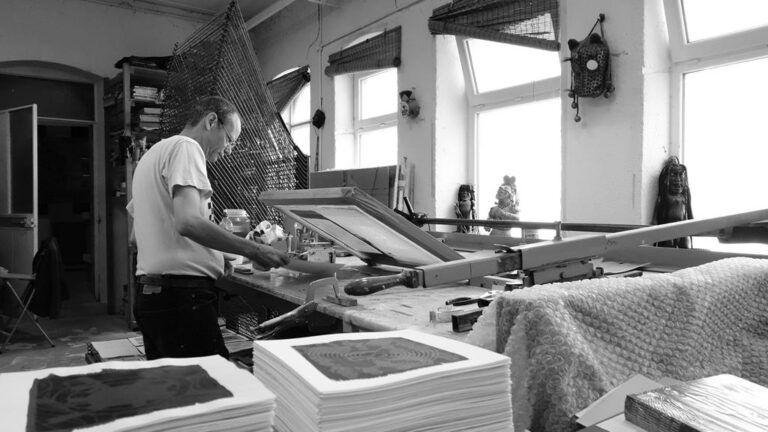
Jean-Pierre Sergent – French artist, born in the small town of Morteau (1958) in the northeast of France. Studied architecture in Strasbourg and painting at l’école des Beaux-Arts in Besançon (1978-1981). Jean-Pierre settled in Montreal (1991-1992) where he developed his repertory of artistic form and had successively three studios in New York in Brooklyn, Chelsea and Queens (1993-2003), then he returned home to his native France again (2004) in the City of Besançon where he is living and working now. He has exhibited in France, Canada, the US, Switzerland, England, Austria and China.
He tells Luxury Splash of Art that ‘Firstly, you need to learn a lot of things, to read a lot of books, to see a lot of movies, to visit a lot of museums, to live a lot of life experiences, to visit a lot of countries, to have a lot of sex, to paint a lot of paintings… before you can even know really what you want and can do. What will be your personal artistic path?’
Luxury Splash of Art: Jean-Pierre it is the greatest pleasure to talk to you, thank you for your time to share your artistic life story with us. Today, I would like to talk to you about your artwork, your projects, inspiration, spirituality and your current exhibition 4 Pillars of the Sky at the Besançon Fine Arts & Archeology Museum but before we get to these questions, can you please tell us more about yourself. When your journey with art started? What is it in art that makes you so passionate about it?
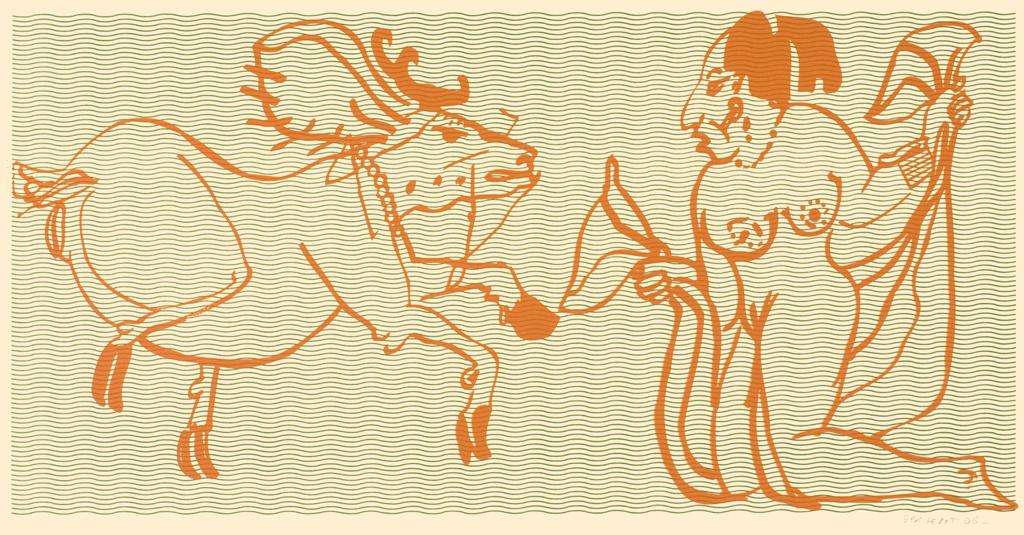
JPS: Hello dear Agnieszka and Luxury Splash of Art readers, thanks for your interest in my art and for your questions. Being a visual artist is to embrace the oldest profession in the world, with all due respect to prostitutes, that we commonly say they have been doing their work since the beginning of time. In any case, when we think about the first traces of humanity, beyond all the skeletons and genetic material found by archaeologists like skeletons and cave settlements, artists have been able to be traced back to the first milestones of human thoughts and beliefs. So, artist, as a profession, a specification, is without a doubt significantly older than priesthood, architects, warriors, farmers, politicians, insurers or even bankers! And it is like belonging to a long lineage, a large family or some kind of “old souls club”. Picasso once said in an interview with the famous French writer and Minister of Culture André Malraux in Le Miroir des limbes: “Do you know what I think sometimes? It amuses me: I’m superstitious. I think it’s always the same Little Man, from the stone ages. He comes back, like the wandering Jew. Painters inevitably reincarnate as painters; it’s a breed, like cats.”
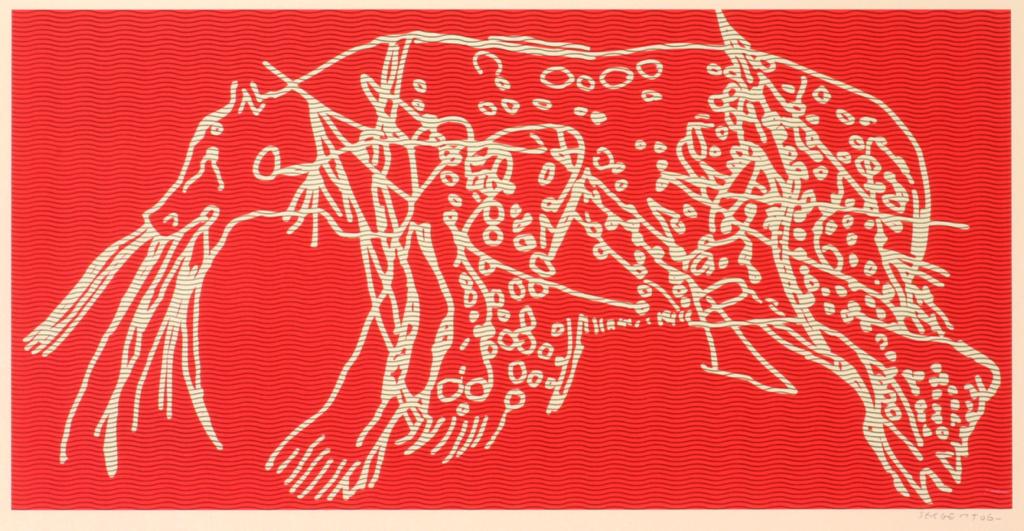
So, being an artist is being part of an everlasting community and at the same time having a need to be outside, on the fringe of main societies in which we are living, in order to better understand the whole picture. There is also a point of being some kind of healer, as well, because Art is always deeply connected to Death, Art is always engraved in its essence, the pilgrim of Death and the remembrance of the dead, truly more deeply than Love, I believe. As Henry Miller said in Remember to Remember: “The human mission on earth is to remember.” Without artwork, we will have no ideas in a manner of speaking about all the existences of all historical Gods and Goddesses, all rituals that the pictures and statues accompanied and depicted and made possible; it would be a disenchanted and memoryless World. Somehow Art is the incarnation of the living into its present, its movement and its realization. Not only has it nourished the personal and collective unconscious, but it is and has been a support for all “spiritual” practices starting a long time ago and continuing in the present.
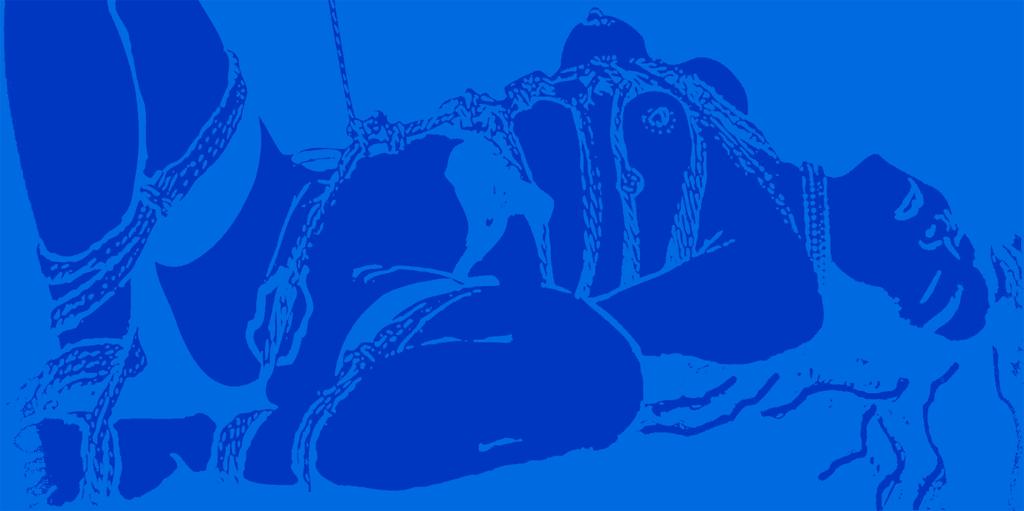
As for what is Art for me: in a few words, I have been making it since I was a child and have continued to make it in an uninterrupted process to the present. As a child, I suffered from a terrible asthma attack, so painting images of animals and landscapes gave me a marvellous way to escape my suffering and the strong anxieties of being afraid of dying by suffocation. It is also this important dimension that I would like to evoke here, which is the strong healing power of Art, for oneself and for others. I believe that art can be experienced as a revelation, that’s what happened to me during various trips to Egypt (into the tomb of Queen Nefertari in Luxor), and in Mexico, while visiting the sacred pyramids like Chichén Itzá or Uxmal. In a certain way, one needs to experience Art with their full-body, not only with their mind, their knowledge or with image reproductions. It’s at the same time a physical (sensual) and spiritual experience. Art helps one to feel the constant flux of life energies, as blood, as rivers, as stars… It’s part of belonging to the Universe and being connected somehow. At some point, it’s also a language that needs to be learned, to be initiated into. Coming back to Picasso saying: “When people want to understand Chinese, they think: I have to learn Chinese, don’t they? Why they never think they have to learn painting?“
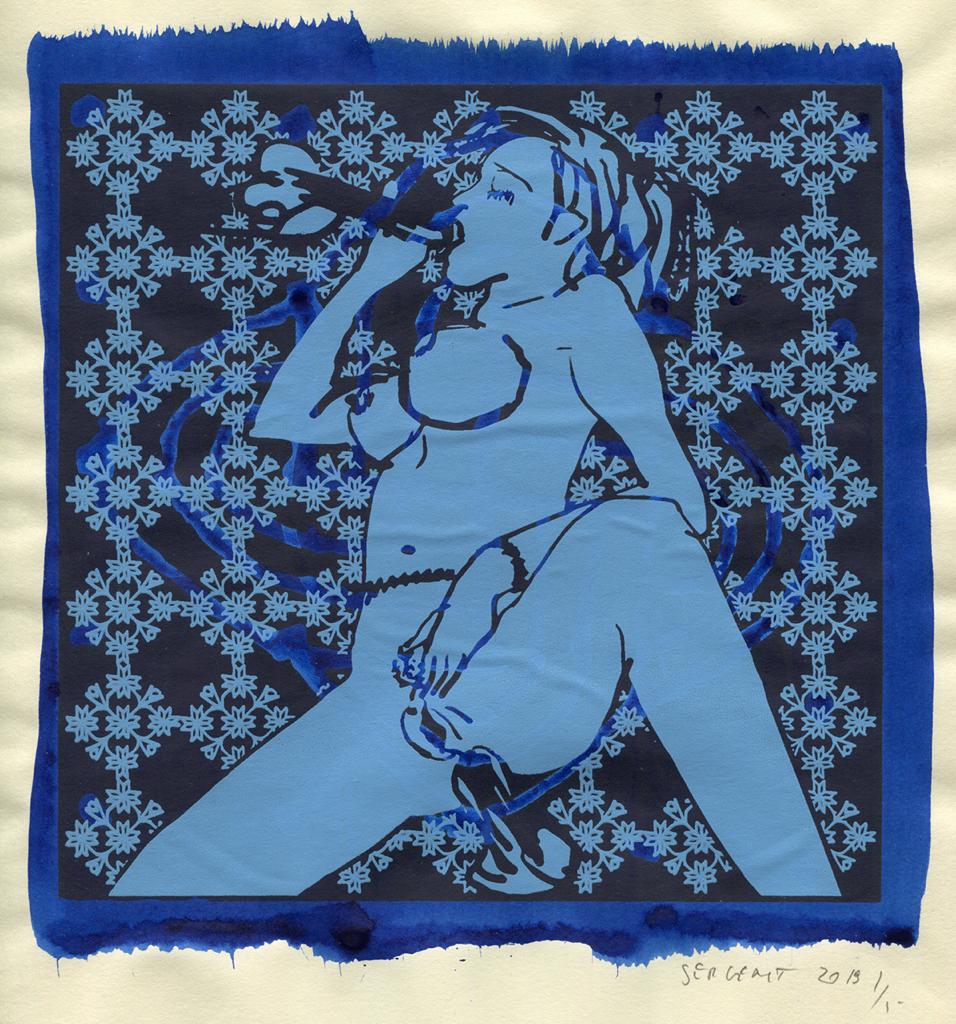
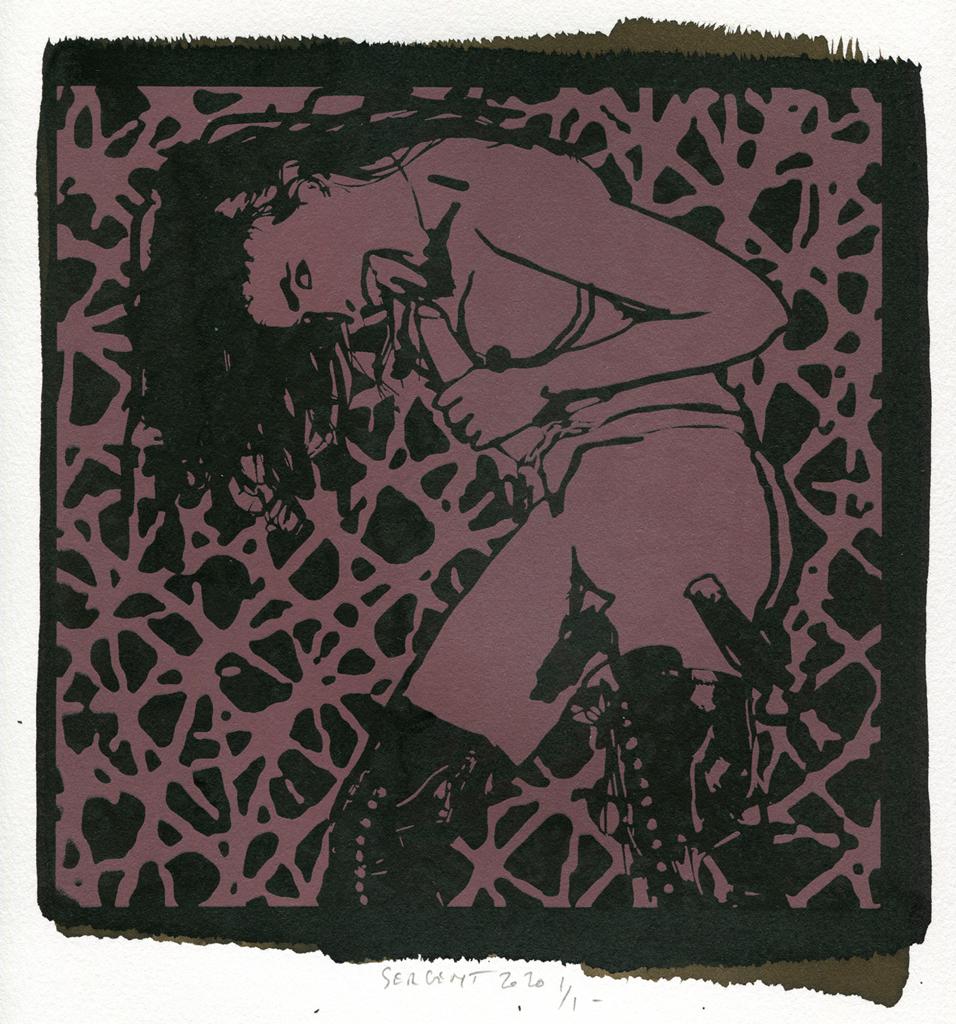
LSA: Once you said that you are ‘Making art alive in a society which is spiritually dead.’ can you please tell me more about this? Should art touch soul, or should it sell? Perhaps both? What is your view?
JPS: Yes, exactly, I always enjoy rereading this sentence, because to tell you the truth, if you profoundly open your eyes and seek reality, we are currently facing a deep, profound and desperate situation, almost an apocalyptic one. I will spare you the list of bad news for your own good. But what strikes me most emotionally is really to have the feeling of the disappearance of spirituality or of spiritualities, leading de facto to the disappearance of the soul. A few months ago, I wrote a small text about that matter: About the disappearance of the soul today
After having read Maurice Maeterlinck’s nice book ‘The Treasure of the Humble’ where he states: “There really are centuries when the soul goes back to sleep and no one cares about it anymore.” and even General De Gaule when interviewed in the same Malraux book, said roughly the same thing: “And if our civilization is certainly not the first one to deny the immortality of the soul, it is the first for which the soul has absolutely no importance.”
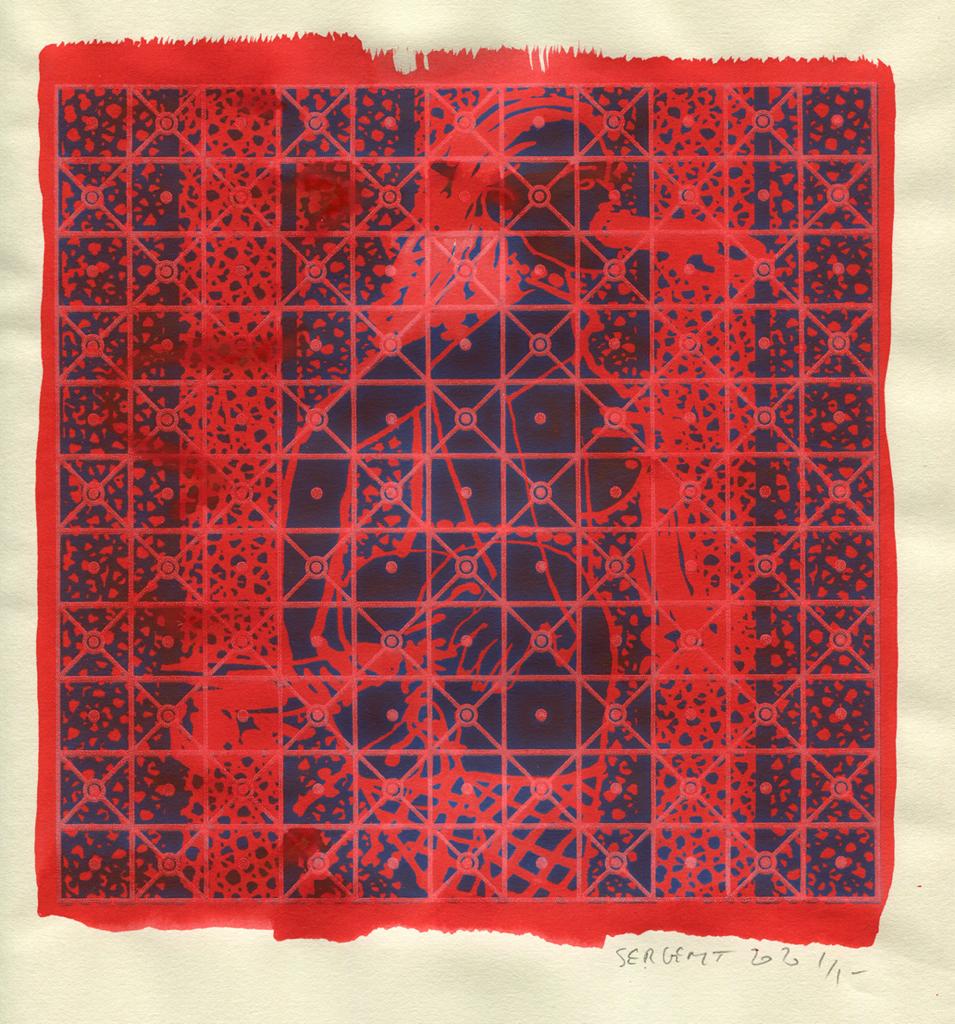
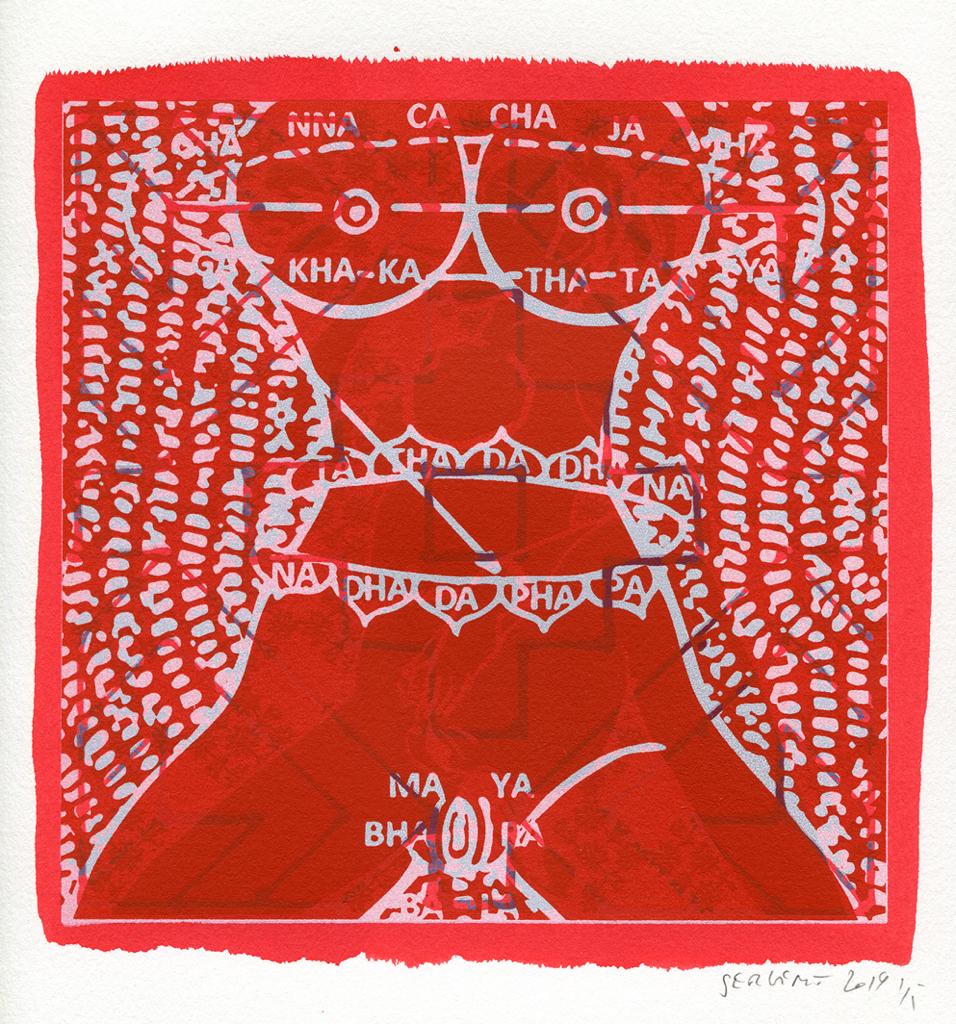
Those sentences are deeply moving for me and as an artist, I can’t imagine living in a world totally secularised and deprived of any spirituality. In a matter of fact, my artistic practice allows me to exhibit my works in galleries, Art Fairs and Museums and I always have the feeling that the audience as a whole or even curators or art critics, in particular, don’t have any clue, any access to the strong and powerful spiritual meaning, presence and statements of my paintings. But again, to quote Malraux’s book: “The time of art does not coincide with that of the living.” So, I have to deal with that. It’s been somewhat of a constant challenge for all important artists throughout time. Especially, even more, today, since Art, by and throughout the Art Market, the Art business, has really become an industrialized and economically luxurious good, that only really highly rich people can afford to buy and exhibit. It is a new situation that somehow nobody had thought of before. Art being stolen by the rich and powerful, somehow, it’s happened before with the religions and the political powers, but at that time Art was supposed to educate the masses or nonbelievers, it could always be seen by everybody in churches, temples or public buildings; which is no longer the case nowadays where most of the art pieces bought in the auctions houses are ending up locked down in private and secure safes. Also, for example, when you are checking the Artprice list, you can see that art is selling for millions of dollars, but the really dark side or downside of that is that nobody is looking at the artwork of artists who don’t sell at that high price range level (under $100,000 US, you are a nobody, a poor John Doe), those kinds of artists can’t exist and survive anymore somehow.
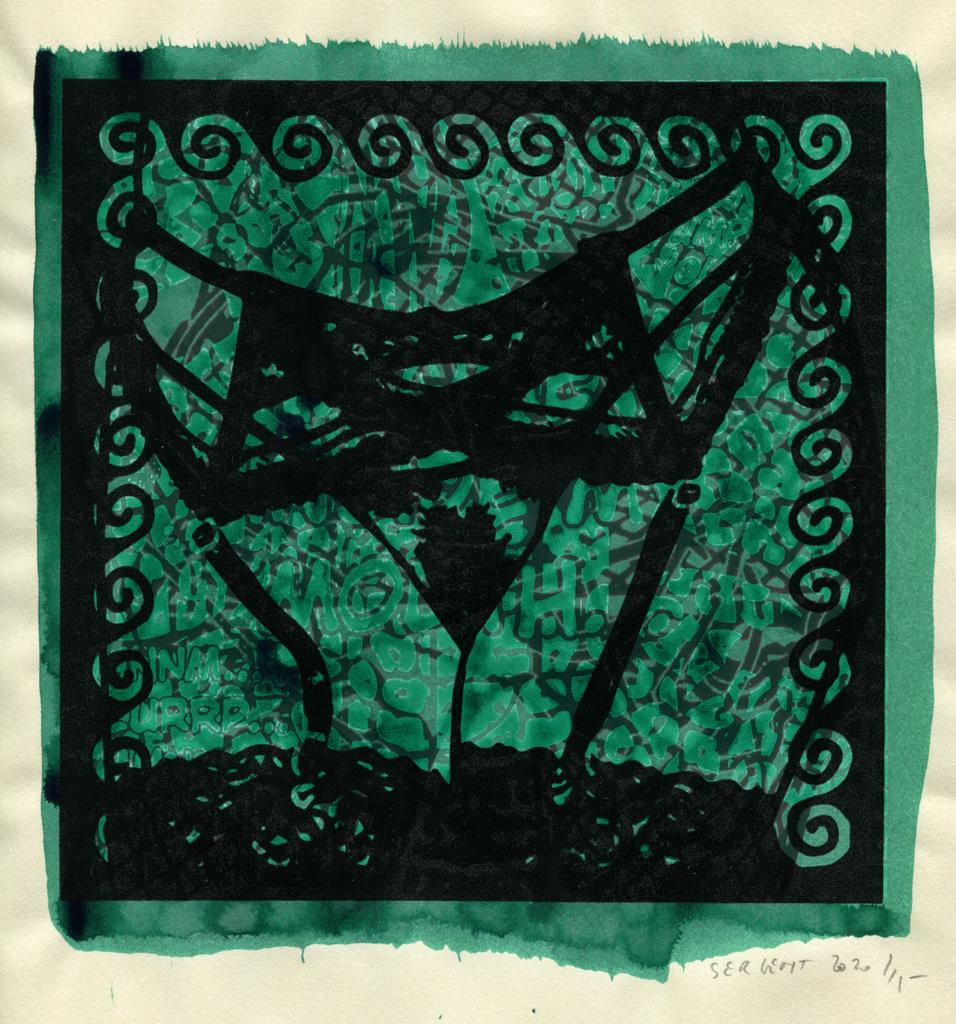
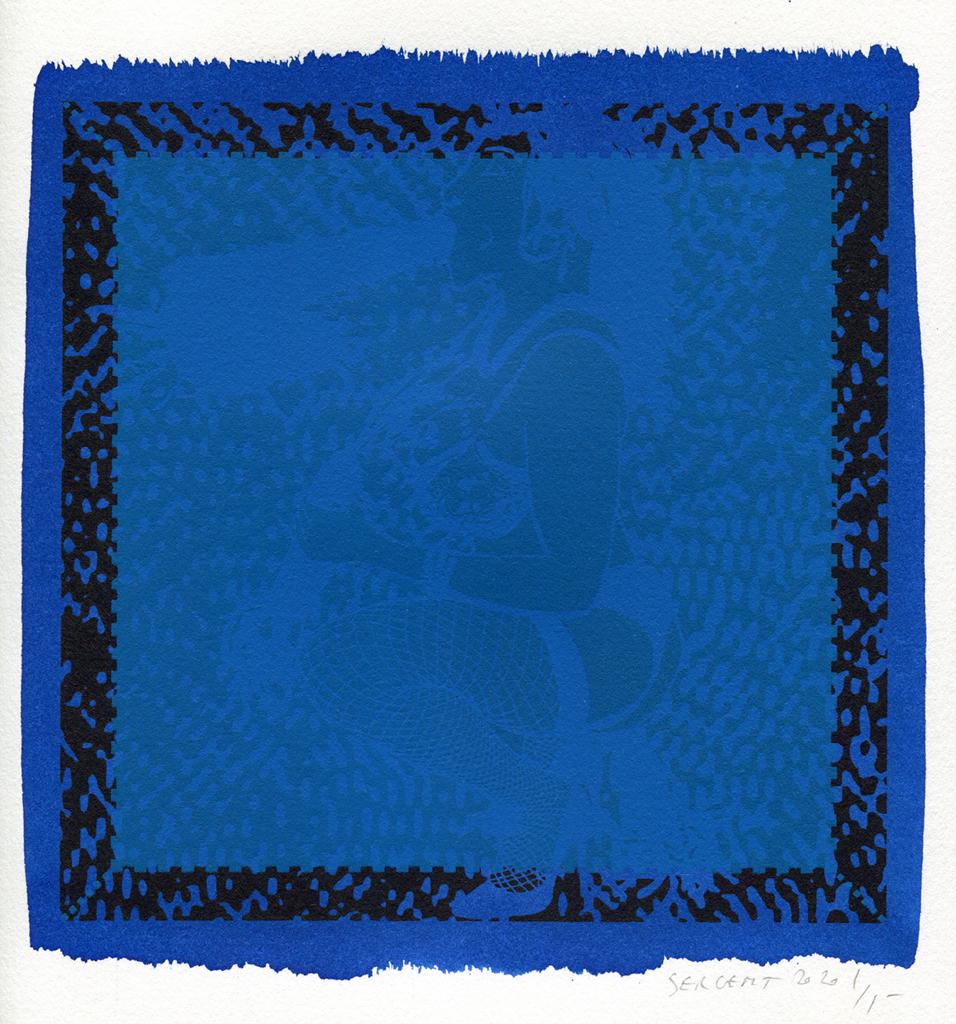
LSA: Thank you so much for sharing your view, it is very interesting what you say. Spirituality is very important to you is that the message you want to deliver through your art? What would you like others to see in your work?
JPS: Well, Art cannot just only be a conveyor of a message, an aesthetic, political, environmental, ideological or even spiritual one, but most precisely and truthfully a conveyor of pure energy. It’s something that should hit you in the gut, genitals, eyes, and emotions. It’s a power, like a nuclear battery, a storm, a vortex, a woman’s pussy, a flux, like a parade, a carnival, a skeletons procession (not like the funny Halloween parade on 6th Avenue in NY) and also, simultaneously a swirling butterfly in a ray of sunshine in the soft light of Spring finally returned!
More seriously, I want my art to testify, to be the witness, the landmark, the emblem of the presence of any disappearing myriad of primitive societies and traditional cultures that at some point in time, some time periods, were alive and flourished all around the world. As stated recently on a radio interview the great street life photographer Sabine Weiss: “Everything changes! But it’s good to have been a photographer to witness many beautiful things that will disappear.”
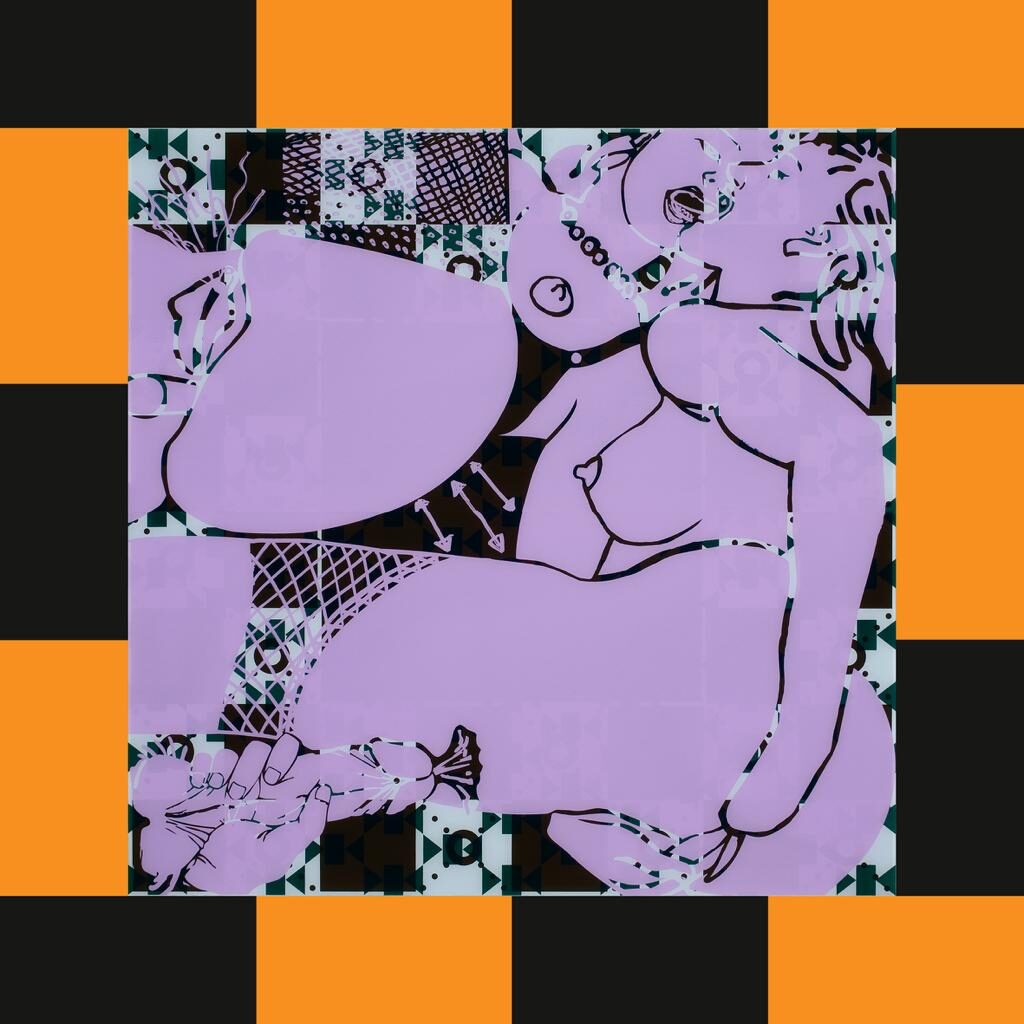
So, I do have a strong and passionate curiosity towards those different cultures, different thinking, different lovemaking, sexual approaches or ritual practices in order to honour the dead, to regenerate and to and revitalize Life, our life, somehow, somewhere, because nothing is granted for free in this world. This could be philosophical, like Buddhism, or Hinduism; or aesthetical, like almost every pre-Colombian artwork like that of Mayan Queen Lady Xoc performing a blood sacrifice passing a rope through a hole in her tongue in order to fall in a trance and be met by the Cosmic Vision Serpent Quetzalcoatl. Sometimes I do also use Japanese bondage images in order to show how an enchained body can access sexual ecstasy by switching anxiety into climax. Art, like sex, has to do with the transcendences of reality, colours, pleasure and death.
LSA: Some artists say that art and creation is like meditation, it allows one to feel connected with inner self and universe. What do you think?
JPS: Yes, that’s absolutely true. It is a long and fastidious working process, all along, an artist needs to be fully focused and present. You need to pay attention to what you are doing at every step, at every moment of this process and if you are not present, you will miss it. Of course, it’s like any mainstream common spiritual teaching from every part of the World: If I am present, God (whoever or whatever it is) should be present too. As said in the Indian Veda:
“I have embraced all beings,
in order to see the taut thread of the sacred,
where the gods, having attained immortality,
have gone to their common abode.” In JPS Notes Besançon – 2005-présent
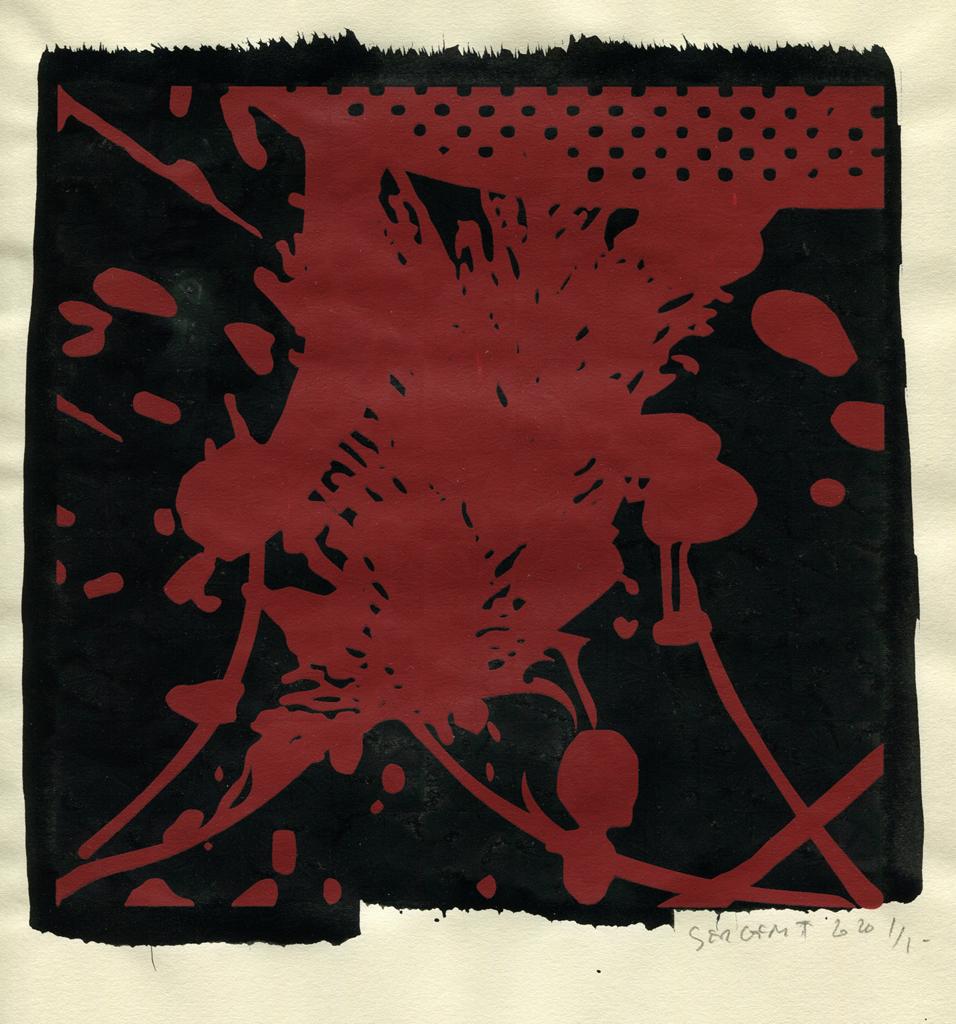
LSA: Where do you take the inspiration from for your projects and how long it takes from the moment the process of creation starts in your head to the moment it is ready. Do you allow yourself to be led by intuition or rather to have every step planned?
JPS: At first, I collect, gather, and glean images. Images depicting ancient rituals from different societies, as I said earlier. While in NY, I used to take many photos in Museums, but now I get them mostly from the web and mainly erotic ones. It is a fact that about 50% of images circulating on the Web are pornographic ones, and it seems to me that some of them, a few rare ones, possess a kind of mystical ecstatic aura. That’s what has caught my interest in every art piece throughout all Art History: its aura, its presence. One can see it in Vermeer’s, Giotto’s, Pollock’s, Rothko’s works, some cave paintings, graffiti pieces or many Mughal Indian paintings, and also of course among the so-named “primitive” artworks etc. So, in choosing a simple popular common image (like the Pop artists in NY in the ’60s have done), not of great importance or meaning; I am transforming it into some kind of an iconic image. It’s of course done throughout the lengthy process of selecting the image, the lengthy process of redesigning it on my computer and selecting it according to the statement I want to make at the time when I finally silkscreen this image on my printing table. Of course, the silkscreening process also requires a lot of preparation, when I am printing out the images and especially when I choose the colour. Throughout this process, I am using my intuition and my spiritual connection with art in general, the sun, the water, my ancestors, the bees, the ground (the soil) or any of my sexual desires…
LSA: In your artwork you use different methods and mediums; you create large installation, paint, sculpt, sketch, you do the scenography… What is your favourite method of expressing yourself and why? Is the process of creating your art challenging, if so – in what way?
JPS: Yes, I like to do a lot of those things passionately and all the ways of expressing myself are important in the present and more a posteriori, as life is always changing and something you were able to do a few years ago, you aren’t able to do now, due to a lack of money or other studio problems etc. That’s why I also like writing texts which don’t cost anything (mostly throughout some years of poverty, as I don’t always have enough money to buy art supplies!) Writing is also important for me, not to justify myself, nor to explain the work, but in order to say a similar thing in a different way. We all know that to access the knowledge and memory centre in our brains, every channel is legitimate. A few years ago, I also started filming video interviews with friends in my studio. I do believe it’s a great change in live today with the new technological possibilities which allow us to use all of those different mediums that can easily be shared on the web. I am not quite sure if it does have the same impact as the physical experience that one can have in front a painting, but at least it could open the doors for new people to get a glance at my art.
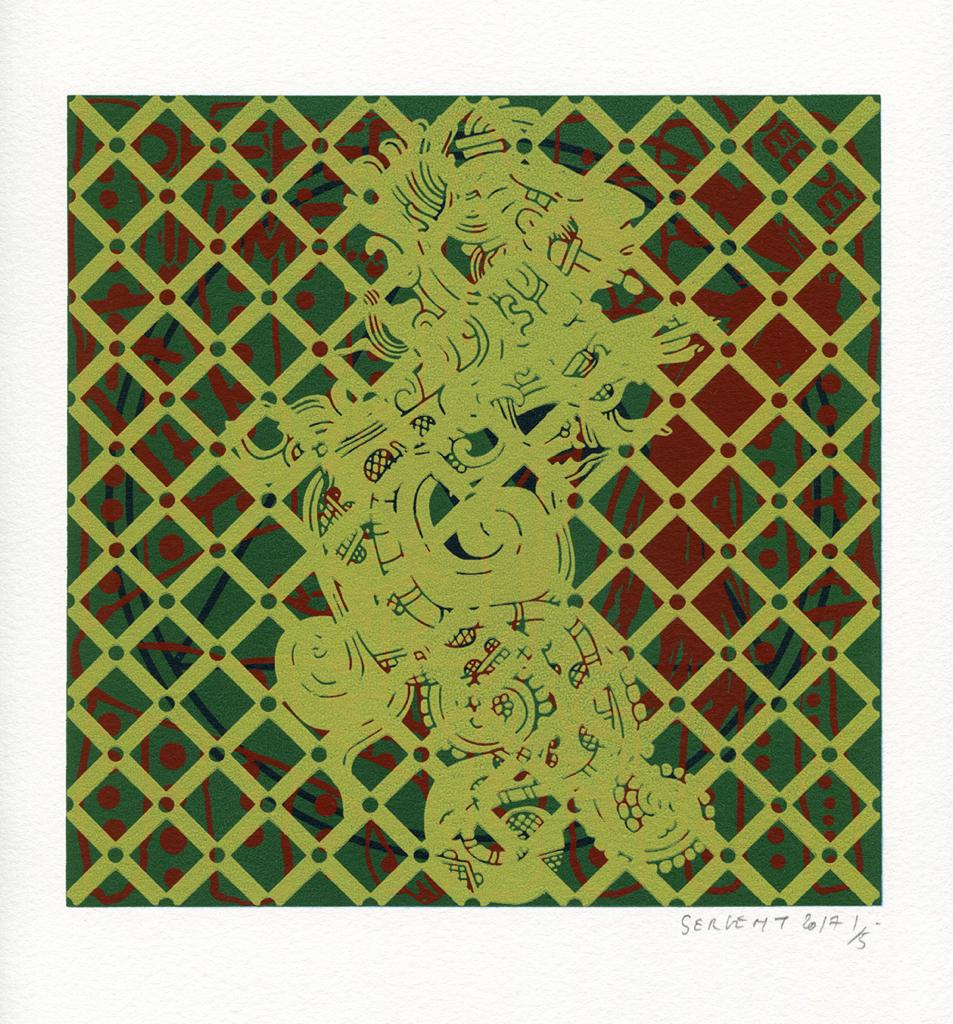
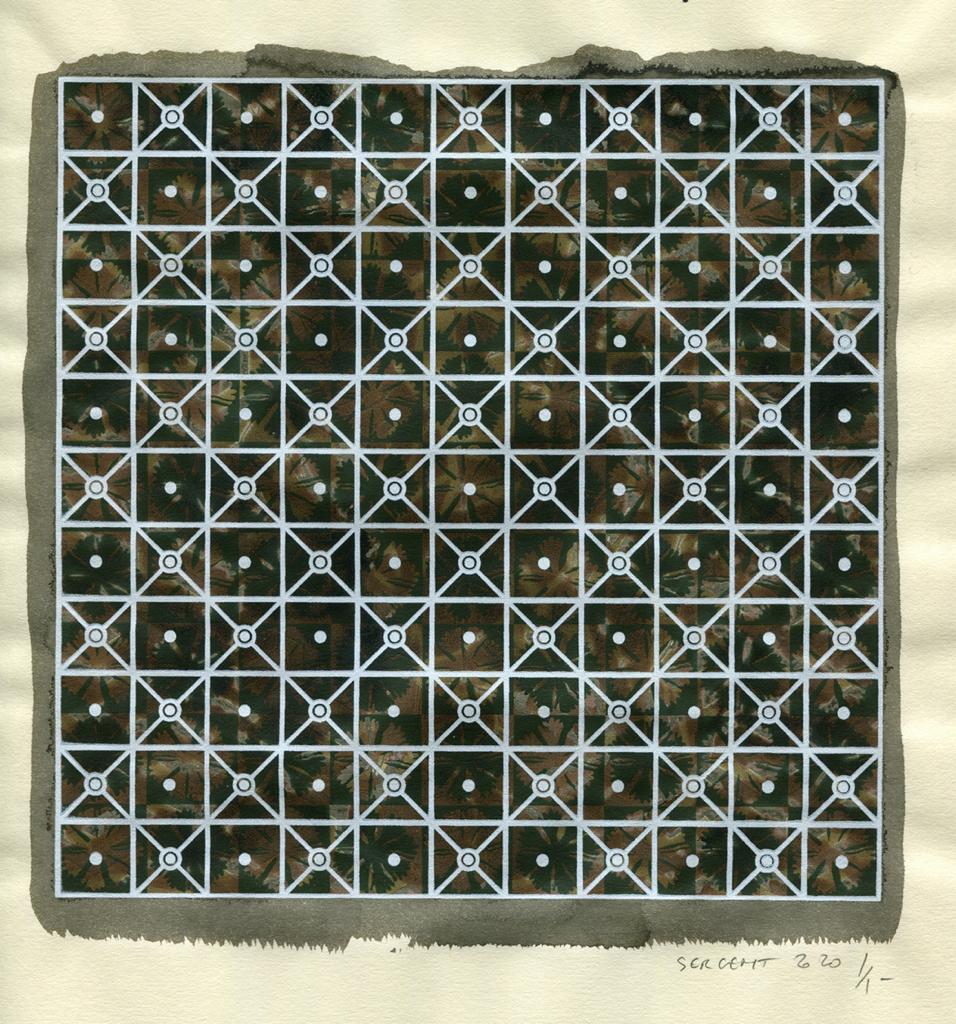
LSA: I would like to ask you about your 4 Pillars of the Sky exhibition in Besancon museum. This exhibition is your latest project bringing eight large installations together. Can you please tell me more about these art pieces? What inspired you to create them, how they were created and is there any message to the world behind your artwork?
JPS: Yes, since September 2019, 72 square Plexiglas paintings, each measuring 1.05 x 1.05 m, have been installed on eight panels surrounding the four corners of the Museum’s two huge main staircases. This monumental installation, 4 Pillars of the Sky measuring eighty square metres in size is to this day the largest I have realised. These exhibitions were proposed by the Museum Director, M. Nicolas Surlapierre, who had this great idea to hang up this huge selection of paintings amongst this beautiful historic architecture, with origins dating back to 1694 and is the oldest French public collection.
It has a been a really challenging project as technicians worked for more than a month in order to affix the wood panels to the old stone walls which are very high. The assistants and I had to work high up on the scaffoldings at a height of more than 5 m. It is a great honour and privilege to have my works shown in this beautiful space where all the paintings assembled and connected together are really amazing and could hopefully bring the viewer into a state, an experience of joy, of elevation aesthetically or even mystically. The show will probably run for a few years and a catalogue has been published. I gave a conference at the Museum and we filmed three interviews with art professionals/friends that you can see on my video webpage. Here is an extract from the press release:
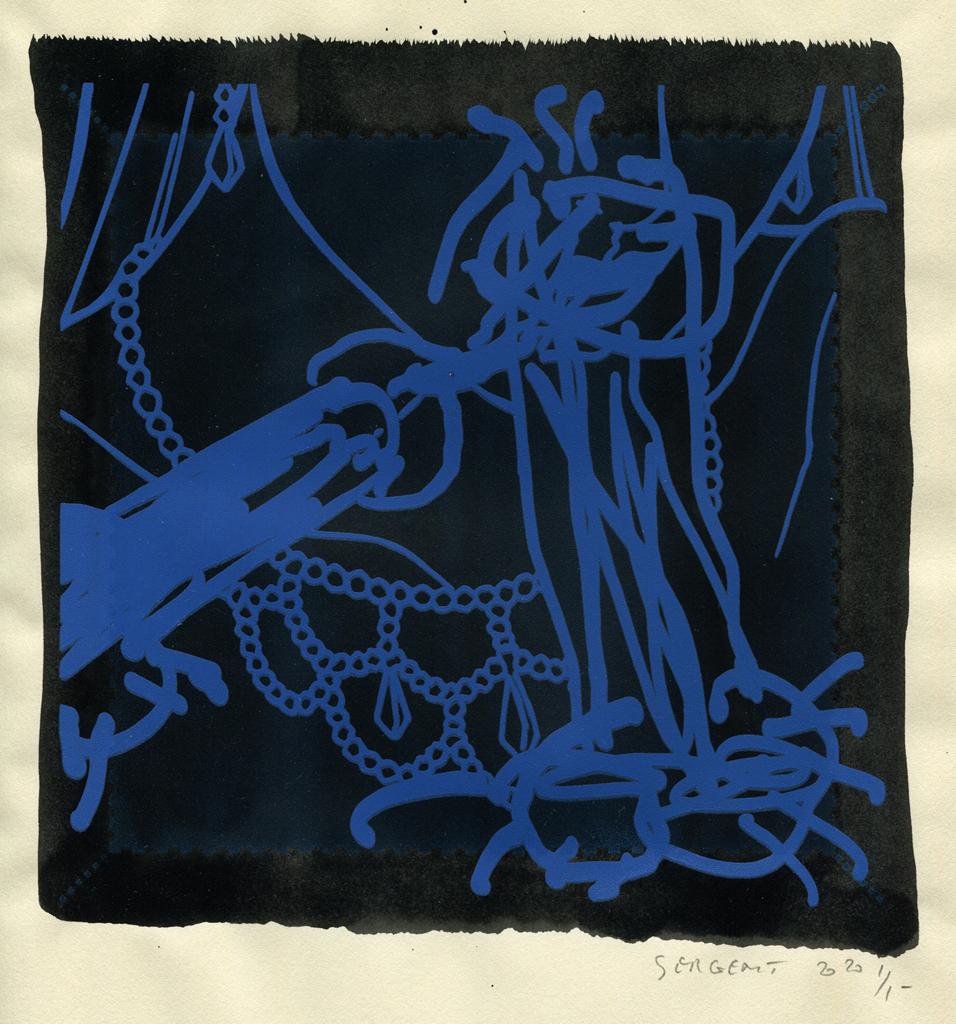
I want my paintings and art to be: a wall-art (even armour if you will! I don’t care!), an art-architecture (like Indian tipis), an animal-art (like Lascaux), an art-tree, a river-art, a void-art (like for Zen Buddhist monks), a nature-art, a sex-art, an art-dead (like Egyptian tombs), an art-pleasure (Dionysian), an art-presence, an art-soul, an art-joy (like in Jean Giono’s books), an art-body (like in sexuality) etc. So, there is not really a singular and simple message there, as my art is highly complex and it’s more a conglomerate, an aggregation of images, a multitude of visual information, of stimulus impulses like the deployment, the blooming, the sprouting out, the ejaculation of an entire life, colourful, multicultural and sexual!
LSA: Is there any message you would like to share with Luxury Splash of Art readers?
JPS: Firstly, thank you very much for having read this article to the end, I hope you found it interesting and enriching. Secondly, I would like to quote the German painter Emil Nolde: “I obeyed an irresistible need to represent a deep spirituality.” Which profoundly shows us how the spiritual meaning, the spiritual seeking and the spiritual quests are important, even essentials for some artists, not for all of them! Paradoxically enough, it is something that seems totally absent from the art scene production nowadays. For we live today in a society mainly and solely based on money, which is the only supreme value worshipped as the biblical golden calf, and this de-spiritualization is, therefore, more than normal, for money, of course, has no intrinsic spiritual value (in and of itself!)
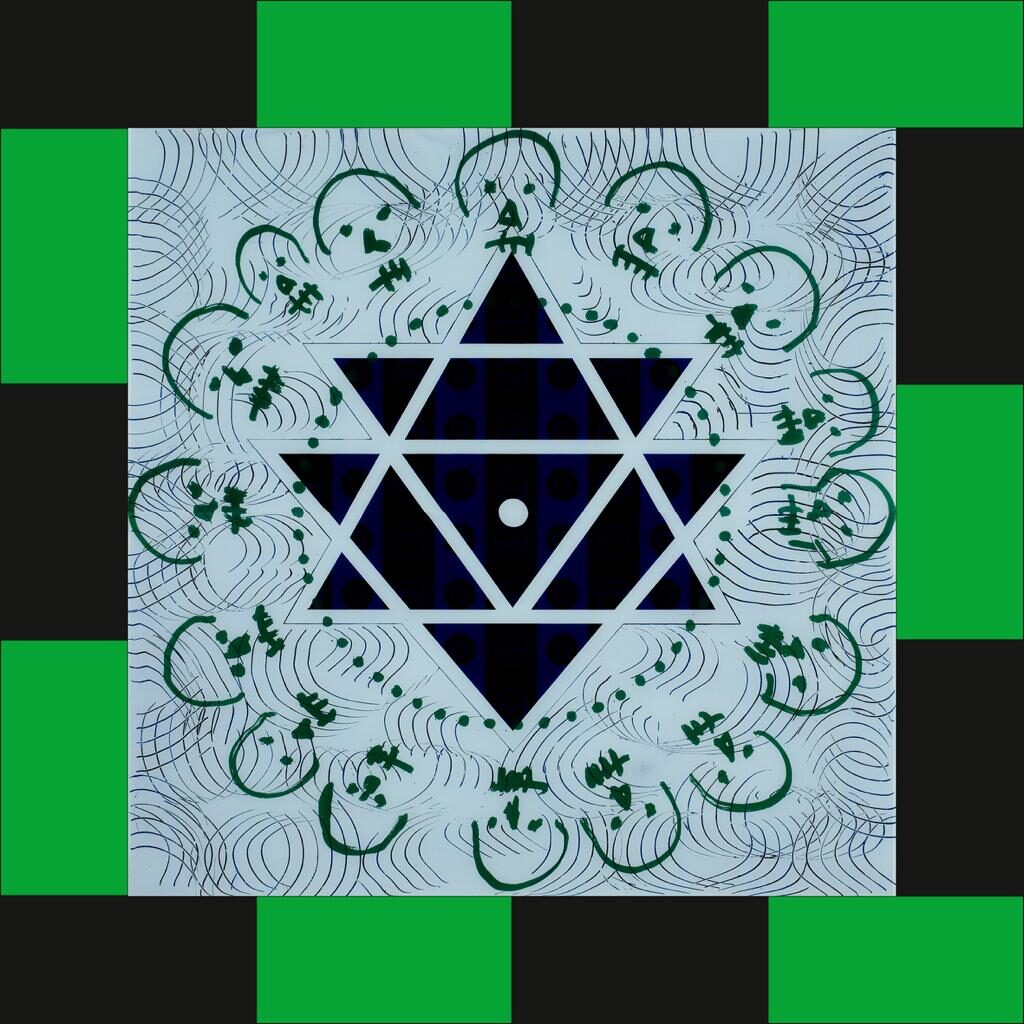
LSA: Do you have any advice for starting artists?
JPS: Yes absolutely, Art is not an easy business, and time, is at the same time our friend and our enemy, as one can’t really be a fully grown artist before the age of maturity, excepted for a few rare exceptions; all artists have done their important works during their years of maturity. So, you need to be enormously curious and profoundly patient. I just read an article on Twitter this morning about the famous Swiss writer-traveller Ella Maillart saying: “I had a sleeping bag, two weeks’ worth of food on my back and I thought, I must go and see the beauty of the world while waiting to find out why I am alive.” It is a fact, a reality: firstly, you need to learn a lot of things, to read a lot of books, to see a lot of movies, to visit a lot of museums, to live a lot of life experiences, to visit a lot of countries, to have a lot of sex, to paint a lot of paintings… before you can even know really what you want and can do. What will be your personal artistic path? Getting back to Picasso, he once said: “You copy, you copy, and then one day you are missing a copy and then, you make an original painting.”
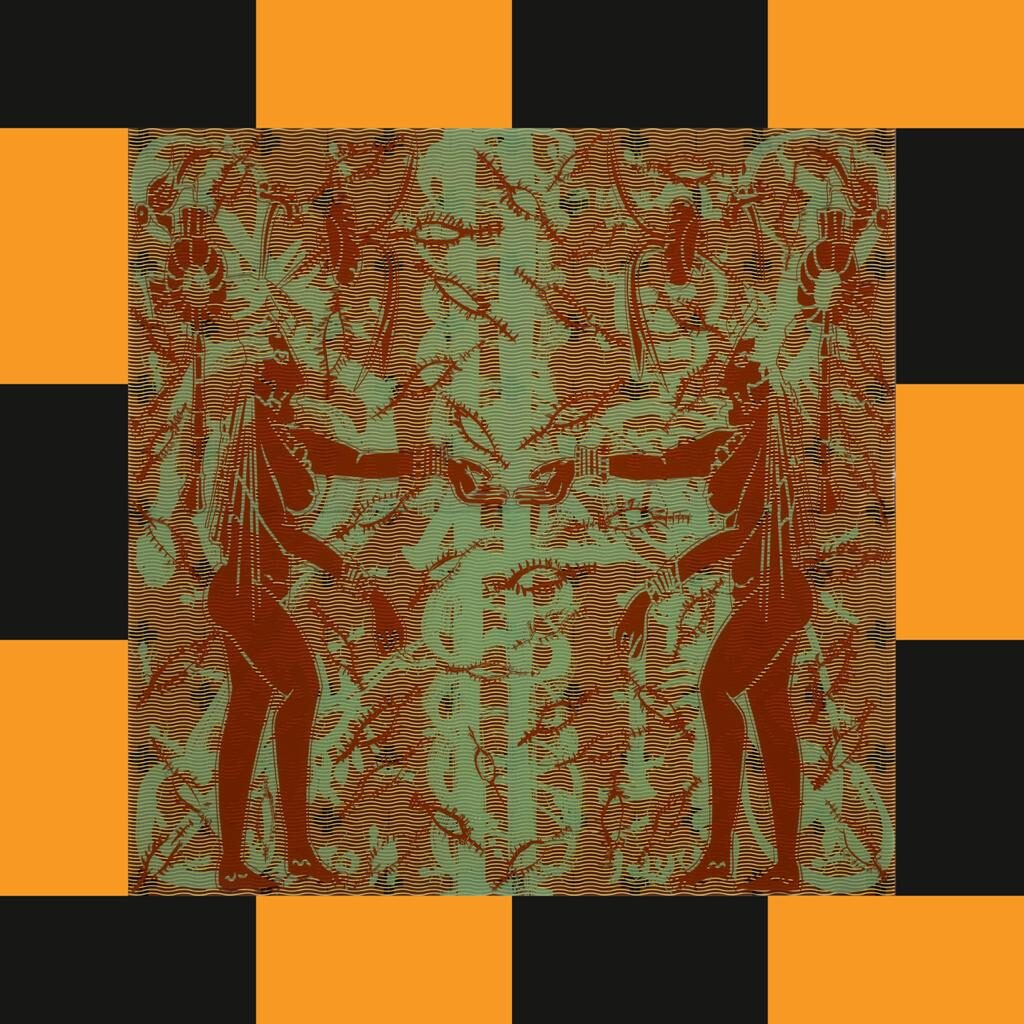
LSA: It was a great pleasure talking to you. Thank you for your time. All the best to you and your future projects. Where can we find you work, please share link to your website and social media.
JPS: Yes, it has been a great pleasure to write this article, thank you so much for your interesting questions, dear Agnieszka. My work can be seen at the Museum in my hometown Besançon (when it reopens), in my Studio and at the Keller Galerie in Zürich, Switzerland. Your readers can also follow me on various social media, and I will be more than happy to follow-up on this discussion with them. I am wishing you all a safe and joyous day and a safe journey during these difficult and challenging times, best regards from France.
Jean-Pierre Sergent, Besançon, Sunday February 7th, 2021