


ON BEAUTY AND SO ON... (2014-2026)


DIGRESSIONS ON HARMONIES AND DISSONANCES, OR A BRIEF REFLECTION ON THE CONCEPT OF BEAUTY THROUGH IMAGES DURING HISTORY
Beauty—what a horror! What a stupid concept! What a utopian, corny stopgap or ersatz! Why not just talk more simply about the violence and ugliness of today’s world, about fun and “Likes”...?
It seems to me, however, that this concept has inhabited the human mind since the first tattoos, the first garments, the first tools, the first magical-cosmic drawings of animals—ever since the wonder-filled human mind opened itself to the world and turned toward the beautiful, the sensual, the universal, the transcendent, and the immanent!
BEAUTY—ALIVE

For certain peoples, such as the Navajo, it seems that the concept of beauty has been important—even essential—just as the desire to live in wealth is for our contemporaries, or the choice to live in poverty is for Buddhist monks! It is, therefore, a collective and intelligent decision that has been made collaboratively and empirically throughout the history of their tribe. The decision to surround themselves with beauty—in their finery, hairstyles, jewelry, dances, gestures of love, adobe homes, and during their ritual ceremonies for births, weddings, and funerals—is a sensible, powerful, and meaningful one! I invite you to discover the Night Navaro song:
ALL DAY LONG MAY I WALK
THROUGH THE RETURNING SEASONS MAY I WALK.
BEAUTIFULLY WILL I POSSESS AGAIN BEAUTIFULLY BIRDS…
BEAUTIFULLY JOYFUL BIRDS…
ON THE TRAIL MARKED WITH POLLEN MAY I WALK.
WITH GRASSHOPPERS ABOUT MY FEET MAY I WALK.
WITH DEW ABOUT MY FEET MAY I WALK.
WITH BEAUTY MAY I WALK.
WITH BEAUTY BEFORE ME MAY I WALK.
WITH BEAUTY BEHIND ME MAY I WALK.
WITH BEAUTY ABOVE ME MAY I WALK.
WITH BEAUTY ALL AROUND ME MAY I WALK.
IN OLD AGE WANDERING ON A TRAIL OF BEAUTY,
LIVELY, MAY I WALK.
IN OLD AGE WANDERING ON THE TRAIL OF BEAUTY,
LIVING AGAIN, MAY I WALK.
IT IS FINISHED IN BEAUTY.
One can truly dream of living in a society that is so intellectually and spiritually advanced (it’s not easy to make a decision as irrevocable as that one), and if we look back a bit through human history, we realize that very often these somewhat paradisiacal periods—with the flourishing of all the arts: music, painting, sculpture, poetry, etc.—were possible when people lived in relatively small communities and there were no particular problems—no wars, no periods of extreme famine, and no overly strong desire for expansion. It’s actually like a kind of paradisical golden age, with cyclical and unchanging times, filled with peace, happiness, and sensuality—could I have invoked Gauguin and Manao Tupapau?

BEAUTY - VARIABLE

We can also see that what is considered beautiful at a certain time and in a certain place will undoubtedly—except to a few open-minded, knowledgeable, and enlightened individuals—be perceived as extremely ugly, and may even provoke revulsion and destructive violence in those who view it. How can we fail to mention here the glaring example of the destruction of all Mexican artifacts during the conquest of Mexico by the infamous conquistadors, who burned virtually all of the Maya and Aztec codices?

On this subject, one should read Diego de Landa, Relación de las Cosas de Yucatán, 1566, who—despite having himself destroyed hundreds and perhaps even thousands of codices and sacred statues in the Yucatán—wrote the only account of the rites and traditions of the Maya. Monotheistic and iconoclastic religious beliefs have always been hostile to the concept of universal and transcendent beauty. Their monolithic thinking, combined with the need for geographical expansion and the systematic plundering of indigenous wealth, is responsible—through pretentious and foolish negative preconceptions—for the destruction and disappearance of nearly all traditional cultures. Yet, for me as an artist, works of primitive art hold paramount aesthetic importance and demonstrate a philosophical coherence sometimes unmatched in the West.
Unfortunately, the thinking of that era did not allow for the recognition of the otherness of our fellow human beings or for respect for others in their human and cultural diversity. In contrast, early animist and polytheistic cultures seem to have always been iconophilic and to have understood that the image preceded the word and also conveyed concepts that were more complex, more powerful, and more subtle than writing and speech could allow.
As an example, consider these few sentences by L. Slain, who analyzes in his book the historical conflicts between image and text and their implications regarding the image in general and that of the female body in particular:
"The sexual orientation of the alphabet can be unmasked by studying the myths of the peoples who used it. Upon learning the alphabet, both women and men turned away from the worship of idols and animal totems that represented images of nature, and began paying homage to the abstract logos. A faceless God replaced the sacred images that had hitherto captivated the faithful. The god of the alphabet-people became indisputably male and became disconnected from the things of the earth. He was abstract, nowhere, and yet everywhere at once.” in The Alphabet versus the Goddess, Leonard Shlain
These prehistoric, pre-biblical, or pre-literate peoples have, for the most part, always shown themselves to be curious and open-minded, and they have been receptive to objects and ideas if these presented any interest to them. It is important to remember that behind every work of art or human creation lies not only the artist with his or her life experiences and culture, but also the artist’s entire family and society, along with the shared cultural history of the group—whether philosophical, technological, religious, or atheistic (though ultimately, atheism seems to be nothing more than a reversed form of monotheism)—within which the artist or group of artists evolves. For example, can one still be moved today by all these scenes of Christ’s crucifixion—displayed like hunting trophies in museums across Europe—while being an atheist, other than by compassionately sharing in the suffering of Christ, a man who was murdered and unjustly cast aside?
One must read carefully Huysmans’ superb description of Matthias Grünewald’s The Crucifixion:
“In the center of the painting, a giant Christ—disproportionate when compared to the stature of the figures surrounding him—is nailed to a roughly hewn tree, revealing in places the fresh blond hue of the wood, and the crossbeam, pulled by his hands, bends and traces, just as in the Crucifixion of Karlsruhe, the taut curve of the arch; the body is similar in both works; it is livid and glossy, dotted with specks of blood, bristling—like a chestnut shell—with splinters from the rods still lodged in the wounds; at the ends of his disproportionately long arms, his hands thrash convulsively and claw at the air; the knuckles of the close-set knees are bent inward, and the feet, riveted together by a nail, are now nothing more than a jumbled mass of muscles upon which the rotting flesh and the nails, now turned blue, decay; as for the head, encircled by a gigantic crown of thorns, it sags onto the chest, which sags and bulges, marked by the grid of the ribs. This Crucified Figure would be a faithful replica of the one in Karlsruhe were it not for the different expression on the face. For here, Jesus no longer has the terrifying, tetanic grimace; his jaw does not twist, but hangs limply, detached, and his lips drool." Three Churches and Three Primitives, J.K. Huysmans

This painting, with its raw, almost obscene realism, transcends its era while expressing the reality of unspeakable suffering in the face of a world torn apart by poverty and religious wars, and by the foolish moral dogmas that suppressed the body’s joy in its most exultant form in order to impose a vision of salvation achieved solely through the imitation of Christ’s pain and death.
For my part, I far prefer—not the paintings or sculptures in museums—but all those objects and images referring to acts of creation, fertilization, and regeneration of the world and all living things during rites of passage in tribal ceremonies, as well as divine incarnations such as the images of the Aztec creator deity couple Huitzilopochtli and Coatlicue, or even Kali, the Indian goddess, the man-eater, mistress of life and death!

"Seated on a white lotus rising from the waters, she fills the Universe with her splendor. In her hands she holds scissors, a sword, a skull, and a blue lotus; her ornaments are snakes, which she wears as a belt, earrings, necklaces, armbands, bracelets, and anklets. She has three red eyes, fearsome tawny braids, a magnificent belt, and terrifying teeth. She wears the skin of a panther around her waist. Her tiara is made of bleached bones. Such is, for our meditation, the form of Târâ*, mother of the three worlds, seated upon the heart of a dead man, her face resplendent with the power of the Incorruptible.” In Myths and Gods of India, Alain Daniélou
* Târâ the Star, the power of hunger and the night of wrath, is another aspect of the goddess Kâlî. She is the power of the golden embryo, the first cosmic locus from which the world develops. She represents the transcendent power of space, a corollary to the transcendent power of time.”
BEAUTY - TRANSGRESSION

In today’s highly complex and “disharmonious” societies, where there are many social tensions caused by the sheer scale of state systems and financial inequalities that forcibly standardize individual thought, beauty and art can serve as a powerful means of escape and transgression against the moral order and aesthetic codes. I’ll cite as examples Picasso’s Les Demoiselles d’Avignon, but also his Guernica, which precisely capture the violence felt by all the people of Europe at that precise moment and which returns like a boomerang to the eyes of the public...! It is the mirror image of war—the greatest and ultimate of human transgressions—turned back toward the viewer, yet sublimated by art and the artist’s genius.

BEAUTY - ULTRA-DESIRE

“BEAUTY WILL BE CONVULSIVE OR IT WILL NOT BE AT ALL.” Nadja, André Breton
Can one be moved by anything other than a brutal, convulsive, sexual, and violent desire when faced with Rubens’ voluptuous figures, as in his provocative Leda and the Swan from 1598? This work truly and literally depicts an unambiguous, orgiastic sexual scene of bestiality. Sometimes Greek mythology serves as a convenient excuse, and even though the divine Ovid is a great poet, this painting is nonetheless a defiance of the bourgeois morality of the time!

From another perspective, we can show Balthus’s painting, The Girl in the White Shirt, which depicts a teenage girl baring her breasts and which, even today, remains a subject of controversy whenever it is exhibited to the public. I am also including here, as a nod to the theme, two images of nude female bodies from contemporary “popular” erotic imagery that correlate with the “elitist” subjects of these “vulgar” paintings.

For, of course, we must also showcase here Gustave Courbet’s masterpiece, The Origin of the World, which depicts in detail a woman’s genitals, abdomen, and breasts. This painting will be on display again this summer of 2014 at the Courbet Museum in Ornans, and we will undoubtedly hear, once again on this occasion, a barrage of indignant cries of outrage at the scandal...!
And I find myself exclaiming, screaming and howling in my nightly nightmares: “You stupid fools, you wretched, uneducated, and malicious beings…! Didn’t you, too, once emerge from your mother’s sex, the vagina dentata? Are you so ashamed of your bodies that they should be amputated…?” Do you think you’re so evolved that the body no longer concerns you...?
And to reiterate this point once again:
"Mortal fools! You believe yourselves to be masters capable of extinguishing the passions that nature has placed within you. They are the work of God. You want to destroy these passions, to restrict them to certain limits. Senseless men! Do you therefore claim to be second creators, more powerful than the first? Will you never see that everything is as it should be, and that all is well; that everything is from God, nothing from you, and that it is as difficult to create a thought as it is to create an arm or an eye?" Boyer d’Argens, Thérèse Philosophe
To temper these remarks somewhat, let us read carefully and calmly this short passage from Alain Daniélou’s book, which I am currently reading with great interest and which perfectly illustrates my ideas:
The Dawn
“In the Rig Veda, the Dawn, Uchas, appears as a maiden who bares her breasts to be admired. Ever young, she drives back the darkness and awakens all living beings. She moves upon a splendid chariot; Sister of the Night, she is the wife or mistress of the Sun, the daughter of the sky.” in Alain Daniélou, op. cit.
Her magnificent breasts, revealed here, also strongly reminded me of Jacques Brel’s beautiful song “Le gaz”:
“You have breasts like suns
Like fruits, like resting places
You have breasts like mirrors
Like fruits, like honey
You cover them, and everything turns black
You uncover them, and I become Pegasus
You have breasts like sidewalks
And me, and me, and me
I come for the gas.”


Let us now recount the beautiful mythological story of the Egyptian goddess Nut. She is the one who, in the evening, swallows the sun or Amun-Re’s phallus (through an act of fellatio), who, at night, copulates with Geb (the god of the Earth) and digests the sun, only to spit it back out in the morning and give birth to it from her womb through her fertile woman’s phallus… . Her bodies—millennia-old lovers in action—and her acts symbolize here the womb-like gates of the World, the cosmic “palingenesis” of the repetitive day and night cycles, and thus the very creation of Time and Eternity... regenerated and sustained daily and constantly by the ceaseless nocturnal copulations of these demiurgic and mischievous Egyptian gods...
Important Questions: Why did all ancient, tribal, archaic, early, or preindustrial cultures manage to preserve a poetry related to the integrity and wholeness of the body: feet, legs, thighs, genitals, anus, belly, intestines, navel, breasts, arms, hands, shoulders, head, mouth, eyes, ears, hair, muscles, bones, skeletons, etc.? and the totality of its functions: eating, dancing, defecating, urinating, speaking, listening, seeing, having sex, giving birth, masturbating, vomiting, playing, dying, etc.?
Yet Western societies—as well as most societies under the influence of monotheistic thought—allow only a select few parts and functions of this body to be shown or discussed? Why do they insist on always depicting him as clothed, hidden, mutilated, castrated, suffering, and asexual? Is it to instill in the people a sense of shame and to teach them how to strip away all the desires and treasures of the body and its functions—which are so normally and naturally offered up to all the sensuality of the world? Where have all the joyful metaphors gone, all the bonds, all the connections that harmoniously united us with the world… with the Earth, the Sea, and the Cosmos?
Why, even today and still, do we treat artists and poets as madmen and the mentally unstable—and why was Artaud institutionalized? Could we not fully and intelligently integrate the concept of beauty and pleasure into our overall way of thinking about Life—and would that be such an unattainable goal? Let us therefore no longer be so estranged from the World and from Beauty, for this notion—this aspiration toward beauty—does not merely imply being beautiful in a social or bourgeois sense, as one might be today, but rather being in harmony, from within the body (the microcosm) all the way to the farthest star in the Universe (the macrocosm)! Perhaps it is simply a matter of wanting it fiercely and hoping for it collectively once again, just as the Navajo Indians and so many other peoples throughout history did in their time!
BEAUTY - WOMEN

One could write entire volumes on feminine beauty and fill library shelves all over the world and across all cultures—which is already largely the case and would therefore be completely unnecessary... From the beauty of the Greek caryatids supporting the roof of the Parthenon in Athens, with their vestal figures virginaly guarding the entrance to the temple-womb that we so long to enter. This Greek feminine beauty has deeply moved the West since the Renaissance, thanks not only to its classical beauty but also to its proud and spiritual sensuality embodied in marble. Feminine beauty is, of course, multifaceted, encompassing every skin tone, every smile in the world, every gesture of love and care—don’t we all long to tenderly embrace that naked, reclining woman painted by Amedeo Modigliani? But this poetry of desire can also turn into violence, into mass destruction, as in the paintings of De Kooning. Or, as in Japan with this woman intoxicated by mad desire, who no longer wants to give life but to commit a crime of passion—to kill her lover by strangling him to bring him to climax, and then castrate him to leave with his penis in her handbag—in the famous and stunning japanese movie The Realm of the Senses by Nagisa Oshima (1976).
For at the very heart of the cycles of desire and life lies, of course, death, and the cycle of life will thus continue eternally, with a new birth in another woman’s body—such is Life...!

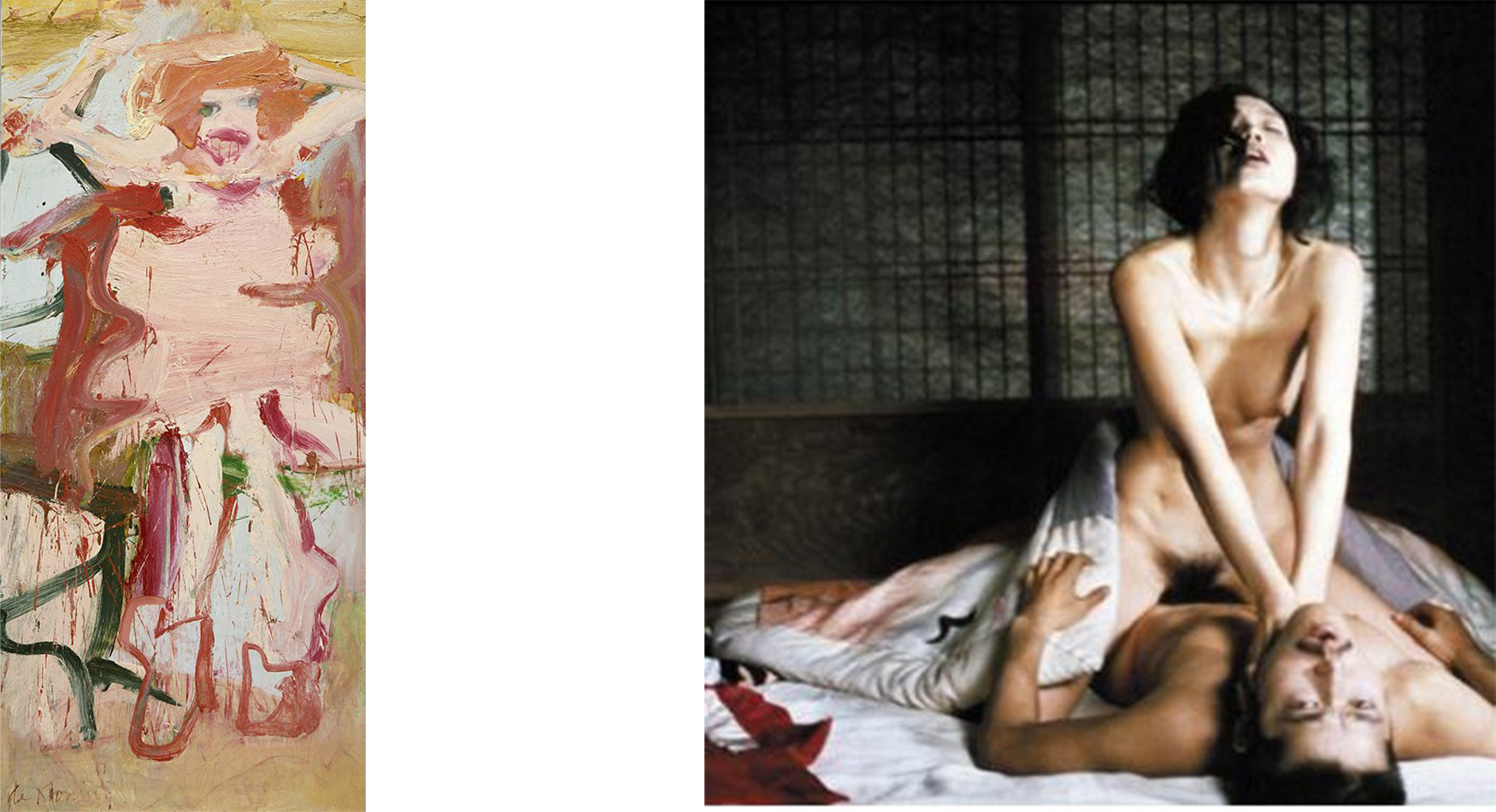
BEAUTY - EROS

"Here the tree appears to him as a living Being, standing upright, upside down, buried in the mane of its roots, raising its legs into the air, spreading them apart, then branching out into new thighs that open up, in turn, becoming smaller and smaller as they move away from the trunk; there, between those legs, another branch is thrust in, in a motionless act of fornication that repeats and diminishes, from twig to twig, all the way to the treetop; there again, the trunk seems to him to be a phallus that rises and disappears beneath a skirt of leaves or, on the contrary, emerges from a green fleece and plunges into the velvety womb of the earth.” Là Bas, J.K. Huysmans
As Huysmans illustrates so well here, Eros is always that which overflows, that which has no limits, no boundaries, no banners, no morality, no justification, no religion: it is simply the impulse of the libido to the power of X! The life force in its raw, violent, rebellious entirety, leaving no room for feelings, love, or reason. It is like a ship that carries us across the ocean of desires, and on which we are absolutely neither captain nor even co-pilot! Chained to desire like Odysseus, listening to the song of those haunting, sensual sirens—dancing like Kali, erotically subversive and lascivious—as we await insatiable sexual pleasure... Throughout history, men have borne witness, through all their iconography, to the pleasure they took in satisfying these sexual impulses, with infinite and joyful imaginative diversity. One must look at these images from the famous Turin Manuscript; the first time I saw a reproduction of one at the Vienna Museum, I was dazzled by the eroticism and the freedom of execution in its content. The sculptures on the exterior of the Khajuraho temple complex in India are also so sensual and evocative of love that it’s hard to remain unmoved by these masterpieces of erotic art! The same goes for the forces—both positive and negative—emanating from Kali: life and death, creation and destruction! And the Greek woman who thrusts large, long phalluses into her vagina and her Bacchante-like anus, seeking orgasm on this vase painted by Epiktetos more than twenty-five centuries ago... Desire is like death; it never ceases its course, and what defines us as humans is our ability to have tamed this revelatory force through Art.


BEAUTY - ECSTASY

— “Ecstasy is cooperating in the divine creation of the world.” The Turbulent Infinite, Henry Michaux
—“For the Takuno Indian, the hallucinatory experience is essentially a sexual one. To make it sublime—to move from the erotic and the sensual to a mystical union with the mythical era, the intrauterine state—is the ultimate goal, attained by only a handful but coveted by all." The Strong Eye of Shamanism, Robert E. Ryan
Depicting, through a work of art, a body in ecstasy—whether spiritual or sexual, or both at once—can have a powerful, transcendent educational value. Who isn’t fascinated by the shamanic scene of the ithyphallic bird-man at the Lascaux well? Who, too, is not impressed by the body and face of Saint Teresa of Ávila, distorted by what she calls the revelation or penetration of divine love? Who is not equally fascinated by the violence and also the raw, vital, and essential truth of the scenes of Mexican human sacrifice—and yet, despite oneself? These priests, lost in a mystical-cosmic ecstasy—embodiments of the gods, regenerators of the world—after ripping out their victim’s heart, drinking its blood, and donning its skin! And who today isn’t fascinated by all these pornographic images of women captured in the heat of the moment in a state of orgasmic sexual climax, receiving on their faces, breasts, genitals—a continuous stream of viscous, oceanic spurts of semen, all while ejaculating in turn from their genitals, gaping like caves, torrents of piss spasmodically expelled by the muscular rhythms of their unbridled orifices...?


BEAUTY - DREAMS

— “Why painting things when they appear so much more beautifully in dreams?”
A medieval monk-painter—mediocre, powerless, and despairing at his own dismal artistic output—experienced in a dream the very next night the scene he had been desperately trying to paint. It was so much more vivid, luminous, harmonious, and sublime that he uttered this beautiful line in Pasolini’s magnificent film adaptation of The Decameron. It is true that the dreamlike power of dreams sometimes creates a surreal beauty, where everything blends, merges, intertwines, and interpenetrates in a kind of lyrical, vibrating song—an ode to life, love, and joy... These dreams, linking the individual and collective unconscious, are portals to other imaginary worlds, within that Hindu Mâyâ where all realities merge and everything is possible:
"The man who dreams is, in reality, recreating the world. [...] When a person falls asleep, they take with them the substance of this world that contains everything. They dismantle it and rebuild it in their dream, illuminating this inner world with their own light. There are no chariots, no yokes, no paths there, yet they bring forth chariots, yokes, and paths from within themselves. There is no joy, happiness, or pleasure there, yet it spontaneously brings forth joy, happiness, and pleasure. There are no lakes, ponds, lotuses, or rivers there, yet it brings forth lakes, ponds, lotuses, and rivers from within itself, for it is their creator." In Upanishad, Daniélou, op. cit.

BEAUTY - GEOMETRY

In all cultures, throughout history, and everywhere, geometry has been one of the primary foundations of architecture and visual art—and thus of beauty. Examples include the canons used to create preparatory drawings for murals and sculptures in ancient Greece and Egypt—and even in India and Mesoamerica—as well as the golden ratio, which seems to be the secret behind the development of all organic forms of life! Geometry can also exist on its own, for and by itself, for even in prehistoric caves we can see the emergence of certain geometric designs consisting of grids, lines, and systems of points arranged in harmony. Personally, I am fascinated by and greatly enjoy working with patterns—which are, in fact, motifs repeated infinitely and can be found on numerous pottery pieces, garments, and tattoos across all eras and cultures.
Contrary to what one might think, these motifs are not merely decorative; for the most part, they represent concepts, symbols, and ideas—in fact, a coherent syncretic system that allows humans to situate themselves socially among their peers, but also within the greater universe. I particularly appreciate all the geometric Hindu yantras, which are complex symbolic systems—at once infinitely beautiful and simple—yet from which also emanate a sensuality, a purity, and a transcendental cosmic eroticism. For example, they depict ten triangles embodying the destructive-creative power of the goddess Kali; they always represent the union of feminine symbols (downward-pointing triangles) with masculine symbols (a point, or upward-pointing triangles). They are thus the very embodiment of the interpenetration of life, of the moment of the creation of life, the world, and every living entity… the origin of the Big Bang or the Bindu point.


BEAUTY - ANIMA
Ultimately, the only universal beauty recognized by humankind—or rather, by men in particular—seems to be that of the female body and the eternal feminine, the anima, the quintessential feminine archetype representing at once: the mother, the lover, the guide, and the ferryman of souls!
Didn’t Cortez take Malintzin—La Malinche—as his lover and translator, the woman who introduced him to Mexican cultures and followed him throughout his conquest? Today, she is regarded as both a symbol of betrayal, a willing victim, and simply the symbolic mother of the modern Mexican mestizo people...
Weren’t Generals Levis and Clark guided—and their expedition saved twice—by the intelligence, kindness, and courage of Sacagawea, a Native American woman from the Shoshone tribe, during their perilous journey across the Western plains and the Rocky Mountains to discover the route to the shores of the Pacific Ocean?
"But most of all the lone Sacajawea is an object of interest. Her figure in the story of Lewis and Clark is very pathetic and engaging. It is doubtful if the expedition could have pushed its way through without her." James Hosmer, in Sacajawea, Grace Raymond Hebard
"No man, even the most polished and civilized, who has once savored the sweet liberty of the plains and mountains, ever went back to the monotony of the settlements without regrets and everlasting determination to return." Stanley Vestal, in Sacajawea, Grace Raymond Hebard
The Native American Pocahontas, a member of the Powhatan tribe renowned for her legendary beauty, saved the life of John Smith, who—after being captured by a group of Native Americans and taken to a village in the Powhatan Empire—was about to be executed when she threw herself in front of him, pleading with the warriors of her tribe to spare his life and keep him as a prisoner. This beautiful love story is superbly told (perhaps a bit romanticized, but the film is a work of fiction!) by Terrence Malick in his excellent film: The New World, in which he recounts the adventures and trials of Pocahontas, the beautiful “wild” Native American woman, and John Smith, the humanist and enlightened English navigator, who struggled to navigate the two worlds: old Europe and the New World!

Also, did not the sublime Queen of Sheba—Balqis—save the great architect Adoniram from death in this magnificent legend described by Gérard de Nerval, an orientalist who was neither sentimental nor insincere but genuinely mystical, in his fabulous Voyage en Orient:
— "Balqis, spirit of light, my sister, my wife—at last, I have found you."
Let’s take a look, then, at this magnificent Salome by Gustave Moreau, dancing naked before the old King Herod—it’s enough to make one lose one’s mind and rouse an old man who, incidentally, is the perfect metaphor for old Europe! For today, if Salome were to return, she would have to dance before a dying man! This feminine sensuality from the East brought the West, through art, a breath of fresh air and a new vitality during the era of rapid industrialization in the nineteenth century. I find myself reading once again passages from À rebours by Huysmans, who, by chance and coincidence, decided to follow me and accompany me with his great lucidity and insight as I wrote this text on beauty:
— “Indeed, when the era in which a man of talent is forced to live is dull and trivial, the artist is, without even realizing it, haunted by nostalgia for another century.”
But he also wrote some observations about the bourgeoisie that are so true—perhaps even more so today:
— "Now it was an established fact. Once its work was done, the common people had been, as a matter of hygiene, bled dry; the bourgeois, reassured, sat enthroned, jovial, by virtue of the power of his money and the contagion of his folly." — “Indeed, when the era in which a man of talent is forced to live is dull and trivial, the artist is, without even realizing it, haunted by nostalgia for another century.”
"Now it was an established fact. Once its work was done, the common people had been, as a matter of hygiene, bled dry; the bourgeois, reassured, sat enthroned, jovial, by virtue of the power of his money and the contagion of his folly. The result of his rise to power had been the crushing of all intelligence, the negation of all integrity, the death of all Art; and, indeed, the debased artists had knelt down and were eagerly kissing the foul feet of the high-ranking horse dealers and lowly satraps whose alms kept them alive!”
Finally, let us return to the subject of Salome dancing:
— "In Gustave Moreau’s work, conceived entirely outside the framework of the Testament, Des Esseintes finally saw realized that superhuman and strange Salome he had dreamed of. She was no longer merely the street dancer who, with a depraved twist of her hips, wrings from an old man a cry of desire and lust; who shatters a king’s energy and melts his will with the swaying of her breasts, the quivering of her belly, and the shuddering of her thighs; she was becoming, in a sense, the symbolic deity of indestructible Lust, the goddess of immortal Hysteria, the Cursed Beauty, chosen above all others by the catalepsy that stiffens her flesh and hardens her muscles; the monstrous Beast—indifferent, irresponsible, insensitive, poisonous—just like the Helen of antiquity, poisoning everything that approaches her, everything that sees her, everything she touches.” À rebours, J.K. Huysmans

BEAUTY - PERVERSION
— The 120 Days of Sodom, Marquis de Sade
"Sept. 30. He fucks a turkey whose head is wedged between the thighs of a girl lying on her stomach, so that it looks as if he’s fucking the girl in the ass. Meanwhile, he’s being fucked in the ass, and just as he cums, the girl snaps the turkey’s neck.31. He fucks a goat from behind while being whipped. He impregnates this goat, which he then fucks in the ass in turn, even though it’s a monster.
32. He fucks goats in the ass.
33. He wants to see a woman climax while being jerked off by a dog; and he kills the dog with a pistol shot to the woman’s stomach without injuring her.
34. He sodomizes a swan, shoving a communion wafer up its ass, and he strangles the animal himself as he ejaculates. That same evening, the bishop sodomizes Cupid for the first time."

Beauty in all its forms and in all places has subverted the social order through the desire it instills in those who discover it. For example, wasn’t Gustave Courbet’s painting The Origin of the World hidden from the public for over a century? This work was completely at odds with the mindset of its time. Meanwhile, throughout India’s history, in all temples and sacred sites, Lingas (the erect male sex organ) and Yonis (the female sex organ, kept perpetually moist) were revered and honored in an almost humble, joyful, and innocent manner—conceptual images that fertilize the world and regenerate the cosmos! These transcendent symbols are perfectly and harmoniously embedded in Hindu thought. I believe that the violence of our time—and, of course, that of the Marquis de Sade—stems (without invoking Freud and his very interesting book Civilization and Its Discontents once again) from the frustration and alienation of the body and bodies. Whether this body is the body of each and every one of us, but also—and above all—the social body of all Western societies and, unfortunately, now of the entire world. For the objectification and commodification of the individual no longer stem solely from the moral codes imposed by monotheistic religions, but also from monstrous economic systems that would almost take us back to a Middle Ages of obscurantist and slave-owning thought.

BEAUTY - LEVITATION

Experiencing the beauty emanating from a painting, a landscape, or a human or animal body can transport us to a state of spiritual levitation, lifting us out of Earth’s gravity. A pictorial example here is Botticelli’s Venus, but also—and above all—the American painter Mark Rothko, with his colorful “clouds” floating in space. Beauty thus serves as a vehicle for the soul, a tool for disembodiment, like a can opener freeing us from gravity to usher us into the cosmic void, the sublime, and absolute fulfillment.

Mark Rothko said once of his paintings:
- “For us, art is an adventure that takes us into an unknown world. Only those who freely embrace this boldness can explore that world.
- This world of the imagination belongs to the realm of the imagination and stands in stark contrast to common human thought. Our task as artists is to lead people to see the world as we see it, and not as they see it.
- A widely held belief among painters is that what one paints does not matter as long as it is well painted. This is pure academicism. There is no such thing as a good painting of nothing. We assert that the subject is paramount and are thinking here solely of the tragic and timeless thematic realm. On this point, we feel close to primitive and archaic art.”
BEAUTY - ETERNITY

There are two ways to enter eternity: either by living forever—which is physically impossible—or by halting the flow of historical time and entering another temporal dimension: the infinite present or the present-infinite. One can imagine that a powerful emotion, an aesthetic awe in the presence of a work of art, a piece of architecture, or a landscape of dazzling beauty, might grant us access to this transcendent universe. It is somewhat like entering a deep mystical trance where, in this state of grace, everything fades away so that only the joy of being in the world remains:
— Infinity and joy: - “That which is infinite—that is joy. There is no joy in the finite. Only the infinite is joy. It is therefore undeniably the infinite that one must seek. - O Venerable One, I set out in search of the infinite.” The Annapurna, in 108 Upanishads

To name a few works that have moved me so deeply, I would mention the paintings in Nefertari’s tomb in Egypt, the Mayan pyramid at Uxmal in Mexico, the Tibetan thangkas depicting the Buddha in the state of nirvana (extinction in ecstasy), a few paintings by Vermeer, numerous geometric designs such as Hindu yantras and mandalas, etc. I would also humbly like to add this blue painting, part of the 2011 Entropic Suites series, which likewise aims to induce a transcendental meditative state in the viewer.


Here are a few verses from the Canticle of Brother Sun by Saint Francis of Assisi, which can also help us immerse ourselves in this infinite, unifying, and eternal reality:
"Praised be You, my Lord, with all Your creatures:
especially Lord Brother Sun,
who brings the day, and through whom You enlighten us;
he is beautiful and radiant with great splendor:
he is a symbol of you, Most High.
Praised be you, my Lord,
for Sister Moon and for the stars:
in the heavens you have created them, bright, precious, and beautiful...”
BEAUTY - ORIGINAL

— “Life doesn’t give you never any gifts!” As Jacques Brel so aptly sang in his song Orly le dimanche.
Moreover, the frequent portrayal of a few Fragonard's or or Boucher's paintings, a few works from the 'Pompier' school, or even Impressionist works... that evokes the fading light and bourgeois taste of a summer evening or cheap Orientalism as the pinnacle of French Beauty! as well as, for that matter, the works of certain contemporary French artists fixated on objects and materials—seems to me to be a kind of intellectual fraud, almost immoral and outdated in relation to Life in its fullness, diversity and complexity and with all its unstoppable, undeniable, unstoppable, and unbreakable energies!

For life, with all its energies and in all its creative forms, is a force, a violence, a higher consciousness—and not a vulgar floral arrangement of bourgeois figurative good taste! I have a subjective yet certain intuition that beauty springs from the source—originally and directly from woman’s sexuality and body—and it is as self-evident as birth itself: beauty is an awakening to the World and to Love!

"La nymphe à la source", Cranach, MBA Besancon
BEAUTY - NATURE

ONE GOD: ONE LIFE: “The Brihad-âranyaka Upanishad speaks of the life-breath (prâna), the principle of life, as the soul of the gods. Without life, there could be no individual perception, no witness, and consequently nothing to give reality to the appearance of cosmic manifestation. Life is the manifestation of “Existence” conceived as the very form of infinite reality and knowledge. It is therefore the sole Supreme Being.” Daniélou, op. cit.
Defining Life and its energy or energies seems to me to be a comprehensive reflection on Nature in general and on everything that surrounds us: from the microcosm to the macrocosm, from the infinite to the finite, and from the material to the transcendental.
To be immersed in a “state of being” is to be curious about the world, about all of nature’s manifestations—from ants to whales, including tree leaves and rivers, and so on. Everything is part of life, and its manifestations are consistently marked by infinite beauty and grace.
I will quote here a text written for an exhibition in New York, describing this sense of belonging to the world and the universe, whose ultimate, effervescent beauty can be fully experienced during shamanic trances:
— The energy and the power of a shamanic trance is an experience beyond the power of common dreams. I personally experienced such a shamanic metamorphosis, and some of the paintings I will show are a memory of such out of body trances. I strongly believe that contemporary spirituality should strive towards more of those shamanistic practices. Primarily because those trances teach us that every thing is connected, every being requires respect, every thing has a meaning and a purpose including our true selves as we all are dependent upon the so called "great spirit", the "anima mundi" or the "red womb of the earth". We can not dissociate one flower from the sun or from butterflies, dolphins, mountains, jaguars, hawks and the human body. Every spirit merges with another. It is pure experience of fusion and love. This strong and humble connection is in total conflict with the pretentious attitude of contemporary man who dissociates and separates all that surrounds him with the help of science, economics, politics and religion. JPS, New York, 2000
BEAUTY - PRESENT

Can the concept of beauty still survive today? Does it serve any purpose beyond insipid fashion shows, luxury goods, and designer items? Can beauty retain its unifying, spiritual, and pacifying power and remain that bath of fusional energies that resonate with our innermost being, our Self? The role of artists is, without a doubt, to try to continue passing on this tiny flame, this subversive spark, this hymn to joy and elation that has illuminated—and will always illuminate, through art—all of humanity, from the dawn of time to the end of time, and as long as humanity remains human...!
